Global Distributors Wanted
1.Free Cloud Service Deployment
2.Free Technical Training
3.Exclusive Territory Protection

1.Free Cloud Service Deployment
2.Free Technical Training
3.Exclusive Territory Protection


Content Menu
● Why Drone Delivery Failed Expectations
>> Flight Success Was Not Delivery Success
>> Drone Delivery Costs Were Underestimated
>> Regulatory Approval Did Not Guarantee Scale
>> Customer Handoffs Became Bottlenecks
>> Reliability Required Ground Alternatives
● Drone Delivery Versus Ground Delivery
>> Comparing the Operating Models
>> Amazon: A Location Closure Is Not Industry Failure
>> Rwanda: A Better Match Between Mission and Method
>> Environmental Benefits Were Conditional
● Building a More Reliable Delivery Network
>> Connect the Entire Workflow
>> Five Steps Before Commercial Deployment
>> Metrics That Reveal Hidden Weaknesses
>> 1. Did drone delivery fail completely?
>> 2. Why is drone delivery expensive?
>> 3. Can drones replace delivery trucks?
>> 5. Are delivery drones always greener?
>> 6. What should businesses ask SIDT?
Drone delivery failed to meet many early expectations because flying a package is not the same as operating a reliable delivery network. Aircraft performance attracted attention, but regulations, operating costs, customer handoffs, and fragmented logistics determined whether projects could become sustainable services.
However, failure does not describe the entire industry. Some operations closed individual locations, while medical delivery programs demonstrated measurable benefits. The important distinction is between a drone that completes a flight and a delivery system that consistently solves a customer's problem.
From a logistics-planning perspective, the most useful comparison is not simply drones versus trucks. It is an isolated aerial service versus a coordinated network that connects aircraft, ground transport, receiving points, and operational oversight.
Understanding that distinction explains why some drone delivery projects struggled—and how businesses can build more practical alternatives.
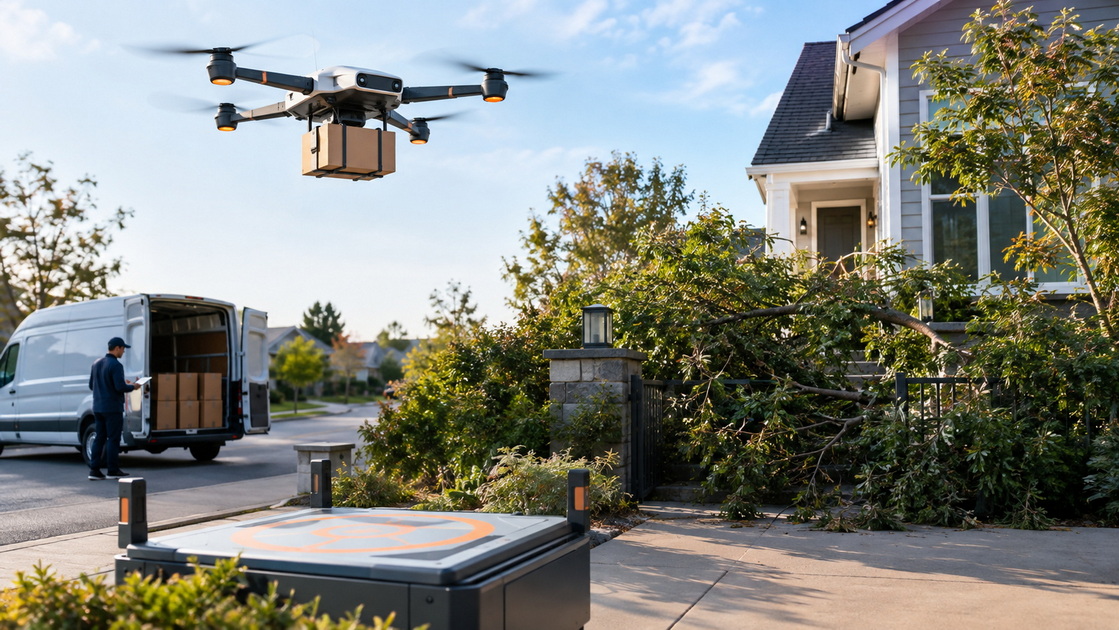
Early demonstrations often showed a lightweight parcel traveling directly to an unobstructed destination. Commercial delivery involves less predictable conditions.
Orders need preparation. Packages must fit the aircraft. Receiving areas must be suitable. Customers need delivery confirmation. Failed attempts require recovery or an alternative transport method.
A completed flight therefore does not automatically represent a completed order.
The essential measure is completion: whether the correct package reaches the intended recipient within the promised service window.
Businesses evaluating drone delivery should distinguish between aircraft reliability and service reliability. A system can perform well in the air while struggling with loading delays, unsuitable destinations, or customer access.
Electric propulsion can make an individual flight appear inexpensive. Yet energy is only one component of the operating budget.
A realistic drone delivery cost assessment should include:
- Aircraft acquisition, maintenance, and replacement.
- Batteries, charging equipment, and energy.
- Packaging, loading, and order preparation.
- Remote supervision and operational oversight.
- Insurance, compliance, and supporting infrastructure.
- Customer support, recovery, and ground alternatives.
Utilization connects these expenses to commercial performance.
Consider an illustrative operation that spends $600 per day and completes 120 customer orders. Its average cost is $5 per completed order. If the same expenditure produces only 60 completed orders, the cost becomes $10.
These figures are hypothetical, not reported industry benchmarks. They demonstrate why low demand or frequent interruptions can undermine apparently attractive flight economics.
The right question is not, "How cheaply can this drone fly?" It is, "How much does the complete system spend to fulfill an order?"
Commercial drone delivery requires more than an aircraft and a mapped route.
In the United States, the Federal Aviation Administration identifies Part 135 certification and the relevant exemption or waiver process as the pathway for small-package delivery beyond visual line of sight.
BVLOS, or beyond visual line of sight, describes operations outside the pilot's direct view. It matters because useful delivery networks often extend beyond what a pilot can observe directly.
However, certification should not be interpreted as unrestricted permission to operate everywhere.
Businesses must align their proposed service with applicable aircraft approvals, operating conditions, airspace requirements, and location-specific restrictions.
Requirements also vary between countries. A successful overseas deployment does not establish that the same operating model can immediately enter another market.
The last few meters can be more complicated than the flight itself.
An apartment entrance, enclosed courtyard, obstructed yard, or busy public area may make package transfer difficult. A destination that looks accessible on a map may not provide a suitable receiving point.
Before launch, operators should answer several questions:
- Where will the package be deposited?
- Is the receiving location accessible and authorized?
- What happens if the area becomes obstructed?
- How will the recipient receive confirmation?
- Who handles an unsuccessful or disputed delivery?
A controlled receiving station deserves comparison with unrestricted doorstep delivery. It may simplify the handoff, although it can also require customers or staff to complete another step.
The best arrangement depends on the application. Handoffs must be designed as part of the service, not treated as occasional exceptions.
Weather, equipment faults, communications problems, and receiving-site restrictions can interrupt a delivery chain.
The operational challenge is not merely preventing interruptions. It is deciding what happens when they occur.
A dependable service needs clear procedures for delaying, rerouting, transferring, recovering, or canceling an order.
Three measures help reveal the difference between successful flights and dependable service:
1. The proportion of orders eligible for drone delivery.
2. The proportion of eligible orders completed by drone.
3. The proportion of all orders completed within the promised window.
This prevents a high flight-success rate from concealing limited customer coverage.
Drone delivery and ground delivery are not universal substitutes. Their value depends on cargo, routes, infrastructure, receiving arrangements, and service expectations.

| Evaluation factor | Drone delivery | Ground delivery |
|---|---|---|
| Route design | Can bypass road detours where flight is authorized | Follows available roads and access routes |
| Cargo suitability | Requires aircraft-compatible payloads and packaging | Offers broader options across vehicle types |
| Customer handoff | Benefits from planned receiving arrangements | Can use established doorstep and building workflows |
| Order consolidation | Depends on aircraft capacity and mission design | Can combine multiple deliveries along a route |
| Supporting infrastructure | Requires launch, recovery, charging, and oversight | Requires vehicles, loading areas, depots, and parking |
| Operational exceptions | Needs aviation-specific recovery procedures | Needs road, traffic, and vehicle contingencies |
| Performance assessment | Completed orders and end-to-end service cost | Completed orders and end-to-end service cost |
The table is a planning framework, not a claim that every aircraft or ground fleet performs identically.
A hybrid model assigns each transport method to the segment where it offers measurable value.
For example, a drone might connect a distribution hub with a controlled receiving station. Ground transport or authorized personnel could then handle local distribution.
That transfer adds handling and coordination. The arrangement only makes sense when its benefits exceed those additional costs.
Amazon's College Station experience illustrates the importance of interpreting headlines carefully.
In August 2025, KBTX reported that Amazon's final Prime Air deliveries in College Station were scheduled for August 31. The report also described expansion into other markets, including Waco.
The documented outcome was closure of one location—not proof that every drone delivery model had failed.
For buyers, the lesson is to examine site-level operating conditions rather than relying on a provider's brand or launch publicity.
Useful questions include whether the proposed service requires dedicated infrastructure, connects to existing fulfillment facilities, or has enough eligible local demand.
These questions do not establish why Amazon closed that location. They identify the diligence businesses should perform before committing to a comparable deployment.

Medical delivery provides an important counterexample.
A 2022 study in The Lancet Global Health examined drone blood delivery in Rwanda. Researchers analyzed 12,733 blood-product orders delivered between March 2017 and December 2019.
Mean drone delivery time was 49.6 minutes. The study also reported an estimated 67% reduction in blood-product expirations at 12 months.
Drone delivery was faster than the estimated road alternatives. Those comparisons used estimated road journey times rather than simultaneous matched vehicle trips.
The central lesson is fit.
Blood products combine urgency, limited shelf life, and unpredictable demand. A routine retail parcel may have a different value proposition.
These findings do not prove that every medical drone project will succeed. They demonstrate that a clearly defined logistics problem can produce measurable benefits when the delivery method matches the task.
Electric flight does not automatically produce the lowest overall environmental impact.
A 2018 study in Nature Communications found that aircraft size, electricity sources, and additional warehousing influenced delivery emissions.
Small-drone delivery could outperform ground alternatives in the modeled scenarios, but supporting infrastructure could reduce those advantages.
Because the research is an older modeling study, its aircraft assumptions should not be presented as current equipment specifications.
For a new deployment, assess lifecycle impacts across energy, infrastructure, handling, and fallback transport—not just the airborne portion.
A common planning mistake is optimizing the aircraft while leaving the surrounding delivery process disconnected.
A stronger operating design connects order intake, inventory availability, transport selection, dispatch, monitoring, receiving, and exception handling.
Shenzhen Intelligent Drone Technology Co. Ltd. focuses on integrating intelligent flight platforms, dynamic perception, precise data collection, and intelligent analysis across low-altitude, ground, and underground environments.
SIDT describes its approach as "one-network coverage," supported by a unified intelligent cloud control platform for command, dispatch, and equipment management across spaces and multiple nodes.
This positioning addresses an important principle: coordination can matter as much as aircraft performance.
However, platform descriptions should not substitute for project-level evidence. Buyers should request defined operating capabilities, integration requirements, approval responsibilities, and measurable acceptance criteria.
SIDT's "urban airspace 3+1 delivery" concept should likewise be explained through the proposed project architecture, with each component clearly defined.
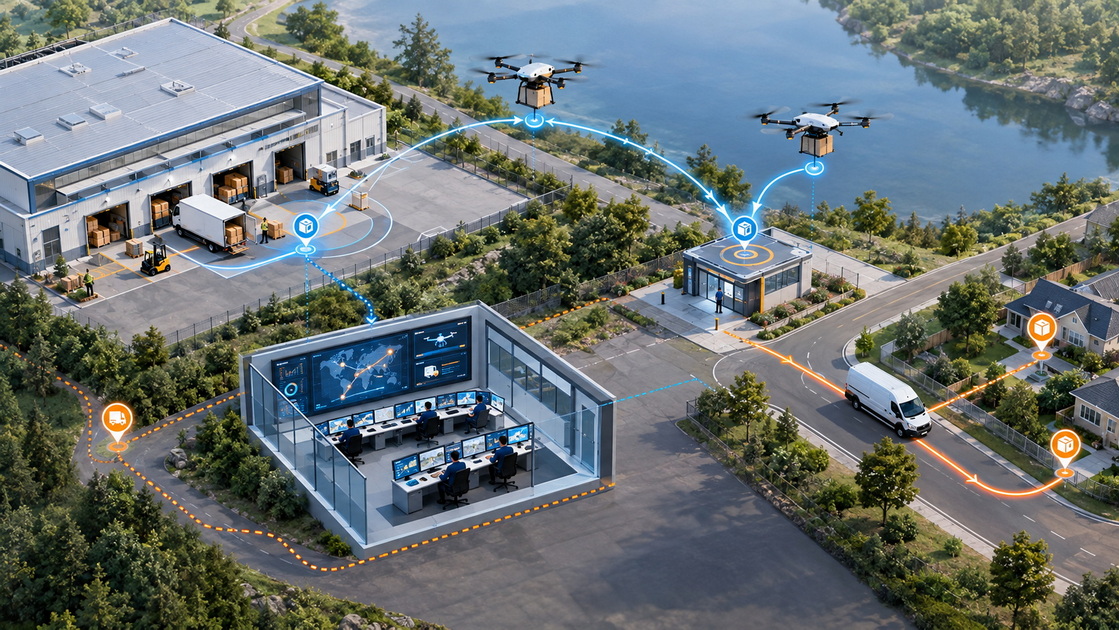
1. Define one delivery problem. Specify the cargo, origin, destination, urgency, receiving method, and existing service limitation.
2. Establish a ground baseline. Measure current delivery time, labor, cost, failed attempts, and availability.
3. Map the complete workflow. Include preparation, loading, authorization checks, flight, receipt, confirmation, and recovery.
4. Test representative conditions. Cover different operating periods, receiving-site constraints, and planned exception scenarios.
5. Set expansion gates. Scale only when reliability, economics, compliance, and customer acceptance meet agreed requirements.
Avoid applying one universal performance target to every application.
A hospital resupply route and a convenience-retail service may require different thresholds. Both need targets established before the pilot begins.
A disciplined pilot should reveal when redesign is necessary—not simply generate successful demonstration flights.
| Metric | What it reveals |
|---|---|
| Cost per completed order | Whether spending produces usable service |
| End-to-end delivery time | Whether flight speed improves the full process |
| Eligible-order share | How much customer demand the system can serve |
| On-time completion rate | Whether the service keeps its promise |
| Ground fallback share | How frequently another transport mode is needed |
| Intervention frequency | Whether routine operations remain labor-intensive |
| Handoff failure rate | Whether receiving arrangements work |
| Complaint frequency | Whether customer or community friction is increasing |
Review these measures together.
Lower flight costs offer limited value if ground fallback increases, customer coverage shrinks, or receiving failures remain unresolved.
The objective is dependable service, not simply more airborne activity.
No. Individual closures and pauses do not establish industry-wide failure. Rwanda's blood-delivery research demonstrated faster delivery and reduced product expirations in a specific application.
Costs extend beyond electricity. Aircraft, maintenance, supervision, infrastructure, compliance, and unsuccessful missions all influence the cost per completed customer order.
Not universally. Compare payload suitability, route consolidation, receiving arrangements, and service availability. A coordinated aerial-and-ground model may be more appropriate for some applications.
BVLOS means beyond visual line of sight. The aircraft operates outside the pilot's direct view, making the applicable certification and operating authorization requirements important.
No. Environmental performance depends on aircraft size, electricity generation, infrastructure, handling, and alternative transport. Each deployment requires a complete system assessment.
Request a defined architecture, operating scope, receiving workflow, integration requirements, exception procedures, and acceptance criteria. Distinguish existing capabilities from proposed project-specific development.
1. Federal Aviation Administration.. Official guidance on U.S. drone package delivery, certification, and beyond-visual-line-of-sight operations. Supports the regulatory discussion.
2. KBTX, August 24, 2025.. Supports the reported August 31, 2025 closure date and expansion into other markets. It does not establish a definitive economic cause for the closure.
3. Nisingizwe, M. P., et al., 2022.. *The Lancet Global Health*, 10, e564–e569. Supports the delivery-time findings, estimated road comparisons, and reduction in blood-product expirations.
4. Rwanda National Health Research Database.. Provides the Rwanda study period, 12,733 blood-product orders, and principal research findings.
5. Stolaroff, J. K., et al., February 13, 2018.. *Nature Communications*, 9, 409. Supports the discussion of electricity sources, aircraft size, additional warehousing, and system-level environmental impacts.
6. Shenzhen Intelligent Drone Technology Co. Ltd. Company background supplied for this article. Source for SIDT's stated intelligent-platform capabilities, "one-network coverage," unified cloud control positioning, and application areas. No public company page was provided for independent verification.
7. Editorial analysis. The comparison framework, hypothetical cost calculation, deployment steps, metric recommendations, and procurement questions are analytical proposals. They are not reported SIDT operating results or independently measured industry benchmarks.


