Global Distributors Wanted
1.Free Cloud Service Deployment
2.Free Technical Training
3.Exclusive Territory Protection

1.Free Cloud Service Deployment
2.Free Technical Training
3.Exclusive Territory Protection


Views: 221 Author: Aaron Publish Time: 2026-10-19 Origin: Site


Content Menu
● How Drone Communication Works
>> Telemetry and Aircraft Status
● Choosing a Drone Communication System
>> Hybrid Communication Architectures
● "One-Network Coverage" Without One Point of Failure
>> Protect Critical Traffic Before Improving Video
● Drone Communication for Underground Inspection
>> Design Around the Actual Inspection Route
>> Avoid an Automatic Return-to-Home Assumption
● Urban Delivery and Ground-Air Emergency Coordination
>> Urban Delivery: Keep Status Information Trustworthy
>> Emergency Response: Share Information Selectively
● Six Steps to Validate Drone Communication Before Deployment
>> 1. Define the Mission Envelope
>> 2. Set Mission-Specific Acceptance Criteria
>> 3. Test Representative Coverage
>> 4. Measure Performance Under Load
>> 5. Verify Degraded-Link and Lost-Link Behavior
>> 6. Retain Logs and Recheck Changes
● Secure Drone Communication Requires More Than Encryption
● Evaluate the Complete Solution, Not Just the Radio
>> 1. What Is Drone Communication?
>> 2. What Determines Drone Communication Range?
>> 3. Can Drones Communicate Underground?
>> 4. Is Cellular Connectivity Enough for a Drone Mission?
>> 5. Does MAVLink Encrypt Drone Communication?
>> 6. What Should Happen When a Drone Loses Its Connection?
Drone communication connects an aircraft with its operator, mission software, and supporting equipment. For industrial users, however, a reliable drone communication system must do more than transmit commands and video. It must keep information usable as the mission moves between open airspace, ground-level obstacles, and underground environments.
At Shenzhen Intelligent Drone Technology Co. Ltd. (SIDT), our focus is the integration of drone technology into practical, full-stack applications. Our approach connects dynamic perception, precise data collection, and intelligent analysis through an independently developed intelligent flight platform.
The central question is not simply, "How far can this drone fly?" It is, "Can the entire operation remain coordinated when connectivity changes?"

A drone exchanges several types of information with its ground control station. Although modern systems can carry them over shared infrastructure, each serves a different operational purpose.
The command-and-control link carries instructions that influence aircraft behavior, including mission changes and flight-mode selection.
Its value depends on predictable delivery, not just raw speed. A high-capacity connection is inadequate if essential commands become delayed when other traffic increases.
Telemetry communicates information such as position, altitude, speed, battery condition, and system status.
Operators use this information to understand whether the aircraft is performing its mission safely. Automated systems also depend on telemetry to identify conditions requiring intervention.

There is no universally best connection. Selection should begin with the operating environment, required information, and consequences of interruption.
Direct radio connects the aircraft and ground equipment without depending on a public mobile network.
It can suit localized operations where antenna placement and coverage are manageable. However, buildings, terrain, interference, and aircraft orientation can change performance.
Published range figures should therefore be treated as test-condition results, not guaranteed operating distances.
Cellular networks can connect aircraft, remote operators, and cloud services over wider areas.
However, ground-level coverage does not establish usable coverage throughout an aerial route. Network loading, coverage gaps, and handovers must be evaluated under representative conditions.
Cellular connectivity is an architectural option, not evidence that a particular route is safe or authorized.
A hybrid system combines complementary links, potentially using direct radio for local connectivity and another network for remote coordination.
The important question is how those links interact:
- Which connection carries flight-critical messages?
- What triggers a change of connection?
- Can the operator recognize degraded performance?
- What happens if both connections fail?
- Does the backup share a vulnerable power supply or antenna location?
Two connections do not automatically provide meaningful redundancy.
SIDT describes "one-network coverage" as a unified approach to commanding, dispatching, and managing equipment across spaces and multiple nodes.
The operational value is coordination. Aircraft, ground resources, and mission teams can contribute to a shared workflow rather than operate through disconnected tools.
However, one management layer should not be confused with one physical communication path.
A resilient architecture can combine centralized visibility with locally defined aircraft behavior. If cloud access becomes unavailable, the system should have a documented response rather than depend on uninterrupted remote access.
From a systems-design perspective, resilience means preserving essential functions as conditions deteriorate—not merely maximizing performance when conditions are ideal.
When capacity falls, the system needs a deliberate policy.
Possible measures include reducing nonessential video bitrate, postponing bulk uploads, and retaining detailed sensor files onboard.
The appropriate policy depends on whether video supports observation or immediate aircraft control. Reducing video indiscriminately can create a different operational risk.
The objective is controlled degradation: maintaining the information required for the next safe decision.
Underground spaces require a different planning approach from open-air operations.
Tunnel bends, reinforced structures, and equipment can obstruct radio propagation. Satellite positioning may also be unavailable, creating a separate navigation challenge.
Communication and localization must therefore be assessed together, but they should not be treated as the same problem.
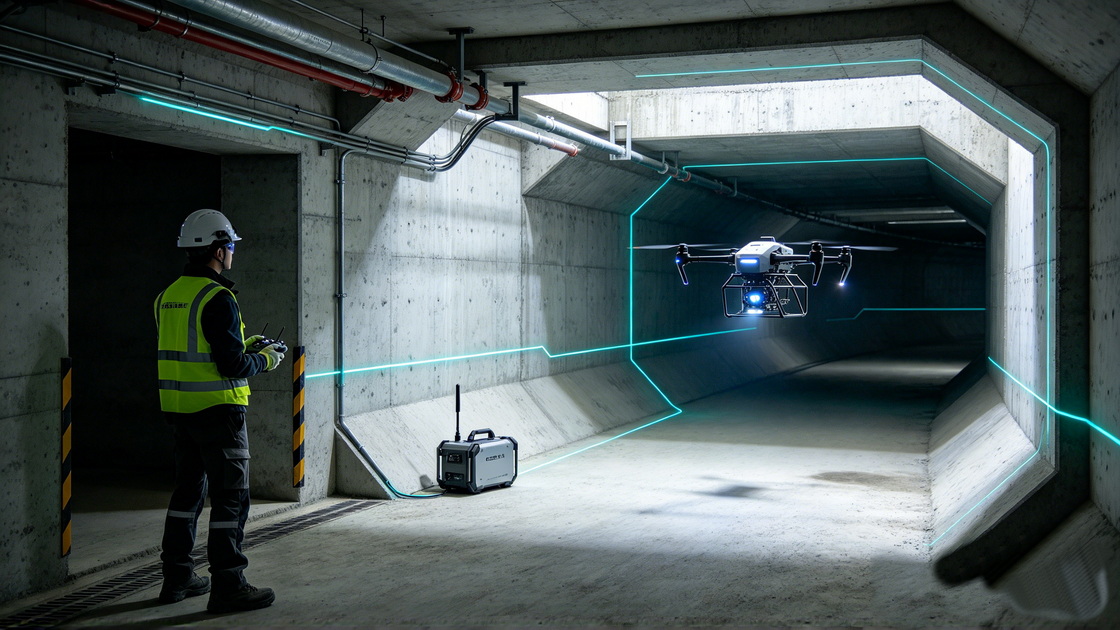
Start with the route rather than a headline transmission distance.
Identify entrances, turns, vertical sections, chambers, and places where the aircraft may become separated from the operator by substantial material.
Depending on the equipment and site, options may include:
- Repositioning the operator or ground antenna.
- Using a compatible range extender or relay.
- Dividing the inspection into shorter segments.
- Recording high-resolution data onboard.
- Defining a conservative mission boundary.
A tunnel layout that supports communication near its entrance may behave very differently beyond the next bend.
An outdoor return procedure may be unsuitable inside a confined structure.
A safe response could involve stopping, landing at an assessed location, or following a previously validated recovery behavior. The correct choice depends on navigation capability, obstacle clearance, and available landing space.
Never assume that a manufacturer's default lost-link setting is appropriate for an underground mission.
SIDT identifies urban airspace "3+1 delivery" and ground-air coordinated emergency response among its application areas.
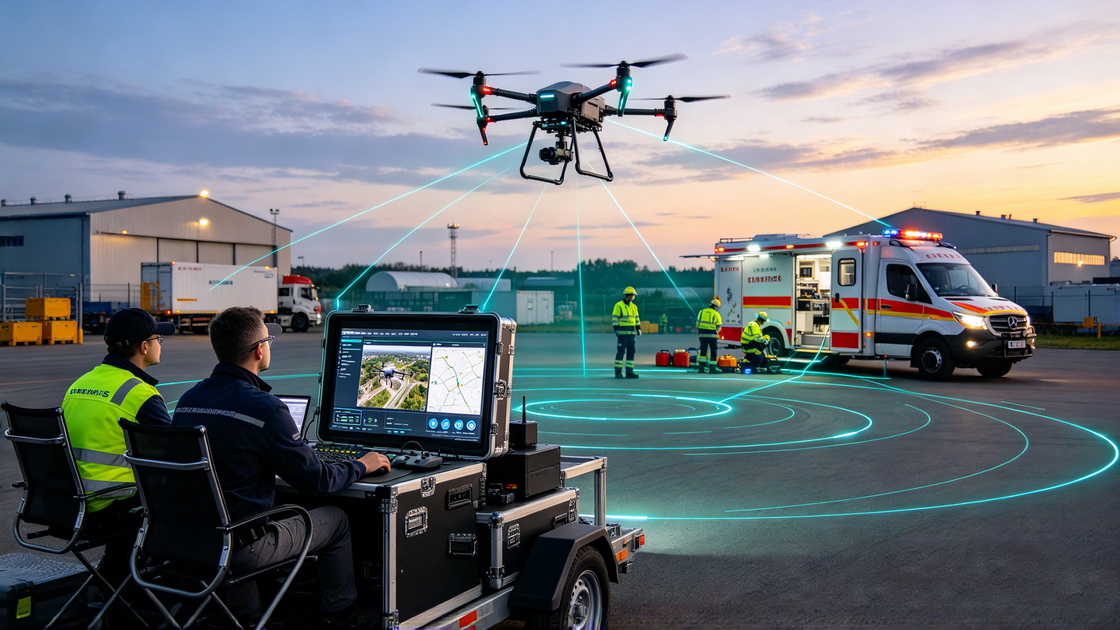
For these missions, communication design extends beyond the aircraft-to-pilot connection. Dispatchers, receiving teams, ground vehicles, and other authorized participants may need different views of the same operation.
An illustrative delivery workflow involves mission assignment, departure, transit, destination confirmation, and completion reporting.
At each stage, distinguish between:
- An instruction being issued.
- The aircraft acknowledging it.
- The requested action actually being completed.
These are different events. A dashboard should not present an unconfirmed command as a completed delivery.
For procurement teams, this distinction is often more useful than comparing maximum transmission distance alone.
Emergency teams may need live observations, equipment locations, and task updates simultaneously.
Not every participant needs every feed. Role-based access and selective distribution can reduce unnecessary traffic while keeping relevant information available.
The workflow should also define who controls the aircraft, who assigns tasks, and how responsibility changes between teams.
A shared platform is most useful when it clarifies authority rather than merely displaying more information.
A practical acceptance process converts broad reliability claims into observable behavior.
Document the route, operating environment, payload, operator positions, and expected obstructions.
Include the conditions that would require cancellation or early termination.
Specify acceptable command responsiveness, telemetry freshness, video behavior, and recovery actions.
Avoid adopting universal latency or range thresholds without considering the aircraft and task.
Evaluate the planned route under controlled, authorized conditions.
Include relevant aircraft orientations, obstructions, and network transitions. Record environmental conditions so results can be interpreted accurately.
Test while the intended cameras, sensors, and data services are operating.
Useful measurements include round-trip latency, jitter, packet loss, telemetry age, and application-level interruption. Received signal strength alone cannot establish mission readiness.
Using an appropriate controlled test method, confirm what happens when a connection weakens or becomes unavailable.
Check both aircraft behavior and operator notifications. Avoid uncontrolled interference or intentional disruption of public networks.
Keep configuration records, test results, and event logs.
Repeat relevant tests after changes to antennas, firmware, payloads, routes, or network services. A previously successful configuration does not validate every later modification.
Security has several separate objectives: identifying trusted participants, protecting information, and limiting unauthorized actions.
For example, MAVLink 2 supports message signing to authenticate messages. Signing does not encrypt their contents.
A secure implementation should therefore consider:
- Authentication of operators and connected devices.
- Encryption where sensitive information requires protection.
- Appropriate permissions for mission changes.
- Secure handling and replacement of credentials.
- Logged access and administrative actions.
Ask suppliers which layer provides each safeguard. "Secure communication" is too broad to serve as an acceptance criterion.
A supplier demonstration should show what happens when the operation becomes difficult.
Ask to see delayed telemetry, a reduced-bandwidth condition, a disconnected cloud session, and the recovery process.
Also distinguish technical capability from operational permission. A connection extending beyond visual range does not itself authorize such a flight. Applicable aviation and spectrum requirements must be assessed for the operating jurisdiction.
For environmental monitoring, communication also influences data usefulness. Images need reliable association with collection time, location where available, and mission context. Connectivity alone does not demonstrate environmental benefit.
SIDT's objective is to turn integrated sensing, data collection, analysis, and coordination into practical customer value.
To discuss an application, share your operating environment, route, payload, existing connectivity, and required failure behavior with SIDT. These inputs provide a stronger foundation for a solution assessment than transmission distance alone.
Drone communication is the exchange of commands, aircraft status, and payload information between a drone and connected systems. Its design should reflect both normal operation and foreseeable interruptions.
Range depends on factors including radio configuration, antennas, interference, obstructions, terrain, and operating conditions. A manufacturer's published distance should be checked against its test conditions and validated for the intended mission.
Yes, suitable systems can support underground operations, but coverage is highly site-dependent. Turns, structural materials, and equipment may require modified antenna placement, compatible range-extension equipment, or shorter inspection segments.
Not automatically. The complete route, required performance, network transitions, and failure behavior need evaluation. Cellular availability also does not replace required operational authorization.
No. MAVLink provides message-signing capabilities for authentication, but not message encryption. Confidentiality requires protection elsewhere in the communication architecture.
The aircraft should execute a predefined, validated response appropriate to its surroundings. Returning, holding, landing, or another recovery behavior may be suitable, but no single response is safe for every mission.
1. Original article explaining manual control, telemetry, video transmission, and integrated communication. The visible reader comment informed the environmental-context discussion only; it was not treated as verified customer evidence.
2. Technical background on telemetry messaging, bandwidth-constrained links, and packet integrity.
3. Primary documentation for message authentication and secure signing-key handling.
4. Clarifies that MAVLink supports authentication through signing but does not provide encryption.
5. U.S.-specific reference for visual-line-of-sight requirements, waivers, and preflight communication checks. Requirements elsewhere differ.
6. Context on the proposed regulatory framework; proposals should not be confused with effective operating permissions.
7. Historical, product-specific example of range-extension equipment for difficult indoor environments; not evidence of SIDT performance.
8. Shenzhen Intelligent Drone Technology Co. Ltd. — Client-supplied corporate description. Source for SIDT's stated platform approach, "one-network coverage," and named applications. No public source link or independent performance verification was supplied.
The architecture recommendations and illustrative workflows above are editorial synthesis, not reports of completed SIDT deployments or measured product results.


