Global Distributors Wanted
1.Free Cloud Service Deployment
2.Free Technical Training
3.Exclusive Territory Protection

1.Free Cloud Service Deployment
2.Free Technical Training
3.Exclusive Territory Protection


Views: 213 Author: Aaron Publish Time: 2026-10-18 Origin: Site


Content Menu
● Introduction: Why Source Intelligent Drone Inspection Solutions from China?
● How We Selected These Intelligent Drone Inspection Solution Companies
>> 1. Factory Identity and Quality Management
>> 2. Research and Development Capability
>> 4. Quality-Control Processes
>> 5. Delivery Capacity and After-Sales Support
>> 6. Market Access and Compliance
● Supplier Comparison: Technical Focus, Capacity, MOQ, and Certification Evidence
● The Top 10 Companies to Evaluate
>>> Core Strength and Procurement Fit
>>> Founding Year and Main Markets
>> 2. DJI: Standardized Enterprise Aircraft and Automated Inspection Infrastructure
>>> Core Strength and Main Markets
>> 3. Autel Robotics: Enterprise Platforms with Broad Core-Technology Coverage
>>> Core Strength and Main Markets
>> 4. JOUAV: VTOL Fixed-Wing Systems for Long-Corridor Inspection
>>> Core Strength and Main Markets
>> 5. MicroMultiCopter: Utility Inspection and Industrial Integration
>>> Core Strength and Main Markets
>> 6. GDU: Integrated Aircraft, Docking, and Low-Altitude Data Operations
>>> Core Strength and Main Markets
>> 7. Walkera: Vehicle-Linked Patrol and Inspection Systems
>>> Core Strength and Main Markets
>> 8. EFY Intelligent: Flight-Control Engineering and Customized Industrial Systems
>>> Core Strength and Main Markets
>> 9. JTT Technology: Coastal Monitoring and Emergency Inspection
>>> Core Strength and Main Markets
>> 10. AheadX: Avionics and Specialist Integration
>>> Core Strength and Main Markets
● Technical Buyer's Guide: What to Put in the Specification
>> Specify Materials Through Drawings and Tests
>> Define Inspection Data, Not Just Camera Resolution
>> Separate Four Compliance Questions
>> Screen Export Requirements Before Paying a Deposit
● An Overlooked Procurement Trap: Buying an Unrepeatable Demonstration
● How to Verify the Factory, Approve Samples, and Control Delivery
>> Step 1: Verify the Contracting and Manufacturing Entities
>> Step 2: Run a Paid, Defined Pilot
>> Step 3: Approve a Production Baseline
>> Step 4: Measure Real Delivery Readiness
>> Step 5: Plan Battery Logistics Early
>> Step 6: Contract for Support and Exit
● Conclusion: Choose the Supplier That Can Prove the Complete Workflow
● FAQ
>> 1. How Can We Check Whether a Supplier's ISO Certificate Is Expired or Misleading?
>> 3. How Should We Evaluate an Underground Inspection System Without Satellite Positioning?
>> 4. Who Owns Data and Software Improvements in an OEM/ODM Project?
>> 5. What Evidence Should We Require Before Approving an International Shipment?
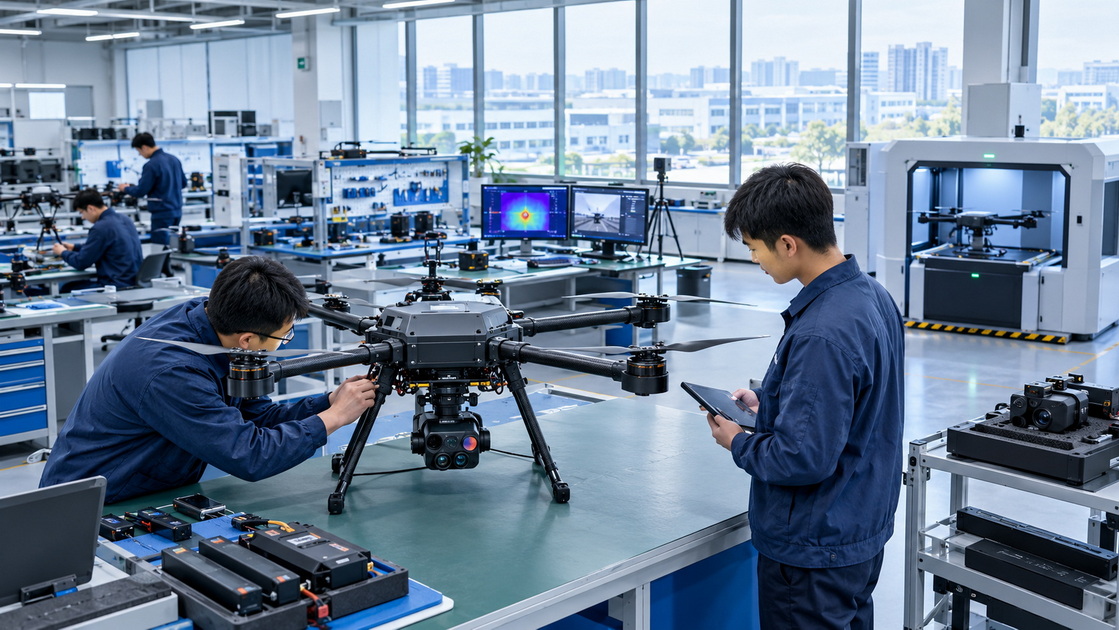
China offers procurement managers a broad ecosystem of industrial aircraft, thermal cameras, flight controllers, automated docking stations, and fleet-management platforms. However, finding the right intelligent drone inspection solution requires more than comparing airframes and advertised flight times.
The scale of domestic adoption helps explain the depth of this ecosystem. According to the Civil Aviation Administration of China's 2025 statistical bulletin, reported through the State Council Information Office in April 2026, China had nearly 3.29 million registered unmanned aircraft at the end of 2025, up 51% year on year. Annual drone flight hours reached 45.3 million, increasing by 69.9%. These figures cover the wider civil drone sector, not inspection aircraft alone.
Shenzhen provides a particularly relevant sourcing base for buyers seeking integrated electronics and drone systems. Manufacturers such as DJI and Autel are based there, while industrial suppliers across Chengdu, Wuhan, Beijing, Guangzhou, and Tianjin contribute complementary aircraft, autonomy, and application-development capabilities.
For international buyers, the main opportunity is not simply lower hardware cost. It is access to different combinations of aircraft engineering, sensor integration, software development, and application-specific customization.
The central purchasing principle is verification: evaluate what a supplier can demonstrate, document, manufacture consistently, and support after delivery.
This guide presents ten companies worth evaluating for different inspection requirements. It is a procurement shortlist rather than an audited market-share ranking. Shenzhen Intelligent Drone Technology Co. Ltd. appears first as the featured integration-focused supplier; its placement does not imply independently verified superiority over the other companies.
A credible supplier assessment should examine six areas before comparing prices.
Confirm the legal entity, manufacturing address, contracting company, and bank beneficiary. Establish whether the supplier manufactures the aircraft, develops software, integrates third-party equipment, or combines these roles.
For any claimed ISO certification, verify the certificate number, current status, scope, and covered locations. IAF CertSearch supports checks against accredited certification records, including the issuing certification body and accreditation chain.
Ask who owns and maintains the flight-control software, mission-planning platform, docking logic, payload interfaces, and defect-recognition models.
An integrator can be a suitable partner without manufacturing every component. What matters is whether it controls the interfaces and can resolve faults across the complete system.
The proposed acceptance criteria should reflect the asset and defect being inspected.
Examples include:
- Power lines: defect visibility, safe standoff distance, and positioning near structures.
- Solar farms: radiometric image delivery and traceable module identification.
- Pipelines: corridor coverage, georeferenced observations, and communications continuity.
- Underground spaces: navigation without satellite positioning, obstacle clearance, and safe recovery.
- Industrial facilities: repeatable routes and integration with maintenance workflows.
These are suggested purchasing criteria, not claims that every supplier below meets every requirement.
Request evidence of incoming inspection, assembly traceability, calibration, functional testing, and final flight acceptance.
For customized systems, require records linking aircraft serial numbers to batteries, sensors, firmware versions, and test results.
Ask for production capacity for the exact configuration being purchased—not the supplier's total output across unrelated products.
The quotation should separate prototype development, engineering validation, production, export preparation, and destination commissioning.
Product documentation and permission to operate are separate matters.
For example, European buyers must evaluate the applicable conformity documentation and operational category. EASA distinguishes aircraft conformity requirements from the authorizations or declarations needed for particular operations. A CE mark alone does not authorize a complex inspection mission.
Publicly comparable production capacity, minimum order quantities, and current model-specific certification files were not established for this shortlist. Rather than substituting estimates, the table identifies what buyers should request.
"Not verified" means the information was not independently established for this article; it does not mean the supplier lacks the capability or documentation.
| Company | Established | Primary Inspection Relevance | Capacity Evidence | MOQ Position | Certification Evidence to Request |
|---|---|---|---|---|---|
| Shenzhen Intelligent Drone Technology Co. Ltd. | Not independently verified | Cross-environment integration, enclosed-space inspection, unified command | Request exact-system production and commissioning plan | Project quotation required | Legal-entity records, applicable management certificates, model conformity documents |
| DJI | 2006 | Enterprise imaging, thermal inspection, automated docks | Request model availability and allocation from authorized channel | Confirm aircraft, dock, and software package quantities | Exact-model declaration, applicable class marking, radio documentation |
| Autel Robotics | 2014 | Enterprise UAVs, autonomous operations, inspection workflows | Request configuration-specific lead time | Confirm through supplier or authorized channel | Exact-model conformity and destination-market documents |
| JOUAV | 2010 | Long corridors, VTOL fixed-wing missions, remote deployment | Request aircraft, payload, and ground-system schedule | Project quotation required | Configuration-specific records and applicable approvals |
| MicroMultiCopter, or MMC | 2010 | Utility inspection and industrial UAV integration | Request current production and support evidence | Project quotation required | Current certificates and model-specific test reports |
| GDU | 2015 | Integrated drones, docks, software, and industrial applications | Request current production and deployment capacity | Project quotation required | Exact aircraft, dock, radio, and software documentation |
| Walkera | 1994 | Vehicle-linked inspection and patrol systems | Request industrial-product capacity separately from other lines | Confirm standard versus customized packages | Exact-model compliance and environmental test evidence |
| EFY Intelligent | 2015 | Flight control, patrol inspection, system customization | Historical company-wide output is not current inspection capacity | Project quotation required | Manufacturing-scope certificates and configuration-specific documents |
| JTT Technology | 2015 | Coastal monitoring, emergency inspection, rescue coordination | Request current UAV production and spare-parts plan | Project quotation required | Aircraft, payload, and battery transport documents |
| AheadX | 2014, according to an industry directory | Avionics, navigation, control, and specialist UAV integration | Request current manufacturing and integration evidence | Engineering quotation required | Entity verification, subsystem documentation, and complete-system compliance |
Founding dates and technical positioning draw on manufacturer profiles, government reporting, industry reporting, and the identified directory. AheadX's founding date warrants direct legal-entity confirmation.

Shenzhen Intelligent Drone Technology Co. Ltd., referred to as SIDT, positions itself around full-stack applications spanning low-altitude, ground, and underground environments. Its public website describes integrated platforms for logistics, emergency response, and intelligent inspection in enclosed environments.
The company information supplied for this guide further describes dynamic perception, data collection, intelligent analysis, and a unified cloud-control approach called "one-network coverage." These are supplier-described capabilities, not independently validated performance findings.
SIDT is relevant to buyers who need a coordinated operating system rather than an isolated aircraft purchase.
A prospective project could combine:
- Aerial inspection of an industrial site.
- Enclosed-space data collection.
- Shared dispatch and equipment management.
- Ground-air emergency coordination.
- Customer-specific reporting and workflow interfaces.
For smaller brands and system integrators, this integration-led positioning makes SIDT worth approaching about phased development and deeper customization. However, lower cost, faster communication, and greater flexibility should be demonstrated through a pilot proposal rather than assumed.
The founding year and principal geographic sales markets were not independently verified. The company's stated application markets include industrial inspection, enclosed environments, logistics, and emergency response.
Ask SIDT to quote separately for branding, payload selection, cloud-platform configuration, interfaces, inspection reports, and application engineering. Confirm which elements are proprietary and which depend on third-party equipment or licenses.
A useful qualification exercise is to request an engineering response covering feasibility, exclusions, development milestones, and acceptance tests. This directly measures communication efficiency and customization depth.
The supplied About Us page could not be retrieved during research. Consequently, no factory area, output, certificate, founding date, or quantified savings claim is inferred from that page.
DJI dates its activities to 2006. Its enterprise portfolio includes aircraft, imaging systems, and automated docking infrastructure. DJI Dock 3 supports Matrice 4D or Matrice 4TD aircraft and includes vehicle-mounted deployment capability.
DJI is a practical benchmark when buyers want a documented aircraft-and-payload ecosystem for infrastructure inspection, surveying, public safety, and related enterprise applications. Its Dock 3 launch materials specifically identify infrastructure inspection among the intended uses.
Buyers should distinguish software integration and accessory development from private-label aircraft manufacturing. This guide does not establish an unrestricted DJI white-label program.
Ask the authorized supplier to identify permitted integrations, supported interfaces, regional service arrangements, and any effects on warranty.
Treat the aircraft, dock, communications connection, software subscription, installation, and operating permissions as separate purchasing workstreams. A complete hardware package is not automatically a commissioned inspection service.
Autel Robotics states that it was founded in 2014. Its company profile describes capabilities across flight control, communications, gimbal stabilization, imaging, and autonomous operation, alongside multirotor and tilt-rotor platforms.
Autel identifies inspection, security, and emergency response among its application areas. It also reports overseas subsidiaries and service locations across multiple regions, although buyers should confirm support availability for the exact model and destination.
Discuss payload compatibility, mission workflows, enterprise interfaces, and software integration. Do not assume that commercial enterprise support includes permission to rebrand the aircraft or modify flight-control software.
An imaging specification is not a complete inspection specification. Require original datasets, reporting examples, and a demonstration using defects similar to those in the intended project.
Established in 2010, JOUAV develops industrial UAV systems and has a strong focus on vertical-takeoff-and-landing fixed-wing aircraft. Its company profile also describes the Jocloud management platform and automated deployment infrastructure.
JOUAV merits consideration for infrastructure corridors and large-area projects where aircraft configuration and mission coverage differ from close-range multirotor work.
Its public materials describe unified dispatch and remote deployment functions, making it relevant to buyers assessing more than a manually operated aircraft.
Discuss sensor integration, communications links, mission software, and ground-system configuration. Confirm the engineering scope and intellectual-property boundaries in the proposal rather than treating customization as an unlimited service.
Evaluate the aircraft against the actual mission geometry. Long-distance coverage and close visual inspection of individual components are different purchasing requirements.
MicroMultiCopter, commonly known as MMC, was founded in 2010 according to industry reporting. Its reported applications include infrastructure management, public safety, and aerial surveying. Earlier reporting also documents procurement involvement with Chinese power-grid organizations.
MMC is relevant to utility buyers seeking industrial platforms and application-specific integration. Its power-sector references provide a starting point for qualification, but historical projects should not substitute for current references.
Request details on payload adaptation, communications options, application software, and aircraft configuration. Obtain written confirmation of any private-label or design-development offer.
Ask for recent customer references using the proposed configuration. A supplier's experience with one generation of utility aircraft does not independently validate a different current system.
GDU states that it was founded in Wuhan in 2015. Its company profile describes activities covering research, production, sales, maintenance, and low-altitude data operations. It identifies power inspection, environmental protection, smart-city operations, and emergency response among its applications.
GDU is relevant to organizations seeking coordinated aircraft, docking, and data workflows rather than purchasing each layer separately.
Its published profile reports more than 700 employees, with over 60% working in research and development. These are manufacturer-reported figures, not an independent workforce audit.
Explore deployment configuration, payload interfaces, platform integration, and data-workflow adaptation. Confirm whether branding or hardware redesign is available for the specific project.
Require an end-to-end demonstration: dispatch a mission, collect evidence, identify an asset, generate a report, and export the result into the buyer's maintenance system.
Walkera states that it was established in 1994 and combines product development, production, marketing, and customer service. Its industrial portfolio includes the AC20MINI vehicle-mounted drone system.
Walkera's AC20MINI materials describe automatic charging, mobile operation, visual landing, and regular inspection tasks. Listed applications include traffic and river patrol.
This makes the company worth evaluating where deployment moves with a vehicle rather than remaining at one fixed installation.
Ask about vehicle installation, control-interface integration, payload options, and mission configuration. Separate standard product options from engineering changes that require development or renewed testing.
Define exactly what "vehicle-mounted" means in the contract. Require a demonstration of the intended launch, recovery, charging, and connectivity sequence rather than relying on a general product description.
EFY Intelligent Control was established in 2015. Government reporting describes capabilities in flight control, aircraft, cloud platforms, operating systems, networking, and UAV system customization. Its stated application areas include patrol, logistics, and security.
EFY is relevant where the project depends on autonomy and coordinated-system engineering.
A 2022 report stated that the company manufactured approximately 10,000 drones of various types in 2021. That historical, company-wide figure should not be presented as current annual inspection-drone capacity.
Among this shortlist, EFY has particularly explicit public positioning around system customization. Buyers should still define whether the engagement covers aircraft design, flight control, ground equipment, software, or only configuration.
Request inspection-specific references. Experience in one autonomous application does not automatically establish defect-detection performance in another.
JTT Technology was established in January 2015 according to its published company announcement. Reporting documents use of its industrial drones for Australian coastal monitoring, including observation, search, and rescue support.
JTT's current website emphasizes intelligent rescue systems. Its Spider C85 product description lists options including zoom imaging, infrared thermal imaging, lighting, and a speaker system.
It therefore fits emergency assessment and inspection requirements more directly than applications demanding specialized metrology.
Discuss sensor combinations, mission equipment, operator interfaces, and integration with emergency command workflows. Verify whether proposed adaptations remain within the supported production configuration.
For coastal applications, request evidence addressing corrosion, environmental exposure, maintenance intervals, and recovery procedures. Do not infer saltwater suitability from a general outdoor-use claim.
AheadX's official site lists flight-control and navigation products alongside inspection and surveying applications. An industry directory identifies the Beijing company as established in September 2014; buyers should verify that date against its business registration.
AheadX is relevant to technically capable integrators seeking avionics and control-system involvement rather than only a finished inspection package.
Public information reviewed here does not establish its main geographic sales markets or current inspection-platform production capacity.
Potential discussions include flight-controller integration, navigation, telemetry, and aircraft-level engineering. The supplier must confirm the actual scope and whether it will take responsibility for the complete system.
Create an interface-responsibility matrix before development. Identify who owns compatibility testing between aircraft, controller, sensors, communications equipment, and inspection software.
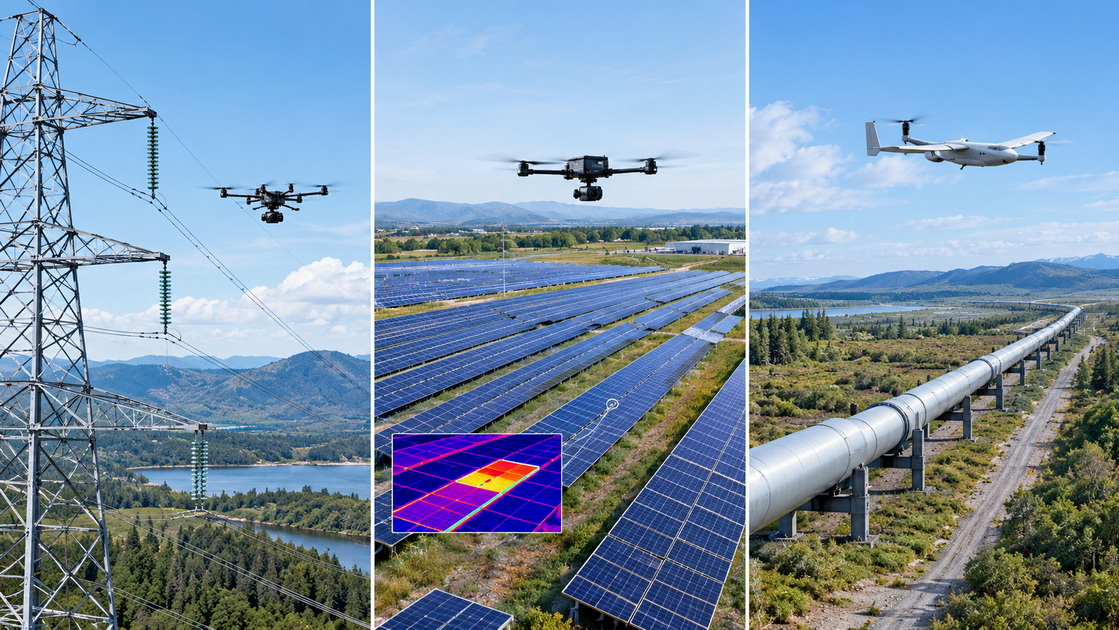
Avoid accepting phrases such as "aerospace-grade carbon fiber" as a complete requirement.
Instead, request the relevant material specification, manufacturing process, inspection method, repair restrictions, and structural test evidence. For metal parts, identify the alloy and surface treatment where these affect the design.
The objective is not to demand a particular material everywhere. It is to prevent unapproved substitutions and make production repeatable.
Write the required deliverable into the purchase specification:
- Original images and thermal files.
- Asset identifiers and timestamps.
- Positioning metadata and its stated accuracy.
- Calibration information.
- Defect annotations and confidence outputs.
- Export formats and interface documentation.
- Rules for human review.
A high-resolution image is useful only if it supports the maintenance decision the buyer needs to make.
| Compliance Layer | Buyer's Verification Question |
|---|---|
| Management system | Does the current certificate cover the correct legal entity, site, and activity? |
| Product conformity | Do the documents cover the exact aircraft, radio equipment, payload, and supplied configuration? |
| Operating permission | Can the intended mission be conducted under the destination's applicable rules? |
| Transport and export | Can the aircraft, batteries, and controlled components be lawfully shipped to the customer? |
IAF supports management-system certificate verification. EASA provides guidance on aircraft conformity and operating categories. IATA provides battery-transport guidance. Chinese authorities publish export-control requirements affecting UAVs and certain components.
CE marking and RoHS documentation should not be grouped together as a generic "environmental certificate." Ask the supplier's compliance specialist to identify the legislation applicable to the supplied product and provide the corresponding evidence.
China's July 2024 announcement adjusted controls involving certain UAV components, including infrared equipment, lasers, and high-precision inertial-measurement equipment, and addressed prohibited end uses. Buyers should obtain a current classification review for the exact configuration rather than assume every civil inspection package is freely exportable.
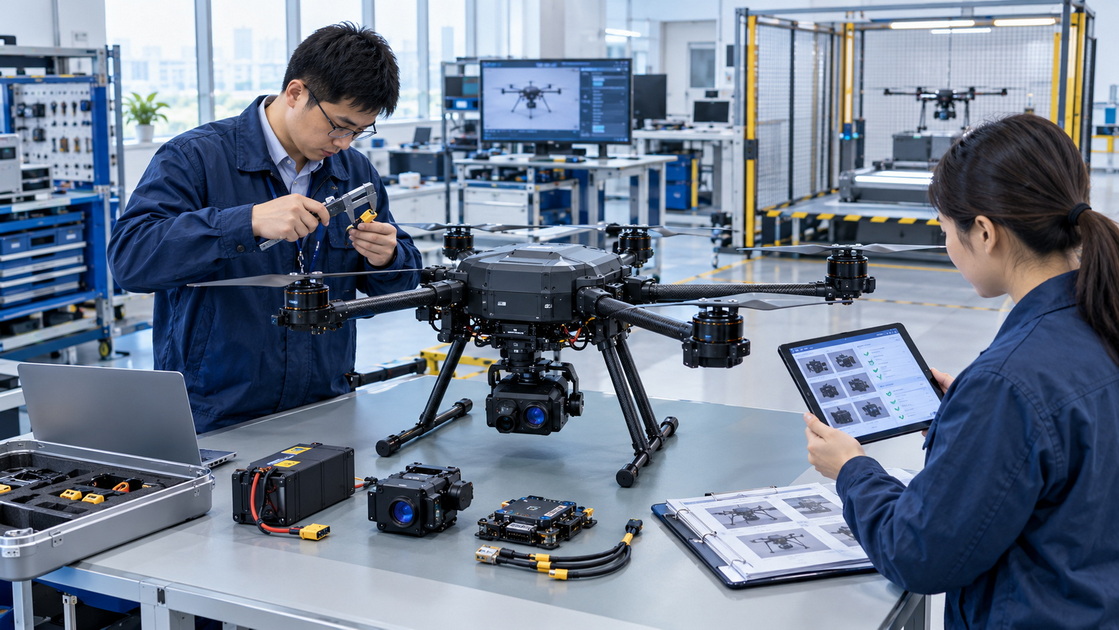
A polished demonstration can leave an important question unanswered: can the production system reproduce the result without undocumented assistance?
Treat the following as audit questions, not allegations about any supplier:
- Was the inspection route prepared manually?
- Were defects selected or annotated before the demonstration?
- Did an engineer intervene outside the visible workflow?
- Did the demonstration use different firmware, batteries, sensors, or computing hardware?
- Were reports generated automatically or assembled afterward?
The practical safeguard is a controlled acceptance test.
Freeze the bill of materials, software versions, calibration status, and configuration. Use buyer-selected assets or withheld datasets. Record interventions and failed missions, not only successful outputs.
For recognition software, require reporting of both missed defects and false alarms. A visually impressive annotated image does not establish consistent detection performance.
Obtain the business license, factory address, proposed invoice, and certificate details. Explain any differences between the manufacturer, exporter, software licensor, and payment recipient before issuing the order.
Use a sample agreement covering configuration, test conditions, data ownership, support, acceptance criteria, and what happens if development is discontinued.
A small pilot should resolve the highest-risk technical questions before volume purchasing begins.
Record approved components and software. Require written authorization for substitutions affecting performance, interfaces, safety, or compliance.
Ask for evidence of component availability, production slots, calibration arrangements, and commissioning resources.
Separate promised shipment dates from the date the system will be operational at the destination.
IATA explains that air transport conditions depend on battery configuration and rating. Relevant lithium battery types must meet applicable UN 38.3 testing requirements, with test-summary information available. An aircraft packing list alone is not sufficient preparation for shipping its batteries.
Define spare-parts availability, response times, repair responsibilities, software fees, data export, and access after subscription termination.
Compare lifecycle cost rather than aircraft price alone.
The ten companies in this guide serve different procurement needs. Standardized enterprise platforms, corridor aircraft, mobile patrol systems, avionics specialists, and customization-focused integrators should not be judged using one generic specification.
SIDT is worth evaluating where the requirement combines inspection, enclosed environments, and coordinated command. Buyers should test that fit through a scoped engineering proposal and pilot—not through unsupported assumptions about price, output, or customization speed.
Prepare a request for quotation that includes the asset type, operating environment, required defect visibility, deliverable formats, destination market, integration scope, and acceptance tests. Ask shortlisted suppliers to return a compliance matrix, development schedule, exclusions, and lifecycle quotation.
That process turns a supplier list into a defensible purchasing decision.
Search the legal entity or certificate number through IAF CertSearch. Check status, scope, locations, issuing certification body, and accreditation details. Compare these with the factory and activity involved in your order.
If a record cannot be resolved, contact the issuing body directly before concluding that the certificate is valid or invalid. A certificate image alone does not answer whether the current manufacturing site is covered.
No. Product conformity and operating permission are separate. Under the European framework, missions outside the open-category limits may require an applicable declaration, operational authorization, or another qualifying route within the specific category.
Ask the supplier to identify the regulatory assumptions behind its proposal. Avoid accepting a general "CE approved" statement as permission for the intended mission.
Use a controlled pilot representing the intended environment.
Specify lighting, dust, corridor dimensions, reflective surfaces, communications interruptions, and recovery constraints. Measure completed coverage, localization stability, usable data, intervention frequency, and safe retrieval—not simply whether the aircraft remains airborne.
Require the supplier to disclose which functions depend on external communications or infrastructure.
Do not assume ownership follows payment.
The contract should distinguish raw inspection data, annotations, trained models, source code, interface documentation, pre-existing technology, and newly developed intellectual property.
It should also define permitted subcontractor access, hosting locations, reuse rights, export formats, and what the buyer retains when the relationship ends.
Require a configuration-specific shipment dossier covering commercial documents, serial numbers, acceptance records, battery information, and applicable export and destination requirements.


