Global Distributors Wanted
1.Free Cloud Service Deployment
2.Free Technical Training
3.Exclusive Territory Protection

1.Free Cloud Service Deployment
2.Free Technical Training
3.Exclusive Territory Protection


Views: 211 Author: Aaron Publish Time: 2026-10-11 Origin: Site


Content Menu
● Which States Allow Drone Delivery Today?
>> Why "Allowed" and "Available" Must Be Compared Separately
● Federal Drone Delivery Rules vs. State and Local Requirements
>> What States and Local Governments Influence
>> Why Part 107 Is Not a Universal Delivery Authorization
● Comparing States by Delivery Network Maturity
>> Texas: Multiple Providers and Delivery Models
>> North Carolina: Medical and Residential Applications
>> Newly Served States: Local Coverage Still Matters
● Latest Drone Delivery Data: Actual Service vs. Expansion Targets
● How to Check Drone Delivery Availability at Your Address
● A Practical Market-Entry Checklist for Businesses
>> Step 1: Define the Delivery Mission
>> Step 2: Map Hubs, Routes, and Receiving Locations
>> Step 3: Confirm the Authorization Pathway
>> Step 4: Test the Complete Delivery Workflow
>> Step 5: Measure Service Performance
● SIDT's Perspective: Why One-Network Coverage Matters
>> Connect Dispatch with Ground Operations
>> Separate Technical Capability from Legal Authority
>> 1. Is Drone Delivery Allowed in All 50 States?
>> 2. Which States Currently Have Amazon Drone Delivery?
>> 3. Can a City Stop a Drone Delivery Hub?
>> 4. Does a Part 107 Certificate Allow Paid Drone Delivery?
>> 5. Can Drones Deliver Medical Supplies?
>> 6. Does an Announced Expansion Mean Service Is Available?
Which states allow drone delivery? Commercial drone delivery is available in selected communities across multiple U.S. states, including Texas, Arizona, Florida, Georgia, North Carolina, Kansas, Louisiana, Michigan, and Nebraska. Other states have hosted approved operations, environmental reviews, or announced expansion projects.
However, availability is not the same as statewide permission. There is no simple federal list dividing the country into states where drone delivery is universally allowed and states where it is universally prohibited. Operators need the appropriate federal approvals, while delivery hubs must satisfy applicable state and local requirements.
For consumers, the decisive question is whether a provider serves their exact address. For businesses, it is whether a specific aircraft, route, hub, and operating model can receive the necessary approvals.
This guide compares state-level delivery footprints, explains the approval process, and examines what makes a drone delivery network commercially practical.
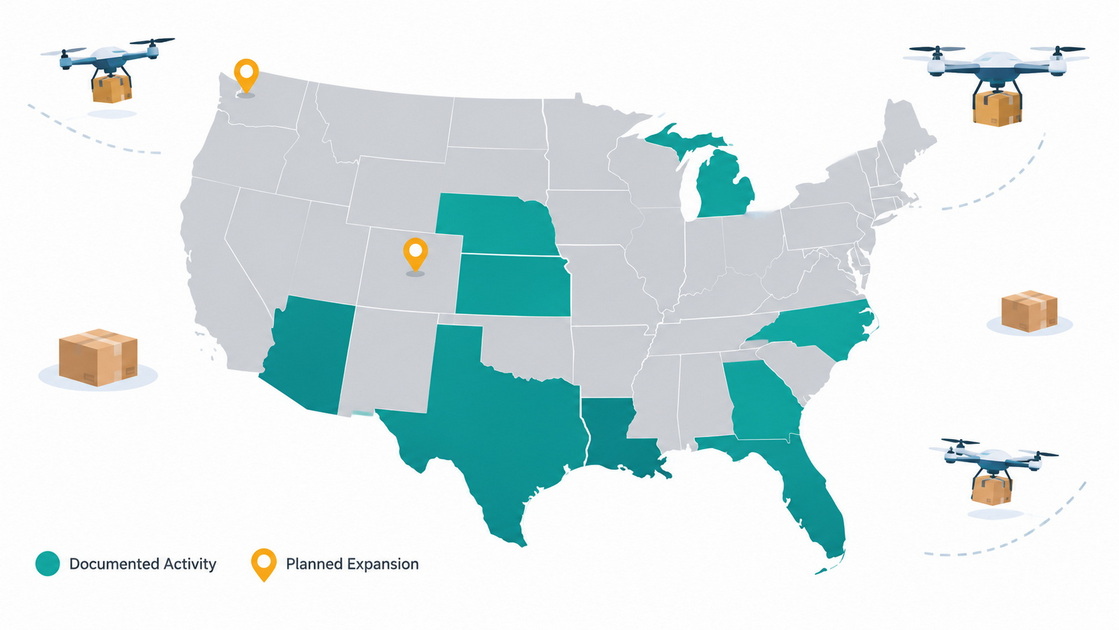
The following table separates reported service from historical activity and future plans. It is a practical comparison, not an exhaustive legal inventory.
A listed city does not mean every neighborhood has access. Likewise, a state missing from the table should not automatically be treated as prohibiting drone delivery.
| State | Documented delivery activity | What the status means |
|---|---|---|
| Texas | Amazon Prime Air sites around Houston, Dallas, San Antonio, and Waco; Wing and Walmart operations; Zipline launches in Mesquite and Waxahachie | Multiple providers serve selected communities |
| Arizona | Amazon Prime Air in the Phoenix metropolitan area | Delivery depends on the exact address |
| Florida | Amazon Prime Air near Tampa; Wing and Walmart activity including Orlando | Selected service areas, not statewide coverage |
| Georgia | Wing and Walmart service in the Atlanta metropolitan area | Current activity; Amazon also announced expansion plans |
| North Carolina | Documented Wing, UPS Flight Forward, Zipline, and Causey Aviation Unmanned activity | Includes residential delivery and medical logistics |
| Kansas | Amazon Prime Air in Kansas City, Kansas | Selected communities within the local service footprint |
| Louisiana | Amazon Prime Air around Baton Rouge | Address-specific eligibility |
| Michigan | Amazon Prime Air sites in Hazel Park and Pontiac | Selected Detroit-area communities |
| Nebraska | Amazon Prime Air in Papillion | Selected Omaha-area communities |
| Arkansas | Walmart has documented operations in Northwest Arkansas | Verify current participating stores and addresses |
| Virginia | Wing's early commercial deliveries in Christiansburg | Historical authorization does not establish current coverage |
| Ohio | FAA certification documentation identifies DEXA's planned Dayton operations; Amazon announced Cleveland expansion | Certification and announcements require separate launch verification |
| Colorado and Washington | Wing and Walmart announced Denver and Seattle expansion for 2027 | Future plans, not evidence of current service from those projects |
I would start any market assessment by separating two questions: can an operation be authorized, and can a customer order today?
Federal approval addresses aviation safety and the operator's permitted activities. Local approvals address matters such as hub siting and land use. Commercial availability adds another layer: participating merchants, delivery zones, eligible products, and operating hours.
These layers explain why a provider can announce a metropolitan expansion without immediately serving every customer there.
Drone delivery operates within overlapping responsibilities. Understanding those responsibilities is more useful than looking for a single state-issued permission slip.
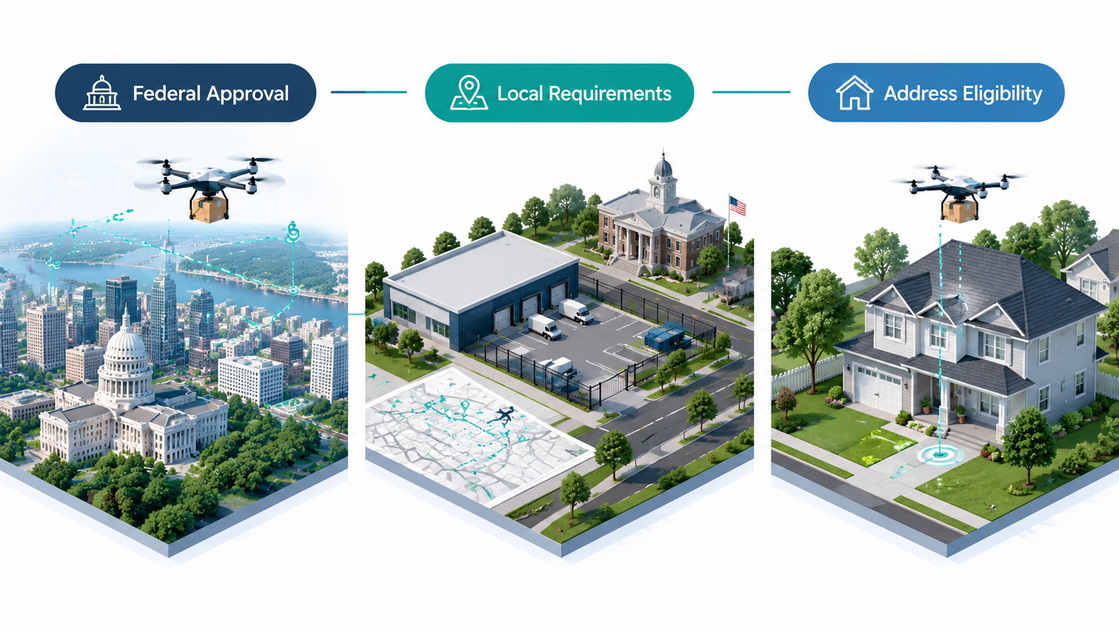
The Federal Aviation Administration regulates aviation safety, aircraft-related approvals, operator certification, and airspace authorizations.
The FAA identifies Part 135 certification as the current pathway for small drones carrying another person's property for compensation beyond visual line of sight. Beyond visual line of sight, or BVLOS, means the aircraft flies outside the pilot's direct view.
Depending on the operation, providers also need exemptions, waivers, and operating specifications. A certificate alone does not authorize every aircraft, route, or delivery scenario.
The FAA's certification process includes five phases, with document review, facility inspection, and validation of flight and maintenance procedures among the requirements.
Drone distribution hubs must comply with applicable state and local land-use and zoning requirements.
Practical issues can include:
- Whether the proposed property permits the intended use.
- Where takeoff and recovery infrastructure can be installed.
- Setbacks from noise-sensitive locations.
- Public consultation and neighborhood concerns.
- Access, storage, and supporting facilities.
The FAA does not choose commercial hub locations. Operators select them and must coordinate with the relevant authorities.
Part 107 permits many small-drone activities, and package delivery may be possible under specific conditions. However, it is not a blanket authorization for a scalable residential delivery network.
Businesses should not assume that a remote pilot certificate permits paid BVLOS package delivery. The proposed operation must be evaluated against the applicable regulatory pathway and its limitations.
Part 107 also prohibits transporting dangerous goods. Medical and industrial delivery projects therefore require careful examination of package contents, not just package weight.
For commercial planning, I would compare states using operational evidence rather than a binary "yes" or "no" label.
Texas offers documented examples of several providers operating within one state.
Amazon lists four Texas metropolitan markets: Houston, Dallas, San Antonio, and Waco. Wing and Walmart identify Dallas–Fort Worth and Houston among markets with customer access. Walmart also documented Zipline's P2 launches in Mesquite and Waxahachie.
This makes Texas useful for studying different fulfillment approaches. However, provider overlap does not establish identical coverage, aircraft capabilities, pricing, or delivery windows.
North Carolina illustrates how delivery use cases differ.
The FAA documents UPS Flight Forward's medical-supply operations at WakeMed in Raleigh, Zipline's initial operations in Charlotte, and Causey Aviation Unmanned's on-demand deliveries in Holly Springs and Raeford.
A medical-campus route and a residential retail network solve different problems. The former may emphasize chain of custody and facility integration. The latter must accommodate many delivery addresses and varied customer environments.
The lesson is to match the system to the mission, rather than assuming one delivery model fits every market.
Amazon's August 2026 announcement identified current service across seven states: Arizona, Florida, Kansas, Louisiana, Michigan, Nebraska, and Texas.
That announcement broadens the practical answer to "which states allow drone delivery," but it remains an operator-specific snapshot.
Amazon expressly notes that not every location within a listed ZIP code qualifies. Businesses should therefore evaluate actual delivery footprints, not simply count states or cities.
Growth announcements are valuable, but their numbers need context.
Amazon reported 11 U.S. sites across 10 metropolitan areas and seven states. It also announced a target of nearly 500 cities and towns by the end of 2026.
Wing's October 2026 announcement reported access for more than three million customers through its Walmart partnership. Its longer-term expansion targets include more than 270 Walmart locations and over 40 million potential customers.
These figures describe different things:
| Measurement | What it tells you | What it does not prove |
|---|---|---|
| Operating sites | Number of delivery hubs | Number of completed deliveries |
| Metropolitan areas | Geographic market presence | Universal coverage within each metro |
| Eligible customers | Potential access within delivery zones | Actual customer adoption |
| Announced locations | Intended expansion | Completed launches |
| Completed deliveries | Demonstrated operational activity | Profitability or statewide access |
The FAA also lists 11 states represented in previous environmental reviews. That is a record of review activity—not a national count of states with currently available consumer service.
Consumers can verify access in a few practical steps.
1. Enter the full delivery address in the provider's app or website. A city name or ZIP code alone may be insufficient.
2. Select eligible products. Size, weight, and product restrictions vary.
3. Check whether drone delivery appears at checkout. A nearby hub does not guarantee eligibility.
4. Confirm the proposed drop-off area. Follow the provider's instructions for a clear delivery location.
5. Review the current delivery window and restrictions. Weather and operating conditions can affect service.
Amazon describes eligible items generally as weighing five pounds or less and fitting inside a large shoebox.
Walmart's help page describes order limits ranging from two to eight pounds, depending on the vendor. These are provider-specific limits, not a universal legal payload allowance.
A credible drone delivery feasibility study should begin with the route and operating concept, not with aircraft purchasing.

Document the payload, package dimensions, delivery urgency, expected volume, and customer type.
Groceries, laboratory samples, spare parts, and emergency supplies require different handling processes. Identify sensitive or potentially hazardous contents early.
Assess candidate hubs alongside the addresses they could realistically serve.
Review airspace, obstacles, communications, recovery options, and local land-use requirements. Avoid estimating commercial coverage from aircraft range alone.
Identify the operating entity and the approvals it needs.
Ask prospective partners for evidence covering:
- Operator certification.
- Applicable exemptions or waivers.
- Aircraft and operating limitations.
- Geographic scope.
- Environmental review requirements.
- Local hub approvals.
A pilot should test order acceptance, package preparation, loading, dispatch, delivery confirmation, exception handling, and customer support.
A successful flight does not necessarily mean a successful delivery service.
Track completed deliveries, cancellations, delivery time, intervention frequency, customer complaints, and cost per completed delivery.
These are proposed evaluation metrics, not industry-wide benchmarks. Their purpose is to reveal whether the network delivers useful outcomes consistently.
Shenzhen Intelligent Drone Technology Co. Ltd. focuses on integrating drone technology across low-altitude, ground, and underground environments.
Its independently developed intelligent flight platform combines dynamic perception, data collection, and intelligent analysis. The company's "one-network coverage" approach uses a unified cloud control platform for command, dispatch, and equipment management across multiple nodes.
For delivery planning, this suggests a useful architectural principle: connect aerial movement with the surrounding operational workflow.

A proposed integrated network should coordinate package readiness, aircraft availability, receiving locations, and ground-based fallback processes.
This is especially relevant to SIDT's stated urban airspace 3+1 delivery and ground-air coordinated emergency-response applications. Specific capabilities and deployment requirements should be defined for each project.
An intelligent platform can support coordination, but it does not replace operating approval.
SIDT's supplied company background does not establish that it holds U.S. Part 135 certification or operates approved American delivery routes. Any U.S. proposal must distinguish the technology supplier's role from the authorized operator's responsibilities.
That distinction protects buyers from confusing a capable system with a legally deployable service.
There is no simple nationwide state whitelist. Authorization depends on the proposed operation, federal requirements, and applicable state and local rules. Current commercial coverage is much narrower than nationwide availability.
Amazon's August 2026 announcement identifies Arizona, Florida, Kansas, Louisiana, Michigan, Nebraska, and Texas. Access remains limited to eligible addresses within selected service areas.
Local land-use and zoning requirements can affect whether a hub can operate at a particular property. Federal aviation approval does not eliminate those requirements. Specific disputes need jurisdiction-specific legal review.
Not automatically. Some deliveries may fit Part 107 conditions, but paid BVLOS carriage of another person's property requires the applicable Part 135 pathway described by the FAA.
Yes. The FAA documents medical-supply delivery operations in North Carolina. Operators must assess handling requirements and whether package contents introduce dangerous-goods obligations.
No. An announcement describes intended growth. Verify the launch, participating hub, eligible address, and checkout availability before treating the service as operational.
1. Federal Aviation Administration.. Updated September 3, 2026. Source for certification, documented operator activity, environmental-review states, and hub responsibilities.
2. Federal Aviation Administration.. Source for dangerous-goods restrictions and the distinction between Part 107 and Part 135 delivery operations.
3. Federal Aviation Administration.. Source for environmental review and local infrastructure approvals.
4. Amazon.. August 19, 2026. Source for reported service states, sites, expansion targets, address eligibility, and package limits. Figures are company-reported.
5. Wing.. October 5, 2026. Source for current partnership access and planned Denver and Seattle expansion. Figures are company-reported.
6. Walmart.. June 5, 2025. Source for Northwest Arkansas activity, expansion announcements, and Zipline's Texas launches.
7. Walmart.. Source for address eligibility, weather dependence, and vendor-specific order limits.
8. Shenzhen Intelligent Drone Technology Co. Ltd. Company background supplied for this article. Source for SIDT's platform positioning and stated application areas; no public source URL was supplied. Market-assessment recommendations are editorial analysis, not claims of independently verified SIDT deployments.


