Global Distributors Wanted
1.Free Cloud Service Deployment
2.Free Technical Training
3.Exclusive Territory Protection

1.Free Cloud Service Deployment
2.Free Technical Training
3.Exclusive Territory Protection


Views: 221 Author: Aaron Publish Time: 2026-10-08 Origin: Site


Content Menu
● Italy's Position in the Drone Logistics Industry
>> Regional Capabilities That Support Drone Logistics
● Selection Criteria: How to Assess a Reliable Supplier
>> Manufacturing and Quality-Control Capability
>> Research and Development Capability
>> Capacity and Delivery Stability
>> Compliance and Operational Readiness
>> Customization and Lifecycle Support
● Five Drone Logistics Companies and Technology Partners to Consider
>> 1. Shenzhen Intelligent Drone Technology Co. Ltd.
>>> Company Profile
>>> Core Strengths and Procurement Fit
>>> Points to Verify
>>> Company Profile
>>> Core Strengths
>>> Points to Verify
>> 3. ABzero
>>> Company Profile
>>> Core Strengths
>>> Points to Verify
>>> Company Profile
>>> Core Strengths
>>> Points to Verify
>> 5. Dronus
>>> Company Profile
>>> Core Strengths
>>> Points to Verify
● Supplier Comparison: Capacity, MOQ, and Certification
>> Specify Materials Rather Than Accepting General Quality Claims
>> Evaluate Payload and Range Together
>> Separate Product Conformity from Flight Permission
>> Define Medical Cargo Acceptance Requirements
>> Component Substitution After Prototype Approval
>> Comparing Purchase Price Instead of Operating Cost
>> Treating a Demonstration as a Commercial Service
>> Overlooking Battery Freight Arrangements
● An Overlooked Safeguard: Freeze the Mission-Tested Configuration
● A Practical Procurement Process
>> Step 1: Issue a Mission-Based RFQ
>> Step 2: Verify the Supplier and Production Site
>> Step 3: Agree on Acceptance Tests
>> Step 4: Secure Lifecycle Support
● FAQ
>> 1. How Can I Verify Whether a Supplier's ISO Certificate Has Expired or Been Suspended?
>> 2. Can a CE-Marked Cargo Drone Immediately Perform BVLOS Deliveries in Italy?
>> 3. Does a Supplier's LUC Automatically Cover My Company's Flights?
>> 4. How Should Acceptance Testing Be Structured for Medical Delivery?
>> 5. What Should an OEM or ODM Contract Include to Prevent Supplier Lock-In?
Finding a top drone logistics company in Italy requires more than comparing payload specifications and aircraft prices. Professional buyers need a partner capable of supporting reliable deliveries, maintaining consistent product quality, and providing documentation appropriate to the intended operation.
A meaningful supplier assessment should examine manufacturing capability, research and development resources, quality-control procedures, delivery stability, customization support, and operational readiness. Buyers should also distinguish between aircraft manufacturers, medical payload developers, fleet-platform providers, and drone operators. Each occupies a different position in the supply chain.
Italy offers relevant capabilities in heavy-lift cargo transport, medical delivery technology, and integrated mission management. This guide examines four Italian companies and one international technology supplier: Shenzhen Intelligent Drone Technology Co. Ltd., FlyingBasket, ABzero, Telespazio, and Dronus.
The list is organized around procurement relevance rather than a numerical performance ranking. Shenzhen Intelligent Drone Technology Co. Ltd. appears first as a China-based customization candidate for buyers serving the Italian market—not as an Italian manufacturer.
Verification remains essential. Where factory capacity, minimum order quantities, certification, or customization terms are not publicly established, buyers should obtain written evidence before committing to a project.
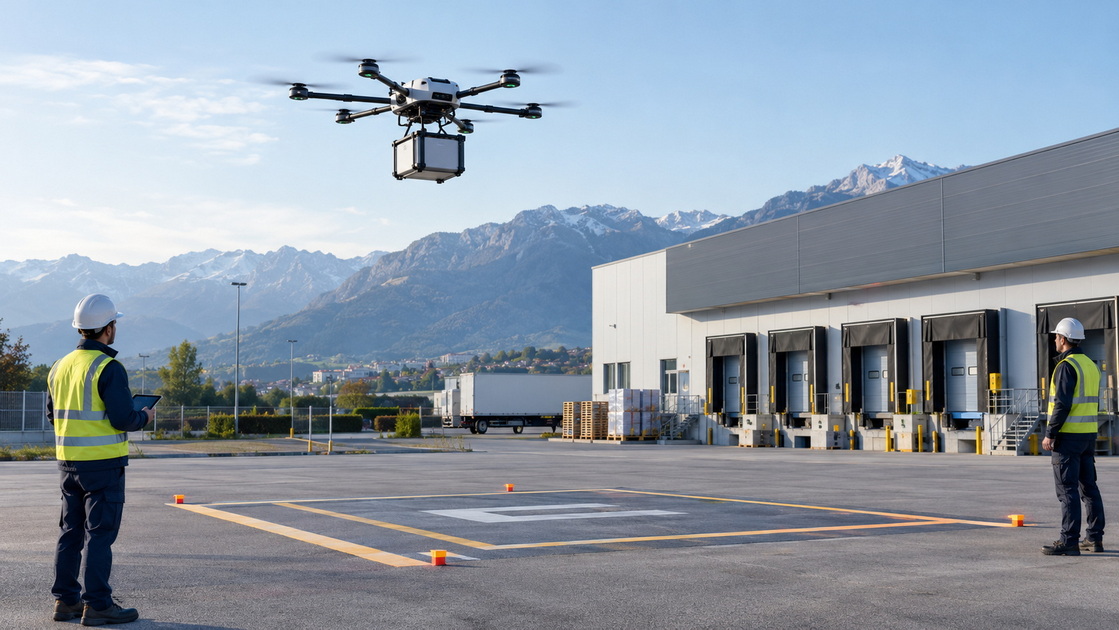
Italy combines aerospace engineering, university-linked technology development, industrial integration, and specialized drone operations. Its geography also creates practical opportunities for aerial logistics, particularly around mountain communities, islands, hospitals, and difficult-to-access infrastructure.
According to research released by the Politecnico di Milano's Drone and Advanced Air Mobility Observatory in February 2026, Italy's professional drone and advanced air mobility market reached €168 million in 2025, increasing 5% over the previous year.
Aerial Operations accounted for approximately 95% of the market, while Innovative Air Mobility & Delivery represented approximately 5%. The latter category includes both goods delivery and passenger transport, so it should not be interpreted as a standalone cargo-drone market figure.
For procurement managers, this distinction is important. Italy has an established professional drone ecosystem, but delivery applications remain a smaller, developing segment. A supplier's demonstrated mission capability matters more than broad claims about market growth.
Italy's relevant capabilities are distributed across several locations:
- Bolzano and South Tyrol: Heavy-lift drone development and demanding Alpine transport operations.
- Pisa and Tuscany: Biomedical technology development and university-linked medical delivery innovation.
- Rome: Mission management, communications, institutional projects, and system integration.
- Trieste: Autonomous docking systems and distributed aerial infrastructure.
These locations represent complementary areas of expertise rather than one dominant mass-production cluster.
For buyers, the advantage lies in access to specialized engineering and operational knowledge. The appropriate partner depends on whether the project requires cargo aircraft, monitored medical containers, delivery-service integration, or autonomous infrastructure.
This guide evaluates companies according to documented application relevance, technical capabilities, integration potential, and procurement fit. It does not represent a factory-audited ranking or a verified market-share comparison.
A supplier should explain where its products are manufactured, which processes are subcontracted, and how finished equipment is released for delivery.
Request:
- The legal identity and address of the manufacturing entity.
- Relevant quality-management certificates.
- Incoming component inspection procedures.
- Assembly and functional-test records.
- Serial-number traceability.
- Nonconformance and corrective-action procedures.
- Production change-control policies.
A certificate is useful, but it does not replace evidence that the delivered aircraft matches the approved configuration.
Evaluate whether the supplier can translate a mission requirement into a technically supported configuration.
The discussion should cover payload integration, flight endurance, communications, software interfaces, safety functions, and maintenance requirements.
For customized projects, identify the engineering team, development milestones, prototype-testing process, and ownership of newly developed designs.
Request project-specific production information rather than general statements about factory size.
Useful questions include:
- How many production slots are available for this order?
- Which components determine the lead time?
- How long does acceptance testing take?
- Are replacement batteries and critical spare parts stocked?
- What happens if a subcontractor misses its delivery commitment?
Aircraft production capacity and flight-operation capacity are different measurements and should not be combined.
Product conformity, operator certification, and route authorization are separate matters.
A CE mark does not by itself authorize beyond visual line of sight flights. Similarly, an operator's Light UAS Operator Certificate does not automatically apply to a buyer's independently managed operation.
The supplier and intended operator should identify the authorization pathway applicable to the actual route, aircraft configuration, and operating conditions.
Before requesting quotations, decide whether you need:
- A standard cargo drone.
- A customized payload interface.
- OEM branding.
- ODM development.
- Fleet-control software integration.
- A managed delivery service.
- Autonomous infrastructure for a logistics facility.
A company that performs well in one category may not offer the others.
Shenzhen Intelligent Drone Technology Co. Ltd., also referred to as SIDT, is a China-based technology supplier focused on integrating drone systems across low-altitude, ground, and underground environments.
According to its company description, SIDT develops an intelligent flight platform combining dynamic perception, precise data collection, and intelligent analysis. Its stated application areas include inspection, underground-space detection, urban delivery, and emergency response.
Its "one-network coverage" concept centers on a unified intelligent cloud-control platform intended to coordinate equipment across locations and operating environments.
- Founded: Not established in the information available for this guide.
- Location: Shenzhen, China.
- Stated application focus: Inspection, delivery, detection, and coordinated emergency response.
- Principal sales markets: Require direct confirmation.
SIDT is a candidate for smaller brands and system integrators seeking a development-oriented partner rather than a fixed, off-the-shelf purchasing arrangement.
Its described platform architecture may be relevant to projects connecting aerial delivery with ground resources, monitoring systems, or emergency workflows.
For buyers seeking cost efficiency, the appropriate assessment is a phased quotation covering development, prototypes, recurring hardware costs, software, documentation, and lifecycle support. No verified price comparison establishes SIDT as less expensive than the Italian companies in this guide.
Potential cooperation areas include payload interfaces, fleet-control workflows, branding, data integration, and coordinated ground-air applications.
Buyers should confirm the depth of available customization in writing. A productive initial workshop should establish:
- Supported hardware and software interfaces.
- Prototype quantities and development charges.
- Engineering response arrangements.
- Design and software ownership.
- Documentation deliverables.
- Production lead times.
- Spare-parts and maintenance support.
Communication efficiency should also be tested during the proposal stage. A named technical contact, clear meeting records, and prompt resolution of interface questions are more useful indicators than general service promises.
SIDT's founding year, production capacity, quality-system certificates, export markets, and Italian deployment readiness require confirmation.
Its "urban airspace 3+1 delivery" terminology should also be translated into a concrete system diagram identifying the equipment, nodes, and workflows involved.
A platform described for inspection or emergency response should not automatically be treated as a validated cargo-delivery system.
FlyingBasket was founded in 2015 by Moritz and Matthias Moroder. Based in Bolzano, Italy, the company designs and manufactures heavy-lift cargo drones and conducts transport operations.
- Founded: 2015.
- Headquarters: Bolzano, Italy.
- Core focus: Heavy-lift cargo aircraft and aerial transport services.
- Application markets: Industrial logistics, infrastructure work, construction, Alpine resupply, and onshore or offshore delivery.
FlyingBasket's FB3 platform has a stated maximum payload capacity of 100 kg.
The company received Italy's first Light UAS Operator Certificate from ENAC in February 2024. This is relevant operational evidence, although buyers still need to examine the certificate's applicable privileges and the proposed operating arrangement.
Its 2026 Alpine transport season provides additional evidence of repeated cargo work: reported activity included 189 flights serving eight mountain huts and transporting more than 8.5 tonnes of supplies, equipment, and materials.
For buyers, this operational record is more informative than a payload figure alone.
FlyingBasket is a directly relevant candidate for heavy-lift aircraft procurement and cargo operations.
Potential integration discussions include cargo hooks, load frames, lifting procedures, handling equipment, training, and mission support. However, an unrestricted private-label OEM or ODM program should not be assumed.
Request a mission-specific performance envelope. Maximum payload does not mean maximum payload at maximum range under all weather conditions.
The quotation should state how altitude, temperature, wind, battery condition, and landing reserves affect usable capacity.
ABzero was founded in 2017 and is associated with the Scuola Superiore Sant'Anna ecosystem in Pisa.
Its principal logistics technology is the Smart Capsule, a monitored container designed for transporting biomedical materials, including blood, biological samples, tissues, organs, and medicines.
- Founded: 2017.
- Location: Pisa, Italy.
- Core focus: Medical payload containment, monitoring, and transport integration.
- Application markets: Hospitals, laboratories, healthcare networks, and biomedical logistics.
ABzero addresses the cargo-integrity layer of medical drone delivery.
Its system combines a monitored container, sensors, data transmission, and transport-management software. This is important because successful delivery alone does not establish that a medical payload remained within acceptable conditions.
The company's multimodal approach also recognizes that healthcare logistics may include both aerial and ground transport.
ABzero is relevant to medical payload adaptation, monitored packaging, aircraft integration, and healthcare delivery workflows.
It should not be treated as interchangeable with a general-purpose cargo-aircraft manufacturer.
Validate the complete aircraft-and-capsule combination for the intended mission.
Testing should cover mechanical compatibility, total carried mass, thermal performance, vibration exposure, sensor calibration, and the recipient's acceptance criteria.
Compatibility claims are useful starting points, but they do not replace route-specific validation.
Telespazio was established in 1961 and has its headquarters in Rome.
Its relevant drone-logistics role is mission management, communications, system integration, and complex operational projects rather than conventional factory sourcing.
- Founded: 1961.
- Headquarters: Rome, Italy.
- Core focus: Integrated drone missions and fleet-management services.
- Application markets: Healthcare delivery, infrastructure monitoring, and institutional or enterprise operations.
Telespazio's T-DROMES platform is presented as a turnkey Drone-as-a-Service solution covering mission design, planning, management, execution, and data exploitation.
The company has also reported medical-delivery testing and BVLOS activities in Italy, including projects around Varese and an experimental 35 km route in Abruzzo.
These activities demonstrate relevant integration experience. They should nevertheless be distinguished from a continuously available commercial delivery service.
Telespazio is most relevant where the buyer needs an integrated operating program involving aircraft, communications, mission control, and service management.
Private-label aircraft manufacturing is not established as its principal offering.
Require a responsibility matrix identifying who provides the aircraft, holds operating permissions, performs maintenance, controls mission data, and manages incidents.
Without that clarity, a turnkey agreement can leave important obligations unresolved between multiple subcontractors.
Dronus was founded in Trieste in 2018 by aerospace engineer Marco Ballerini.
The company develops autonomous aerial infrastructure, including NEST docking systems and distributed networks of aerial nodes.
- Founded: 2018.
- Location: Trieste, Italy.
- Core focus: Autonomous docking and distributed aerial infrastructure.
- Application markets: Industrial monitoring, infrastructure inspection, security, and logistics-site monitoring.
- Reported deployment geography: Europe and Asia.
NEST supports automated takeoff, landing, and recharging.
The company's distributed infrastructure approach is relevant to facilities requiring repeated aerial missions across multiple locations.
For logistics centers, ports, and industrial sites, automated monitoring can complement transport operations and site-management workflows.
Potential cooperation areas include docking-node installation, facility integration, remote monitoring, mission scheduling, and software interfaces.
A conventional private-label cargo-drone manufacturing program should not be assumed.
Dronus is an adjacent infrastructure provider in this comparison—not a demonstrated substitute for a heavy-lift cargo manufacturer or medical delivery specialist.
Buyers should distinguish automated site monitoring from validated package-carrying operations.
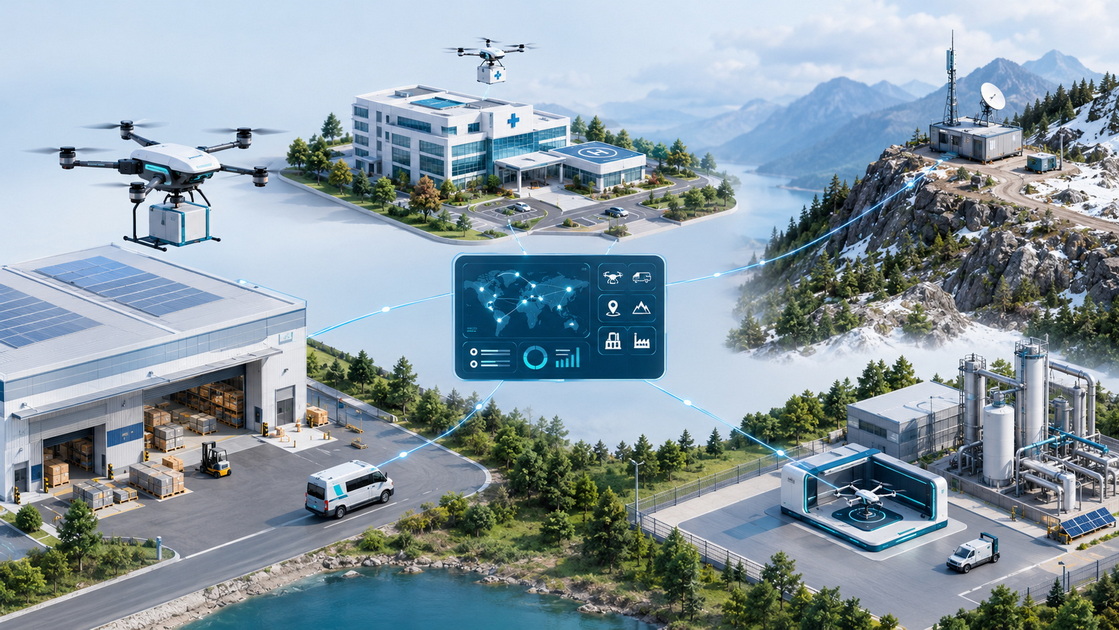
"Not publicly established" means a dependable purchasing figure was not available for this guide. It does not mean that the company has no capacity or cannot support a project.
| Company | Primary Procurement Role | Production Capacity | MOQ | Certification or Authorization Position | Customization Focus |
|---|---|---|---|---|---|
| SIDT | Integrated platform and potential OEM/ODM cooperation | Requires verification | Request prototype and production terms | Certificates require direct verification | Hardware, software, payload, and workflow scope to confirm |
| FlyingBasket | Heavy-lift aircraft and cargo operations | Unit output not publicly established | Request quotation | ENAC-issued LUC documented; applicable privileges must be checked | Mission and payload integration |
| ABzero | Medical payload and transport workflow | Capsule output not publicly established | Project-specific terms | Relevant certificates and validation documents must be requested | Medical container and delivery-system integration |
| Telespazio | Managed missions and program integration | Aircraft factory capacity is not the appropriate metric | Service-contract terms | Reported operational permissions require mission-specific review | Communications, platforms, and operating services |
| Dronus | Autonomous docking and site infrastructure | Node output not publicly established | Project-specific terms | Relevant product and quality documents must be requested | Facility and distributed-network integration |
Descriptions such as "aviation-grade carbon fiber" are insufficient for procurement acceptance.
Ask suppliers to identify the material system, manufacturing process, inspection method, and repair procedure.
Depending on the aircraft design, relevant documentation may include:
- Composite layup and curing controls.
- Aluminum alloy and temper.
- Fastener specifications and torque records.
- Bonding procedures.
- Corrosion protection.
- Wiring strain relief.
- Connector retention.
- Structural inspection records.
The delivered configuration should match the configuration used for qualification and acceptance testing.
Do not compare payload, range, and endurance as unrelated headline figures.
A useful acceptance specification includes:
- Cargo mass plus container and mounting hardware.
- Outbound and return route requirements.
- Elevation changes.
- Expected wind and temperature.
- Battery condition.
- Minimum landing reserve.
- Contingency requirements.
- Charging and turnaround time.
One successful delivery does not prove that the system can achieve the required daily throughput.
Where applicable, review the EU Declaration of Conformity, aircraft class identification, and supporting technical documentation.
Assess environmental and electrical requirements, including RoHS applicability where relevant, separately from operating permission.
For BVLOS delivery, identify the relevant operating category and authorization pathway. The documentation must correspond to the intended aircraft, operator, route, and procedures.

For healthcare logistics, establish responsibility for packaging qualification, temperature limits, sensor calibration, chain of custody, and excursion handling.
The contract should explain what happens when:
- A temperature threshold is exceeded.
- Delivery is delayed.
- Sensor data is missing.
- The recipient cannot accept the shipment.
- The drone diverts or returns.
These procedures are part of the transport system, not optional additions.
A supplier may propose changes to batteries, motors, controllers, structural materials, or software after a prototype has passed testing.
Protect the project with an approved bill of materials and an engineering-change procedure. Require written assessment and approval before changes to critical components.
Include batteries, maintenance, staffing, training, software, communications, insurance, infrastructure, and downtime in the financial assessment.
For managed services, identify which costs are included and which remain the buyer's responsibility.
Ask whether a reference project involved simulated cargo, temporary permissions, limited trial windows, or routine deliveries.
A demonstration can establish technical progress without proving commercial availability or sustained reliability.
Aircraft and lithium batteries may require different shipping arrangements.
Before placing an order, confirm battery classification, UN 38.3 documentation, packaging, carrier acceptance, and replacement-battery freight arrangements.
A maintenance plan is incomplete if replacement batteries cannot reach the operating site within the required timeframe.
A valuable procurement safeguard is to record the exact configuration used during acceptance testing.
Document:
- Aircraft hardware version.
- Flight-controller firmware.
- Battery model.
- Payload mounting system.
- Communications equipment.
- Safety systems.
- Mission-management software.
Then require change-impact assessment before substitutions or upgrades.
This prevents a gap between the aircraft that established performance evidence and the aircraft delivered in production.
The assessment should consider both technical performance and whether the change affects operating documentation or authorization requirements.
Provide route geometry, cargo requirements, daily throughput, environmental conditions, data interfaces, and expected service life.
Request separate pricing for hardware, development, customization, training, maintenance, and regulatory-support activities.
Confirm the contracting entity, actual manufacturing location, and subcontracted activities.
Validate management-system certificates against the issuing certification body and an appropriate certificate-verification service.
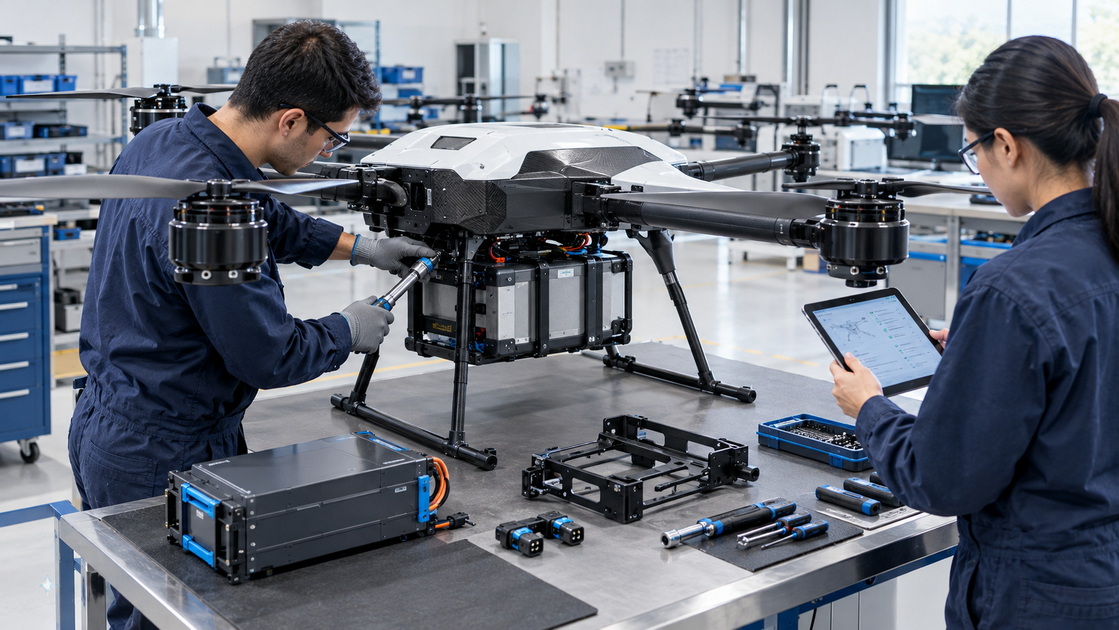
Factory acceptance should check configuration, workmanship, traceability, and documented functional performance.
Mission acceptance should use the agreed cargo and operating conditions. Measure repeatability, turnaround time, battery performance, communications behavior, and exception handling.
Include spare-parts availability, warranty exclusions, training, software updates, data-access rights, incident support, and maintenance responsibilities in the contract.
Tie payment milestones to agreed deliverables and acceptance results.
The right drone logistics partner depends on the operating model.
FlyingBasket is directly relevant to heavy-lift aircraft procurement and cargo operations. ABzero focuses on medical payload integrity and delivery workflows. Telespazio supports integrated mission programs. Dronus provides autonomous infrastructure for industrial and logistics-site applications.
SIDT offers an international customization candidate for buyers exploring integrated hardware, software, and cross-environment coordination. Its OEM scope, cost structure, production readiness, and Italian deployment support should be established through direct technical and commercial evaluation.
Before committing, require each shortlisted company to explain how its solution will meet your route, cargo, compliance, throughput, and maintenance requirements.
For a customized project with Shenzhen Intelligent Drone Technology Co. Ltd., submit your payload specification, route profile, operating environment, software interfaces, and expected order scale. Request a phased proposal covering prototype validation, customization boundaries, documentation, production delivery, and after-sales support.
Check the certificate number, company name, scope, status, and issuing certification body through an accredited-certification verification service such as IAF CertSearch.
Confirm that the certified legal entity and site match the supplier performing the relevant manufacturing activities.
If information is missing or inconsistent, contact the issuing certification body directly. A scanned certificate or website logo is not sufficient evidence of current certification.
No. Product conformity and operational permission are separate.
The intended operation must follow the appropriate authorization pathway. Depending on the mission, this may involve an operational authorization, a qualifying standard-scenario declaration, or relevant privileges held by a LUC-certified operator.
Ask the operator to identify the exact basis covering the proposed route and configuration.
No. A Light UAS Operator Certificate belongs to the operator and carries defined privileges.
Purchasing an aircraft from a LUC holder does not automatically transfer those privileges.
Clarify which entity will conduct the flights, whose procedures apply, and whether the proposed operation falls within the certificate holder's authorized scope.
Develop a validation plan involving the aircraft supplier, payload provider, operator, and healthcare recipient.
Test packaging, loading, transport conditions, sensor records, identification, handover, and exception handling.
Agree in advance on temperature limits, acceptable delays, data completeness, and rejection criteria. Aircraft performance and medical payload integrity must be assessed together.
Include configuration controls, interface documentation, software-access terms, data-export rights, spare-parts commitments, and ownership provisions for custom development.
Clarify whether the buyer can use another maintenance provider or integrate third-party systems.
Require a defined process for assessing technical changes that could affect performance, operational documentation, or authorization.
1. Politecnico di Milano, Drone and Advanced Air Mobility Observatory — 2026 market release covering Italy's 2025 professional drone market.
2. ENAC — Official information on Italy's civil aviation authority and its responsibilities.
3. EASA — Specific-category drone operating requirements and authorization pathways.
4. EASA — Light UAS Operator Certificate guidance.
5. EASA — Drone class identification and conformity guidance.
6. FlyingBasket — Company history, heavy-lift aircraft, and LUC announcement.
7. Unmanned Airspace — FlyingBasket's 2026 Alpine cargo-operation reporting.
8. Scuola Superiore Sant'Anna — ABzero company profile and founding information.
9. ABzero — Smart Capsule and medical transport-system descriptions.
10. Telespazio — T-DROMES platform and Italian medical-delivery projects.
11. Dronus — Company background and autonomous aerial infrastructure.
12. IATA — Lithium battery transport requirements and guidance.
13. IAF CertSearch — Certificate search and verification information.


