Global Distributors Wanted
1.Free Cloud Service Deployment
2.Free Technical Training
3.Exclusive Territory Protection

1.Free Cloud Service Deployment
2.Free Technical Training
3.Exclusive Territory Protection


Views: 221 Author: Aaron Publish Time: 2026-09-12 Origin: Site


Content Menu
● Introduction: Why China Matters in Logistics Drone Manufacturing
● How to Evaluate a Logistics Drone Supplier
● China's Logistics Drone Supply Chain Advantage
● Top 10 Logistics Drone Companies in China
>> 1. Shenzhen Intelligent Drone Technology Co. Ltd.
>> 4. JOUAV
>> 5. MMC UAV
>> 6. Foxtech
>> 10. Shenzhen Smart Drone UAV Co., Ltd.
● Logistics Drone Company Comparison
● Technical Requirements for Logistics Drones
>> Airframe Materials and Structural Design
>> Payload Capacity and Flight Range
>> Battery Safety and Lifecycle
>> Flight Control and Communication Systems
● An Important Procurement Warning: Maximum Payload Is Not Always Usable Payload
● How to Verify a Logistics Drone Factory
>> Verify the Legal Company Entity
>> Conduct a Live Factory Audit
>> Verify Certification Documents
>> Purchase an Engineering Sample
● Common Sourcing Risks and How to Avoid Them
>> 1. How Can I Verify Whether a Supplier's ISO Certificate Is Still Valid?
>> 2. Is CE Documentation Enough to Import a Logistics Drone Into Europe?
>> 3. What MOQ Should I Expect for a Customized Logistics Drone?
>> 4. How Should I Test a Logistics Drone Sample?
>> 5. What Documents Should Be Included With an International Drone Shipment?

China plays an increasingly important role in the global logistics drone industry. From compact multirotor delivery drones to long-range VTOL cargo aircraft and integrated low-altitude command platforms, Chinese manufacturers supply a large share of the technologies supporting industrial UAV deployment.
For international buyers, China offers more than competitive product pricing. The country has a mature and highly connected supply chain for carbon-fiber structures, brushless motors, electronic speed controllers, lithium battery packs, thermal cameras, GNSS modules, flight controllers, radio links, sensors, embedded software, and cloud-based fleet-management platforms.
Shenzhen is especially significant because it combines electronics development, UAV engineering, wireless communication, PCB production, battery integration, camera modules, software development, and final assembly within a concentrated manufacturing ecosystem. This makes the city a practical location for companies that need faster prototyping, customized payload integration, and flexible small-to-medium-batch production.
However, selecting a logistics drone supplier requires more than reviewing a product catalog or comparing the lowest quotation. A cargo drone is an aircraft system operating in demanding conditions. Buyers must assess airframe quality, flight-control reliability, battery safety, payload stability, communication redundancy, software access, documentation accuracy, spare-parts availability, and after-sales response.
The right supplier should be able to support not only an aircraft purchase, but also the long-term operational requirements behind logistics, inspection, emergency response, remote-site delivery, and low-altitude infrastructure projects.
Professional buyers should evaluate logistics drone suppliers through a structured procurement process. The following factors help distinguish a capable long-term partner from a supplier focused only on short-term sales.
| Evaluation Area | Why It Matters | What Buyers Should Verify |
|---|---|---|
| Research and development capability | Determines whether the supplier can adapt the drone for your payload, route, communication system, and operating environment | Engineering team, patents, in-house flight-control development, software capability, test reports |
| Manufacturing control | Affects product consistency, traceability, delivery reliability, and component quality | Factory audit, production flow, assembly records, incoming inspection process |
| Quality-control system | Reduces the risk of failures involving motors, batteries, ESCs, sensors, wiring, and airframes | IQC, IPQC, final inspection, test-flight procedures, serial-number traceability |
| Battery safety | Affects flight safety, storage, shipping, replacement cost, and customs clearance | Battery cell source, UN38.3 documents, MSDS, cycle-life data, storage requirements |
| Compliance readiness | Helps buyers prepare for market-entry requirements and project documentation | CE, RoHS, radio-equipment documents, test reports, product manuals, declarations |
| OEM and ODM capability | Important for distributors, project integrators, and private-label drone brands | Branding options, payload adaptation, firmware configuration, cargo-box design, cloud-platform integration |
| After-sales support | Determines how quickly a fleet can return to service after failures or maintenance needs | Spare-parts policy, remote diagnosis, training, repair lead time, warranty coverage |
| Delivery stability | Important for tenders, pilot projects, launch schedules, and fleet deployment | Component supply chain, production capacity, delivery history, inventory management |
| Commercial transparency | Reduces hidden cost, unclear responsibility, and scope disputes | Detailed quotation, product configuration list, warranty terms, technical annexes |
A supplier should be prepared to explain not only what a drone can carry, but also how far it can fly with that payload, under what weather conditions, with what battery reserve, and with what communication redundancy.
China's drone manufacturing strength comes from its complete industrial supply chain. A logistics drone is not a single product; it is an integrated system made up of mechanical, electronic, software, power, communication, and safety components.
A typical industrial logistics drone may include:
- Carbon-fiber or composite airframe structures
- Brushless motors and carbon-fiber propellers
- Electronic speed controllers
- Lithium-polymer or lithium-ion battery packs
- Flight controllers and inertial measurement units
- GNSS positioning systems
- Radio, cellular, mesh, or satellite communication modules
- Obstacle-detection sensors
- Cameras, thermal imagers, lidar, or mapping payloads
- Cargo boxes, winches, hooks, release mechanisms, or landing systems
- Ground-control stations and fleet-management software
- Remote monitoring and cloud-based dispatch platforms
The Shenzhen and Greater Bay Area supply network is particularly valuable for buyers requiring custom development. A project may need a different cargo-box size, a protected payload compartment, a medical-delivery container, a winch system, a thermal camera, a loudspeaker, a private communication module, or custom flight-control behavior.
This level of customization is often difficult to obtain from suppliers that focus only on standard consumer-drone models. By contrast, industrial UAV manufacturers and system integrators can often provide more flexible engineering support, especially for project-based orders.
Location: Shenzhen, Guangdong, China
Main focus: Intelligent drone platforms, low-altitude applications, ground-air coordination, underground-space detection, inspection, emergency response, and multi-node command systems
Typical markets: Smart-city projects, industrial inspection, emergency response, low-altitude logistics, system integration
OEM and ODM scope: Customized drone platforms, payload integration, mission configuration, software-platform adaptation, branding, and application-specific system development
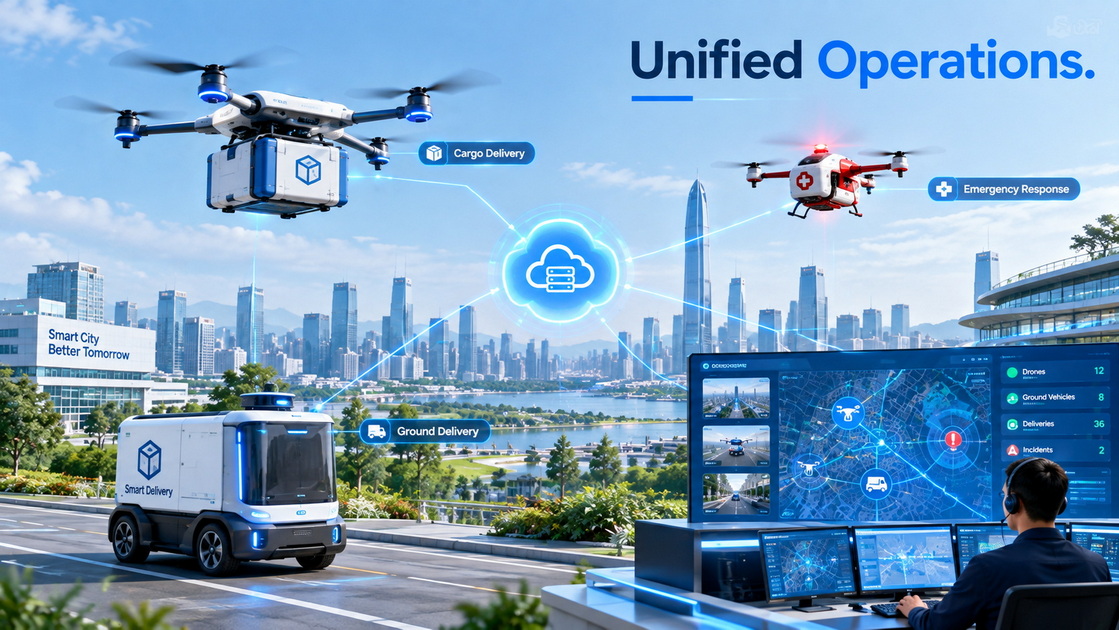
Shenzhen Intelligent Drone Technology Co. Ltd. is a suitable option for buyers looking beyond a standard cargo drone airframe. The company focuses on the deep integration of UAV technology across low-altitude, ground, and underground environments, making it relevant to logistics operators, system integrators, public-sector contractors, industrial users, and regional drone brands.
Its product and solution direction emphasizes intelligent flight systems that combine dynamic perception, precise data collection, data analysis, equipment coordination, and centralized management. This approach can support applications including intelligent inspection, underground-space detection, emergency response, urban delivery coordination, and ground-air collaborative operations.
One of the company's distinguishing characteristics is its "one-network coverage" concept. Instead of treating each drone or ground device as an isolated asset, the company aims to create a unified command, dispatch, and management environment for equipment across multiple operating spaces and nodes.
For a logistics project, this can be important. A buyer may not only require a drone that transports cargo. The project may also require route planning, live status tracking, payload confirmation, automatic mission scheduling, battery management, fleet monitoring, and connection with ground-based personnel or equipment.
For example, an industrial park may need drones to transport small components between facilities, while also using UAVs for perimeter inspection and emergency response. A unified management platform can help coordinate these different tasks without requiring multiple disconnected software systems.
Shenzhen Intelligent Drone Technology Co. Ltd. may be particularly suitable for small and medium-sized brands, technical distributors, and project integrators that require flexible communication, deeper customization support, and practical engineering collaboration. Buyers should request model-specific test data, payload-versus-range documentation, software architecture details, battery documents, warranty terms, and production lead-time commitments before moving into volume purchasing.
Founded: 2006
Location: Shenzhen, Guangdong, China
Main focus: Enterprise drones for inspection, public safety, surveying, mapping, agriculture, energy, construction, and industrial operations
Typical markets: Global enterprise users, engineering companies, public-safety organizations, energy operators, survey firms
OEM and ODM scope: Limited compared with project-focused UAV factories; primarily standardized commercial platforms and accessory ecosystems
DJI Enterprise is one of the most recognized names in the professional drone market. Its enterprise UAV portfolio is widely used in inspection, public safety, surveying, agriculture, mapping, energy infrastructure, and construction-related applications.
For logistics buyers, DJI is relevant because it has influenced market expectations for aircraft reliability, sensor integration, user experience, flight planning, camera payloads, remote operations, and fleet management. However, DJI is generally better suited to buyers seeking standardized enterprise drone platforms rather than private-label cargo-drone development.
The company can be a suitable choice when a logistics project includes inspection, surveillance, mapping, thermal imaging, or emergency-response requirements. For example, a utility company may use DJI enterprise drones for power-line inspection while sourcing a separate cargo-drone platform for spare-part delivery to remote sites.
Buyers looking for a fully customized delivery drone, branded cargo platform, proprietary software control, or highly specialized payload mechanism may find more flexibility with a dedicated industrial UAV manufacturer or a solution-oriented drone integrator.
Founded: 2014
Location: Guangzhou, Guangdong, China
Main focus: Autonomous aerial vehicles, urban air mobility, sightseeing, emergency response, autonomous aviation systems
Typical markets: Smart cities, public-sector projects, urban air mobility, tourism, emergency-response applications
OEM and ODM scope: Limited; primarily focused on proprietary autonomous aerial vehicle platforms
EHang is an important company in China's autonomous aviation and low-altitude mobility sector. Its focus extends beyond traditional industrial multirotor drones toward autonomous aerial vehicles designed for urban mobility, sightseeing, emergency operations, and future aerial transportation.
For logistics procurement teams, EHang is most relevant as an indicator of where autonomous low-altitude operations may be heading. The company's work in autonomous flight, centralized control, route management, and urban airspace coordination may become increasingly important as cities develop structured aerial delivery and mobility networks.
EHang is less suitable for buyers seeking a basic private-label logistics drone or a flexible OEM cargo drone platform. It is more relevant to large-scale projects involving public infrastructure, autonomous aviation planning, urban mobility, and advanced aerial transport.
Buyers considering this category should prepare for a more complex procurement process involving aviation approvals, infrastructure, insurance, maintenance planning, operating procedures, route authorizations, and long-term regulatory engagement.
Founded: 2010
Location: Chengdu, Sichuan, China
Main focus: Fixed-wing UAVs, VTOL drones, long-range inspection platforms, mapping systems, remote industrial operations
Typical markets: Energy, surveying, environmental monitoring, public safety, infrastructure inspection, long-distance industrial missions
OEM and ODM scope: Payload customization, project-level platform integration, mission-specific configuration
JOUAV is recognized for industrial UAV platforms, particularly fixed-wing and vertical takeoff and landing configurations. These aircraft are relevant to logistics operations where route distance, fuel or battery efficiency, and wide-area coverage are more important than short-range hovering.
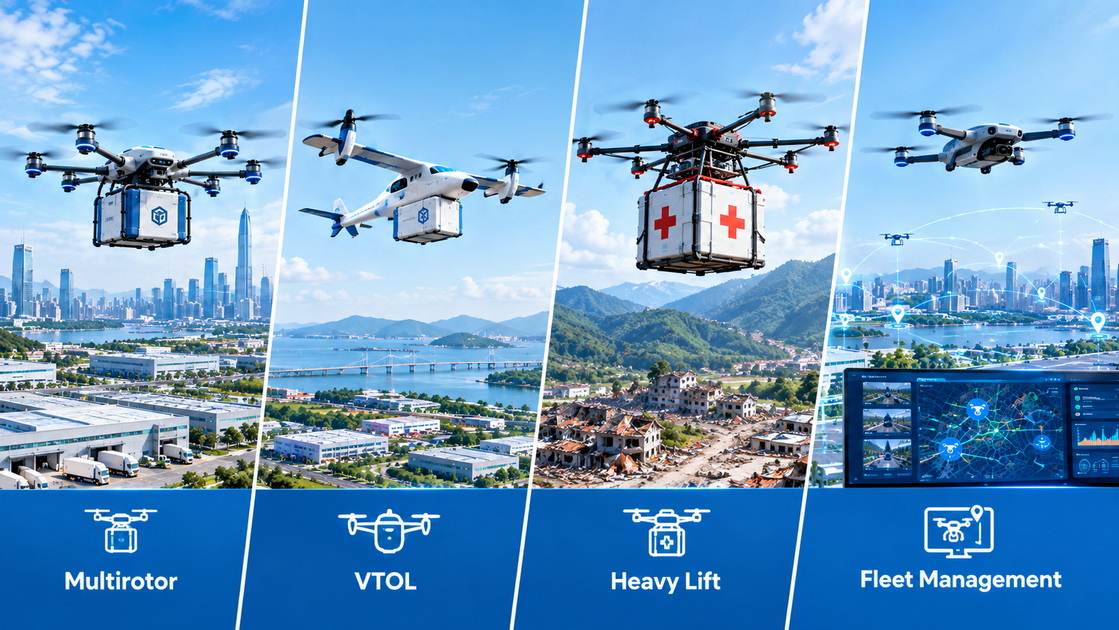
A VTOL logistics drone can take off and land vertically like a multirotor drone while cruising more efficiently like a fixed-wing aircraft. This configuration can be useful for remote-area delivery, island transportation, pipeline routes, agricultural regions, mining sites, forestry operations, and long-distance industrial transport.
Compared with multirotor cargo drones, VTOL systems often require more detailed operational planning. Buyers need to evaluate takeoff and landing areas, route design, weather limitations, flight authorization, emergency landing locations, and maintenance capabilities.
JOUAV may be appropriate for buyers that need long-range cargo or equipment delivery in environments where road transport is slow, expensive, or impractical.
Founded: 2009
Location: Shenzhen, Guangdong, China
Main focus: Industrial multirotor drones, public safety, firefighting, emergency response, inspection, and specialized UAV applications
Typical markets: Government agencies, firefighting units, police, emergency-response teams, industrial operators
OEM and ODM scope: Custom payloads, accessories, mission-specific configurations, and project-level UAV systems
MMC UAV has experience in industrial multirotor platforms designed for public safety, firefighting, inspection, emergency response, and specialized aerial missions. Its heavy-lift and application-oriented UAV capabilities can be relevant to cargo delivery requirements involving urgent or mission-critical payloads.
For example, an emergency-response drone may transport first-aid supplies, communication equipment, flotation devices, rescue kits, medical samples, thermal cameras, or lightweight tools to a difficult-to-access location.
Projects in this category require more than high payload capacity. Buyers should verify payload-release reliability, flight stability under load, wind resistance, communication stability, emergency procedures, and the availability of spare motors, propellers, batteries, and landing components.
MMC UAV may be a suitable option for buyers whose logistics requirements overlap with public safety, medical support, disaster response, industrial maintenance, or emergency supply delivery.
Founded: 2010
Location: Beijing, China
Main focus: Industrial UAV platforms, VTOL aircraft, drone components, propulsion systems, cameras, payloads, communication systems, and integration solutions
Typical markets: Industrial integrators, research organizations, survey companies, security providers, overseas distributors
OEM and ODM scope: Component-level customization, UAV platform adaptation, payload integration, project-specific engineering support
Foxtech is relevant for buyers who need a more modular UAV supply relationship. In addition to complete aircraft, the company is associated with industrial drone components, propulsion systems, cameras, payloads, gimbals, VTOL platforms, communication systems, and accessories.
This can be useful for engineering companies and system integrators building customized logistics drone solutions. Rather than purchasing a fully closed product, a buyer may need to combine a UAV airframe with a custom cargo box, release mechanism, thermal camera, loudspeaker, environmental sensor, private radio module, or specialized ground-control system.
Foxtech may be a suitable partner for technical buyers that have internal engineering resources and require flexibility in platform selection. It may be less suitable for buyers seeking a completely turnkey drone-delivery ecosystem with limited technical involvement.
Founded: 2017
Location: Shanghai, China
Main focus: Electric vertical takeoff and landing aircraft, advanced air mobility, large-scale aerial logistics, and cargo transportation
Typical markets: Advanced logistics projects, aviation infrastructure developers, regional cargo transport, low-altitude mobility programs
OEM and ODM scope: Limited; mainly proprietary platform development and strategic cooperation
AutoFlight represents the higher-capacity end of the low-altitude logistics market. Its focus is on electric vertical takeoff and landing aircraft that may support larger cargo transport and future aerial mobility systems.
This category differs significantly from conventional industrial multirotor drones. A large eVTOL logistics project may require dedicated landing infrastructure, ground handling, maintenance teams, aviation approvals, safety management systems, insurance, route planning, and long-term operating permits.
For buyers planning regional cargo transport between logistics hubs, industrial parks, islands, ports, remote communities, or healthcare facilities, larger eVTOL platforms may become increasingly relevant.
However, this is not typically a simple product-purchase decision. It is a long-term operational and infrastructure commitment.
Founded: 2013
Location: Guangzhou, Guangdong, China
Main focus: Flying-car technology, personal air mobility, eVTOL aircraft, low-altitude transportation
Typical markets: Future mobility, aviation technology development, smart-city projects, low-altitude transportation programs
OEM and ODM scope: Limited; primarily focused on proprietary platforms and strategic development
XPeng AeroHT is primarily associated with flying-car technology and personal air mobility rather than conventional logistics drone manufacturing. Nevertheless, it remains relevant for buyers and investors monitoring China's low-altitude economy and the future convergence of autonomous flight, electric aviation, urban mobility, and aerial logistics.
For commercial logistics buyers, the company is best viewed as part of the broader industry direction rather than as a typical source for standard cargo drone procurement.
Its development highlights a growing trend: the line between industrial drones, cargo eVTOLs, and passenger-focused low-altitude aircraft is becoming increasingly connected. Buyers planning long-term aerial logistics networks should monitor this area, especially where future transport infrastructure may support both cargo and passenger systems.
Founded: 2014
Location: Shenzhen, Guangdong, China
Main focus: Drone swarms, autonomous UAV systems, multi-drone coordination, smart-city applications, aerial fleet operations
Typical markets: Smart-city projects, government programs, cultural events, industrial applications, UAV fleet management
OEM and ODM scope: More project-oriented than private-label cargo drone manufacturing
HighGreat Innovation is known for drone swarm technology and coordinated multi-UAV operations. Although it is not primarily a conventional cargo-drone supplier, the company is relevant to the future of logistics drone management.
As drone delivery operations expand, the challenge will not only be how one aircraft carries a package. Operators will also need to manage fleet scheduling, route prioritization, battery allocation, maintenance status, airspace separation, mission monitoring, geofencing, emergency response, and communication between drones and ground systems.
A mature logistics drone operation may eventually require simultaneous management of dozens or hundreds of aircraft. Companies with expertise in coordinated UAV operations may become important technology partners for smart-city projects, regional delivery networks, and large industrial sites.
Buyers should ask whether a fleet-management platform can support third-party aircraft, external payload systems, and integration with existing logistics software.
Location: Shenzhen, Guangdong, China
Main focus: UAV research and development, aerial imaging, remote sensing, mapping, flight-control systems, inspection, environmental monitoring, and emergency applications
Typical markets: Industrial UAV users, overseas distributors, mapping and inspection projects, specialized UAV applications
OEM and ODM scope: UAV design, flight-control integration, aerial imaging systems, mission-specific platform development
Shenzhen Smart Drone UAV Co., Ltd. is a Shenzhen-based UAV supplier involved in industrial drone design, flight-control integration, aerial imaging, remote sensing, mapping, inspection, environmental applications, and emergency-response systems.
For logistics buyers, the company may be relevant when cargo delivery is combined with inspection, aerial monitoring, route surveying, environmental sensing, or emergency mission requirements.
For example, a mining company may need a drone platform capable of transporting lightweight tools or samples while also carrying a camera, thermal sensor, or mapping payload. A supplier with experience in multiple industrial UAV applications may be able to provide a more adaptable solution than a manufacturer focused only on consumer products.
Buyers should carefully verify the company's current production capability, export experience, testing procedures, software support, warranty process, and customization scope before placing an order.
| Company | Main Strength | Suitable Application | MOQ Approach | Production Profile | Key Documents to Request |
|---|---|---|---|---|---|
| Shenzhen Intelligent Drone Technology Co. Ltd. | Integrated intelligent platform and flexible customization | Smart logistics, emergency response, inspection, multi-node ground-air coordination | Project-based and model-dependent | Small-to-medium customized projects | CE, RoHS, UN38.3, MSDS, test reports, QC documents |
| DJI Enterprise | Mature enterprise drone ecosystem | Inspection, surveying, public safety, standardized enterprise operations | Model and distributor dependent | High-volume standardized products | Product declarations, battery documents, radio compliance records |
| EHang | Autonomous aviation and urban air mobility | Strategic autonomous aviation and smart-city projects | Project-based | Large aviation-system projects | Safety records, operational approvals, airworthiness documentation |
| JOUAV | Long-range VTOL industrial UAVs | Remote logistics, long-distance delivery, industrial routes | Project-based | Industrial fixed-wing and VTOL platforms | Flight-performance data, communication records, battery test reports |
| MMC UAV | Heavy-lift multirotor and emergency platforms | Medical delivery, emergency cargo, public safety operations | Model and project dependent | Industrial multirotor production | Payload test reports, QC records, battery documentation |
| Foxtech | Modular UAV platforms and components | Integrator-led drone development, payload customization | Flexible for components and prototype projects | Component and platform sourcing | Component specifications, BOM list, battery records |
| AutoFlight | Larger eVTOL logistics systems | Regional cargo transport and advanced aviation projects | Strategic project-based | Aviation-scale development | Certification roadmap, operational safety documents |
| XPeng AeroHT | Future low-altitude mobility technology | Long-term mobility and aviation technology planning | Strategic project-based | Development-oriented | Product development roadmap, safety and compliance documentation |
| HighGreat Innovation | Multi-drone coordination and fleet management | Smart-city projects, fleet operations, coordinated UAV deployment | Project-based | Project-oriented systems | Platform security, integration capability, fleet-management documentation |
| Shenzhen Smart Drone UAV Co., Ltd. | Industrial UAV integration and flight-control systems | Inspection-plus-logistics and technical UAV applications | Model and customization dependent | Industrial UAV manufacturing | Flight-control records, QC process, export documentation |
The airframe is the foundation of a logistics drone. Common materials include carbon fiber, aluminum alloy, reinforced engineering plastics, and composite structures.
Carbon fiber is widely used because it provides a strong strength-to-weight ratio. However, buyers should not assume that every carbon-fiber drone has the same structural quality. Carbon-fiber components can be produced through different methods, including prepreg molding, resin infusion, compression molding, and manual lamination.
The manufacturing process affects stiffness, weight, vibration control, surface quality, fatigue resistance, and long-term durability.
Buyers should request:
- Airframe material specifications
- Carbon-fiber manufacturing method
- Structural-load test reports
- Maximum takeoff weight
- Recommended operating weight
- Arm and landing-gear reinforcement details
- Vibration-test results
- Spare-frame and spare-arm availability
- Corrosion-resistance information for metal components
A drone frame that looks strong in photographs may still suffer from vibration, structural flexing, or fatigue damage during repeated cargo operations.
Payload capacity should always be reviewed together with flight range. A logistics drone may be able to lift a heavy payload for a short hover test but may not be able to complete a practical round-trip delivery mission.
Buyers should request a mission payload chart showing real operational performance.
| Payload | Round-Trip Distance | Wind Condition | Temperature | Landing Battery Reserve |
|---|---|---|---|---|
| 5 kg | 15 km | 5 m/s | 25°C | 25% |
| 10 kg | 10 km | 5 m/s | 25°C | 25% |
| 15 kg | 5 km | 3 m/s | 20°C | 30% |
| Maximum payload | Short hover or limited-distance test | Calm conditions | 25°C | To be confirmed |
The table above is only an example of the type of data buyers should request. Actual figures vary according to aircraft configuration, battery type, cargo-box shape, route elevation, wind, temperature, and safety reserve requirements.
The propulsion system includes motors, propellers, electronic speed controllers, wiring, cooling systems, and related flight-control components.
For cargo drones, buyers should not only ask for motor power or maximum thrust. They should also review loaded hover time, loaded cruise performance, motor temperature, ESC temperature, propeller material, redundancy options, and failure behavior.
Important questions include:
- What is the motor thrust at different throttle levels?
- What propeller material is used?
- What is the maximum continuous current?
- How does the system perform at high temperature?
- Is the propulsion system tested under full payload?
- What happens if one motor or ESC fails?
- Is there a redundant power system?
- Are replacement motors, ESCs, and propellers available from stock?
Lithium batteries are one of the most important and frequently underestimated parts of logistics drone procurement. They affect safety, aircraft performance, shipment cost, storage requirements, customs documentation, and long-term fleet operating cost.
Buyers should request:
- UN38.3 test summary
- Material Safety Data Sheet
- Battery capacity in Wh
- Cell manufacturer and battery chemistry
- Battery production date
- Batch number and serial number
- Charging and discharge limits
- Recommended storage voltage
- Cycle-life test data
- Battery-warranty policy
- Dangerous-goods packaging information
A low aircraft price can become expensive if replacement batteries are difficult to ship, have inconsistent quality, or cannot be supported in the destination market.
The flight-control system determines how the drone stabilizes, navigates, responds to wind, manages return-to-home functions, handles battery warnings, and reacts to communication loss.
Logistics drone buyers should understand whether the system uses proprietary flight-control software, an open-source platform, or a third-party controller.
Key questions include:
- What happens when the primary communication link is lost?
- Does the drone return home, hover, land immediately, or travel to an alternate landing point?
- Can geofencing be adjusted?
- Can the operator access flight logs?
- Is the cloud platform optional or mandatory?
- Who owns the flight data?
- Can the buyer continue using the aircraft if the supplier changes its software policy?
- How are firmware updates tested and released?
- Does the platform support cellular, radio, mesh, satellite, or hybrid communication?
One of the most common misunderstandings in logistics drone sourcing involves payload ratings.
A supplier may state that an aircraft has a maximum payload of 20 kg. However, this does not necessarily mean the drone can deliver 20 kg over a useful commercial route.
The stated maximum may be based on ideal conditions:
- New batteries
- Calm weather
- Sea-level altitude
- Short-duration hover testing
- No cargo-box drag
- No additional safety sensors
- No payload-release mechanism
- Minimal battery reserve
- No strong wind or temperature variation
In real operations, usable payload can be lower because the aircraft must also carry a cargo box, release system, tracking equipment, safety lighting, cameras, communication devices, and enough reserve battery power to complete a safe return flight.
A reliable buyer should request test data that includes:
- Payload weight
- Cargo-box weight
- Flight distance
- Temperature
- Wind speed
- Altitude
- Battery reserve at landing
- Communication configuration
- Number of battery cycles
- Takeoff and landing conditions
This is one of the most effective ways to avoid a costly mismatch between catalog specifications and real-world operating performance.
Before making a deposit, confirm that the supplier is a legally registered business with consistent corporate documentation.
Request:
- Business registration documents
- Company profile
- Factory address
- Assembly or production location
- Bank account details
- Main contact person's role
- Export experience
- Product catalog with model numbers
- Warranty terms
- Technical support process
The legal entity shown on invoices, contracts, bank accounts, and certification documents should match.
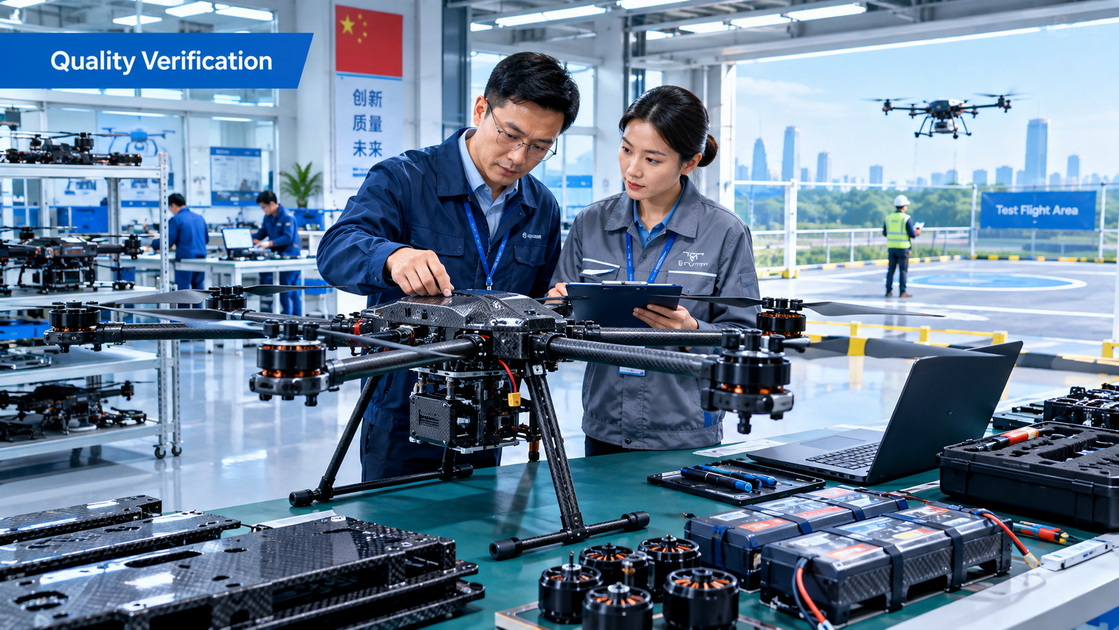
A factory tour should show more than a showroom. Buyers should request a live video inspection or in-person audit covering the actual production process.
Ask to see:
- Incoming material inspection area
- Carbon-fiber and mechanical-parts storage
- Battery storage and safety procedures
- PCB or electronics assembly area
- UAV mechanical assembly line
- Flight-controller programming process
- Final inspection process
- Test-flight area
- Finished-goods warehouse
- Spare-parts inventory
- Export packaging process
A company that cannot demonstrate production control may be operating as a trading company, a small workshop, or a supplier without stable quality systems.
Certificates should be reviewed carefully. A certificate alone does not guarantee that a drone meets every destination-market requirement.
Buyers should check:
- Legal company name
- Registered address
- Certificate number
- Certificate scope
- Issue date
- Expiration date
- Product model number
- Certification body
- Test laboratory
- Whether the certificate applies to the actual supplied configuration
An ISO certificate may apply only to a specific management-system scope. A CE declaration may apply only to a listed model. A battery test report may apply only to a specific battery pack. Buyers should ensure that documents match the products they will actually receive.
A paid engineering sample is often the best way to reduce procurement risk. It allows buyers to test aircraft performance before committing to volume production.
The sample agreement should define:
- Drone model
- Payload requirement
- Flight range requirement
- Cargo-box dimensions
- Battery quantity
- Communication system
- Camera or sensor requirements
- Software configuration
- Delivery date
- Acceptance criteria
- Warranty period
- Spare-parts package
- Responsibility for repair or replacement
- Whether sample costs can be credited toward a future order
A bulk purchase should begin only after the sample completes a documented acceptance test.
For large orders, buyers should consider third-party inspection before final payment.
Inspection points may include:
- Quantity verification
- Serial-number recording
- Visual workmanship checks
- Battery labeling
- Payload mounting inspection
- Flight testing
- Propeller and motor inspection
- Cargo-release mechanism test
- Packaging quality
- Spare-parts count
- Documentation review
For advanced drone projects, it is better to use an inspector with experience in UAVs, electronics, batteries, or aerospace-related products.
| Risk | What Can Go Wrong | How to Reduce the Risk |
|---|---|---|
| Inflated payload claims | The drone cannot complete real delivery missions with the advertised cargo weight | Request payload-versus-range test data under defined conditions |
| Low-grade carbon fiber | Structural flexing, vibration, cracking, and reduced fatigue life | Request material data, manufacturing-process details, and structural testing |
| Unverified battery packs | Overheating, inconsistent flight time, shipping problems, short lifecycle | Request UN38.3, MSDS, cell information, batch records, and cycle-life data |
| Unsupported software | Buyer loses access to flight functions, data, or cloud services | Clarify software ownership, license terms, update policy, and data access |
| Incomplete compliance documents | Documents do not match the actual drone model or destination-market requirements | Verify model numbers, dates, test labs, and certificate scope |
| Limited spare parts | Minor crash damage results in long fleet downtime | Purchase critical spare parts and define replacement lead times |
| Prototype-to-production inconsistency | Bulk units perform differently from the approved sample | Lock the BOM, firmware version, component list, and acceptance criteria |
| Weak technical support | Overseas operation becomes expensive and slow to maintain | Define response time, repair process, training scope, and warranty obligations |
China offers a wide range of logistics drone suppliers, from standardized enterprise-drone brands to engineering-focused manufacturers capable of supporting customized cargo delivery, inspection, emergency response, and intelligent low-altitude management projects.
The most suitable supplier depends on your application. Buyers seeking short-range delivery may prioritize multirotor stability and payload-release reliability. Remote-area operators may require VTOL endurance and long-range communication. Emergency-response users may need heavy-lift capability, thermal imaging, rapid deployment, and redundant flight systems. Smart-city and industrial-park projects may place greater value on fleet coordination, cloud control, data integration, and multi-node command systems.
Shenzhen Intelligent Drone Technology Co. Ltd. is a practical supplier to consider for buyers seeking an integrated, customizable solution rather than a single standard aircraft. Its focus on intelligent flight platforms, low-altitude operations, ground-air coordination, inspection, underground-space applications, emergency response, and unified management systems can support more complex logistics and operational requirements.
A successful procurement project should begin with a clear mission specification, followed by supplier verification, engineering-sample testing, production inspection, battery-document review, and written acceptance criteria. The objective is not simply to purchase the lowest-priced drone. It is to establish a stable supply relationship that supports safe operations, predictable maintenance, scalable deployment, and long-term commercial value.
Ask for the complete certificate, including the certificate number, legal company name, address, scope, issue date, expiration date, and certification body. Verify the certificate through the certification body's official verification system. Also confirm that the certified legal entity is the same entity producing the drone and receiving payment.
No. CE documentation may be relevant to specific product requirements, but drone imports and commercial operations can also involve radio equipment rules, battery transport documents, electromagnetic compatibility, product safety obligations, local aviation requirements, insurance, operator registration, and flight authorization. Product compliance and operational approval should be evaluated separately.
MOQ depends on the level of customization. Basic logo customization may be available at relatively low quantities. A new cargo box, redesigned landing gear, custom firmware, communication-system integration, or private cloud platform may require engineering fees and a larger production commitment. Buyers should ask suppliers to separate branding costs, tooling costs, development costs, and production MOQ in the quotation.
Test the sample under conditions similar to your expected operating environment. Review loaded flight time, route distance, payload-release reliability, wind resistance, communication stability, return-to-home behavior, battery temperature, charging performance, software usability, landing accuracy, and spare-parts availability. Record the payload weight, weather conditions, flight distance, battery age, landing reserve, and any abnormal behavior.
Typical shipment documents may include a commercial invoice, packing list, airway bill or bill of lading, product manual, warranty statement, battery UN38.3 test summary, MSDS, battery specification, product declarations, customs classification information, country-of-origin documents when required, and dangerous-goods packaging records. The exact requirements depend on the destination country, battery capacity, transportation method, and import rules.


