Global Distributors Wanted
1.Free Cloud Service Deployment
2.Free Technical Training
3.Exclusive Territory Protection

1.Free Cloud Service Deployment
2.Free Technical Training
3.Exclusive Territory Protection


Views: 211 Author: Aaron Publish Time: 2026-10-16 Origin: Site


Content Menu
● Introduction: Why Source Medical Delivery Drone Solutions from China?
● How the Companies Were Selected
>> Selection Criteria for Long-Term Suppliers
● Supplier Comparison: Capabilities, Capacity, MOQ, and Compliance
● The Top 10 Companies to Evaluate
>> 1. Shenzhen Intelligent Drone Technology Co. Ltd.
>> 2. DJI
>> 3. Antwork
>> 5. Meituan
>> 6. ZIYAN
>> 7. JOUAV
>> 9. EHang
● Technical Requirements for Drone Medical Supply Delivery
>> Specify Materials Through Traceability, Not Marketing Labels
>> Separate Aircraft Performance from Medical Payload Performance
>> Treat Certification as Several Separate Questions
● Buyer's Guide: From Supplier Verification to Fleet Deployment
>> Step 1: Verify the Contracting Entity and Production Responsibility
>> Step 2: Issue a Mission-Based Request for Quotation
>> Step 3: Run a Controlled Acceptance Program
>> Step 4: Verify Capacity and Delivery Stability
>> Step 5: Plan International Shipping Early
● The Overlooked Procurement Trap: Configuration Drift
● Common Purchasing Mistakes and How to Avoid Them
● Conclusion: Select a Qualified Delivery System, Not Just an Aircraft
>> 2. Does Chinese approval allow us to conduct medical delivery flights overseas?
>> 3. How should we validate a drone for blood, specimens, or temperature-sensitive medicines?
>> 4. Can we obtain private labeling and modifications without affecting the approval basis?
>> 5. How can we compare suppliers when capacity, MOQ, and pricing are confidential?

China offers procurement teams several routes into drone medical supply delivery: standardized cargo aircraft, customized unmanned platforms, hospital logistics networks, and integrated command-and-control systems. However, these suppliers do not all sell the same product—or accept the same partnership model.
The scale of China's broader drone ecosystem is substantial. According to the Civil Aviation Administration of China's 2025 statistical bulletin, reported by the State Council Information Office in April 2026, the country had nearly 3.29 million registered civilian drones at the end of 2025. Annual drone flight hours reached approximately 45.3 million, increasing 69.9% year over year. These figures describe the overall civilian drone sector, not the medical delivery market alone.
For international buyers, the practical opportunity lies in combining aircraft manufacturing with communications, automated docking, dispatch software, and specialized payload integration. Shenzhen and the surrounding Pearl River Delta provide access to companies such as DJI, SIDT, and Fengyi, while Hangzhou, Chengdu, and Shanghai contribute additional delivery-network and aircraft-development capabilities.
The decisive purchasing principle is validation. A drone that carries a package successfully is not automatically a qualified system for transporting blood, diagnostic specimens, temperature-sensitive medicines, or emergency equipment.
This guide presents 10 China-based companies worth investigating, while distinguishing established medical logistics applications from platforms that require further adaptation.
This is a procurement shortlist based on public company information, documented applications, and technical relevance. It is not a market-share ranking, a factory audit, or a claim that every listed company has independently verified medical transport performance.
SIDT appears first because this article was commissioned for its commercial content program. Its inclusion should not be interpreted as an independently measured first-place ranking.
Before approving any supplier, procurement teams should evaluate six areas:
| Evaluation Area | Evidence to Request | Why It Matters |
|---|---|---|
| Legal and manufacturing identity | Business registration, production addresses, subcontractor list | Establishes who designs, manufactures, and warrants the system |
| Research and development | Engineering team structure, design records, integration documentation | Shows whether customization is controlled internally |
| Quality management | Current certificates, inspection plans, traceability records | Helps assess repeatability beyond demonstration aircraft |
| Medical transport suitability | Payload validation, temperature records, chain-of-custody workflow | Connects aircraft performance with healthcare requirements |
| Delivery reliability | Current production loading, component availability, spare-parts commitments | Tests whether promised lead times are credible |
| Regulatory readiness | Model-specific documents and destination-market approval plan | Separates product documentation from operational permission |
The quality-management checks above are recommended procurement requirements, not findings that every company below has passed.
Publicly verifiable annual production capacity and minimum order quantities are not consistently available for these suppliers. Rather than inventing figures, the table identifies those gaps explicitly.
Aircraft payload, route count, and annual production capacity are different measurements and should never be substituted for one another.
| Company | Principal Procurement Fit | Annual Capacity and MOQ | Public Compliance Evidence or Verification Priority |
|---|---|---|---|
| Shenzhen Intelligent Drone Technology Co. Ltd. | Integrated logistics systems and project customization | Not verified; request a project quotation | Request model-specific conformity, quality-system, and operational-support documents |
| DJI | Standardized cargo drone procurement | Model- and distributor-specific; confirm quotation | DJI publishes product-specific EU declarations; verify the exact aircraft and accessories |
| Antwork | Hospital-to-hospital delivery networks | Project-specific; not publicly verified | Historical Chinese urban delivery approvals and documented medical applications |
| Fengyi Technology | Logistics-network and medical transport partnerships | Project-specific; not publicly verified | Verify the operating entity, aircraft model, and route authorization |
| Meituan | Urban delivery-service partnerships | Service-contract model rather than a published aircraft MOQ | Verify the current operating authorization and geographic scope |
| ZIYAN | Unmanned helicopter cargo applications | Not publicly verified | Grey Whale G1 special airworthiness certification reported; inspect the actual documents |
| JOUAV | Industrial aircraft and engineering integration | Not publicly verified | Medical application qualification requires separate verification |
| AutoFlight | Larger regional or offshore cargo projects | Project-specific; not publicly verified | CarryAll type, production, and individual aircraft certification reported |
| EHang | Specialized autonomous aviation partnerships | Project-specific; not publicly verified | Do not transfer passenger-aircraft approvals to cargo applications |
| United Aircraft | Industrial and heavy-duty unmanned platform development | Not publicly verified | Verify the exact civilian model, permitted use, and export eligibility |
The comparison reflects different business models, not equivalent medical-delivery readiness. DJI's documentation, Antwork's medical operations, Fengyi's medical transport offering, and AutoFlight's cargo certification provide different kinds of evidence. ZIYAN, JOUAV, EHang, and United Aircraft should likewise be assessed against their specific products rather than a company-wide certification assumption.

SIDT describes its business as the integration of drone technology into full-stack applications covering low-altitude, ground, and underground environments. Its published logistics offering includes autonomous operation, task scheduling, real-time data transmission, and visualized management for food, parcels, essential supplies, and emergency medical materials.
- Founding year: Not established in the public materials reviewed; request the business registration.
- Principal application focus: Integrated logistics, emergency response, and specialized industrial scenarios.
- Geographic markets: Current country-level sales distribution was not verified.
- Customization scope: Published materials describe scenario-specific aircraft configurations and software-to-hardware integration; contractual OEM/ODM rights require confirmation.
SIDT's most relevant differentiator is its "one-network coverage" approach. Its positioning connects aircraft, dispatch, data, and multiple operational nodes rather than treating the drone as an isolated purchase. Its website also describes compatibility with mainstream flight controllers through its integration platform.
For smaller brands and regional integrators, this makes SIDT a candidate for a phased, customized deployment rather than an immediate large-fleet commitment. That is a procurement fit, not evidence of a published low MOQ or a verified price advantage.
Buyers seeking cost-effective customization should request:
- A named technical project manager and response-time commitments.
- A written division of hardware, software, and payload engineering responsibilities.
- Separate prototype, integration, and repeat-order pricing.
- Branding, interface access, and intellectual-property terms.
- A documented path from pilot deployment to fleet expansion.
SIDT's proposed Xiamen hospital corridor illustrates its medical logistics positioning, but the website describes it as a proposed deployment. Buyers should not treat that description as proof of an established operating network.
Founded in 2006, DJI offers standardized drone platforms with published technical specifications and product documentation. Its FlyCart 30 provides a useful cargo-platform benchmark: DJI lists a 30 kg maximum payload in dual-battery configuration and a 16 km flight distance at full payload under specified test conditions.
- Founding year: 2006.
- Principal market orientation: International commercial drone customers.
- Core strength: Standardized cargo hardware and documented operating parameters.
- OEM/ODM fit: Buyers should plan around standard-platform integration, not assume private-label aircraft manufacturing.
For medical applications, the aircraft must be paired with suitable packaging, restraint, monitoring, and receiving procedures. DJI's published IP55 rating concerns aircraft protection; it does not establish the thermal performance or biological containment of a medical payload.
DJI publishes EU conformity documents, but buyers must retrieve the declaration for the exact model and supplied configuration.
Antwork has one of the clearer medical logistics records in this shortlist. Founded in 2015, the Hangzhou company develops aircraft, automated stations, and cloud-based delivery-network systems. Its documented medical applications include blood, medicines, and diagnostic samples.
- Founding year: 2015.
- Principal demonstrated market: Chinese hospital and urban delivery networks.
- Core strength: Connecting medical facilities through an integrated delivery system.
- OEM/ODM fit: Evaluate network deployment and systems integration; private-label aircraft terms are not established by the sources reviewed.
Historical reporting describes the RA3 carrying blood supplies in Hangzhou, with a stated 5 kg payload and 15 km range. Those figures concern a particular historical platform and should not be treated as the specification of every current Antwork product.
A serious buyer should request current route references, intervention records, container validation, and evidence that the proposed configuration matches the intended medical workflow.
Fengyi Technology is an SF Group company focused on unmanned logistics. Its medical transportation page describes aircraft across multiple configurations and a cooperation with KingMed beginning in November 2021 to develop medical testing and cold-chain logistics services.
- Founding year: 2018, according to published corporate-profile information; verify against the contracting entity's registration.
- Principal demonstrated market: China-based logistics and medical transport.
- Core strength: Linking drone operations with an established logistics ecosystem.
- OEM/ODM fit: Prioritize service integration and network partnerships; confirm whether hardware resale or private labeling is offered.
Its medical offering covers specimens, pharmaceuticals, tools, and other supplies. Published payload and distance ranges span different aircraft, so buyers must not combine the highest payload of one model with the longest range of another.
Also distinguish the Chinese Fengyi entity from Phoenix-Wings GmbH in Germany. The German company states that it was founded in Munich in 2018 and manufactures cargo drones there. Similar branding and corporate connections do not make the legal entities interchangeable.
Meituan is relevant primarily as a delivery-network operator and technology partner, rather than a conventional factory accepting catalog aircraft orders. Its drone operations connect fixed routes with dedicated receiving infrastructure.
- Founding year: 2010 for the parent business; its drone delivery exploration began in 2017.
- Principal market orientation: Urban delivery services, particularly in China.
- Core strength: Coordinating aircraft, dispatch, pickup infrastructure, and customer workflows.
- OEM/ODM fit: A standard private-label manufacturing offer was not verified.
Medical applications described in public reporting include samples, blood, emergency materials, and special medicines. Procurement teams should establish whether their opportunity is a managed service, infrastructure partnership, or technology collaboration before beginning an aircraft RFQ.
For an overseas buyer, local operating eligibility and access to the supporting software environment may matter more than airframe price.
Founded in 2015, ZIYAN develops unmanned helicopters and integrated unmanned systems. Its Grey Whale G1 is positioned for demanding cargo environments, including offshore, mountain, and emergency supply applications.
- Founding year: 2015.
- Principal application markets: Industrial, offshore, remote-area, and emergency operations.
- Geographic sales mix: Not independently established in the reviewed materials.
- OEM/ODM fit: Discuss platform integration and scenario engineering; verify private-label availability separately.
A 2026 technical feature reports a 15 kg payload, a 30 km communication range, and up to 65 minutes of endurance for the Grey Whale G1. These are separate parameters, not proof that the aircraft can carry maximum payload for the maximum endurance. The same feature reports a CAAC special airworthiness certification.
For medical procurement, require model-specific documents and trials using the complete loaded medical container.
Established in 2010, JOUAV develops industrial unmanned aircraft, including vertical-takeoff-and-landing fixed-wing platforms. Its published corporate information covers research, production, sales, and after-sales service, with manufacturing facilities in Chengdu.
- Founding year: 2010.
- Principal market orientation: Industrial unmanned aircraft.
- Core strength: VTOL fixed-wing platform development and manufacturing.
- OEM/ODM fit: Engineering integration should be discussed directly; a medical private-label program was not verified.
JOUAV belongs on an extended engineering shortlist, not an unqualified list of proven hospital-delivery specialists.
Its published product range emphasizes industrial missions and payload flexibility. A buyer considering medical logistics must establish cargo access, usable volume, loading procedures, restraint, center-of-gravity limits, and medical payload qualification before comparing commercial terms.
This distinction prevents procurement teams from treating every long-endurance industrial aircraft as a ready-made medical delivery drone.
AutoFlight was founded in 2017, according to its official company profile. Its CarryAll cargo aircraft addresses a substantially larger logistics category than small hospital-campus multicopters.
- Founding year: 2017.
- Principal demonstrated application markets: Chinese regional cargo, offshore resupply, and emergency logistics.
- Core strength: Larger autonomous electric cargo aircraft.
- OEM/ODM fit: Aircraft acquisition and project integration, rather than small-brand private labeling, are the more relevant discussions.
Reporting on the CarryAll identifies a 400 kg payload capacity and up to 200 km range. A 2025 offshore mission transported supplies and emergency medical materials from Shenzhen to an oil platform approximately 150 km away. These figures should not be read as a guarantee of simultaneous maximum payload and maximum range under every condition.
AutoFlight's reported type, production, and individual aircraft certification milestones are significant, but Chinese certification does not automatically establish operating permission in another country.
Founded in 2014 and headquartered in Guangzhou, EHang develops autonomous aviation platforms. Its public urban air mobility plans have included goods transportation and proposed emergency medical cargo applications.
- Founding year: 2014.
- Principal market orientation: Autonomous aviation and urban air mobility.
- Core strength: Integrated autonomous aircraft development.
- OEM/ODM fit: Strategic platform collaboration rather than an assumed catalog private-label service.
EHang's inclusion requires an important qualification: its 2019 announcement discussed expanding goods transport to items such as blood and organs. That announcement alone does not prove a current, routinely operating medical cargo service.
Buyers should request the exact cargo aircraft model, current customer references, payload qualification, and applicable approvals. Passenger-aircraft achievements must remain separate from cargo-system evidence.
Founded in 2012, Shenzhen-based United Aircraft develops unmanned helicopters, multirotors, onboard equipment, rotor blades, and composite products. Its published applications include emergency rescue, industrial inspection, and cross-island transportation.
- Founding year: 2012.
- Principal demonstrated market: Chinese industrial and public-sector applications.
- Core strength: Broad unmanned aircraft engineering capabilities.
- OEM/ODM fit: Customized industrial projects may be relevant; medical-specific and private-label scope require direct confirmation.
United Aircraft is another engineering candidate rather than a verified specialist in routine hospital logistics.
Before progressing, establish the precise civilian product, export eligibility, end-use conditions, maintenance arrangements, and medical payload compatibility. Its published portfolio includes government and military customers, making entity- and product-specific screening particularly important.
Terms such as "aviation-grade carbon fiber" or "medical-grade container" are inadequate purchasing specifications.
A useful supplier specification should identify:
- Structural material grade and batch traceability.
- Composite manufacturing and repair procedures.
- Metallic fastener specifications and corrosion protection.
- Battery-cell identity and pack serial-number tracking.
- Payload-latch inspection and replacement intervals.
- Container resistance to the hospital's cleaning agents.
These are recommended qualification requirements, not claims that any listed supplier uses a particular material or manufacturing process.
For biological shipments, packaging requirements depend on the contents and classification. The World Health Organization's 2025–2026 transport guidance addresses classification, packaging, marking, documentation, training, and incident response, including relevant triple-packaging arrangements.
A complete medical logistics system has at least three performance layers:
1. The aircraft must complete the route safely.
2. The container must protect the shipment under the specified conditions.
3. The receiving workflow must preserve identity, custody, and timely acceptance.
Consequently, procurement trials should measure more than flight time. Record dispatch-to-receipt time, temperature history where relevant, handling events, failed deliveries, and any manual intervention.
For infectious substances, transportation requirements extend beyond aircraft selection to packaging, documentation, and responsible personnel.
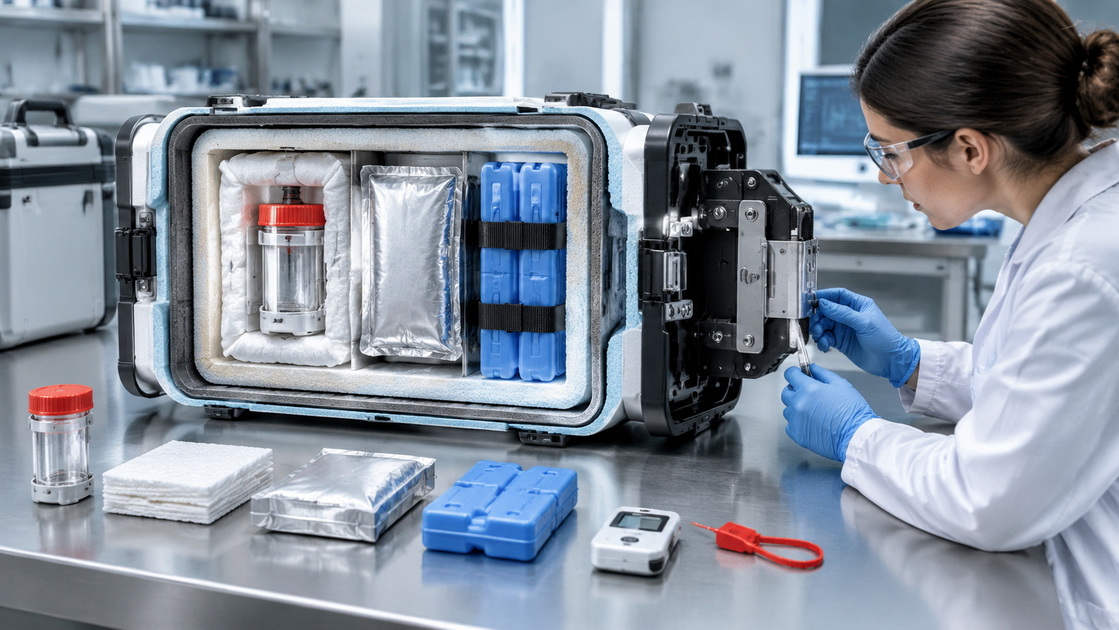
Do not accept "fully certified" without clarification.
Ask separately about:
- The manufacturer's management-system certification.
- Product conformity documents for the supplied equipment.
- Aircraft airworthiness requirements.
- Operator and route permissions.
- Dangerous-goods and medical-shipment requirements.
DJI's EU conformity documents, for example, address particular products. EASA's guidance separately explains that operations outside open-category limits—including typical BVLOS missions—fall under a different operational framework.
For CE and RoHS claims, request the applicable legal basis, exact product identification, declaration, and supporting evidence where required. Neither label should be accepted as proof of cold-chain performance or permission to conduct hospital delivery flights.
Confirm the legal entity on the quotation, contract, invoice, warranty, and payment instructions.
Then establish which party controls:
- Aircraft design and final assembly.
- Flight-control software.
- Battery production or sourcing.
- Medical container integration.
- Cloud services and dispatch software.
- Maintenance and replacement parts.
An integrator can be a suitable partner, but its responsibilities must be explicit. "Own factory" should not replace an auditable production map.
Provide the same mission profile to each shortlisted company:
- Medical cargo type and classification.
- Net cargo mass.
- Total loaded container mass and dimensions.
- Route distance, terrain, elevation, and landing conditions.
- Required temperature range, where applicable.
- Planned operating hours and delivery frequency.
- Destination country and intended operator.
- Required local software, data, and maintenance arrangements.
This prevents suppliers from quoting incompatible configurations.
A practical qualification sequence is:
1. Review documents and inspect the proposed equipment.
2. Conduct bench tests using the complete payload assembly.
3. Perform flights with representative nonclinical loads.
4. Validate packaging and handling with the healthcare partner.
5. Run a monitored pilot under applicable permissions.
6. Approve expansion against agreed acceptance criteria.
Use agreed thresholds rather than inventing universal pass rates. The hospital, laboratory, operator, and supplier should approve their respective responsibilities before clinical cargo is introduced.
A factory tour does not establish annual production capacity.
Request current order loading, production schedules, critical-component availability, final acceptance throughput, and spare-parts stock. Separate assembly capacity from the number of aircraft that can complete inspection and flight acceptance.
For customized projects, tie delivery milestones to design freeze, prototype acceptance, documentation completion, and final inspection.
Drone batteries can complicate freight arrangements. IATA explains that manufacturers and distributors must make available the relevant UN 38.3 test summary for lithium cells and batteries. Shipping requirements also depend on how batteries are packed and the applicable rules.
Before shipment, have a qualified dangerous-goods specialist confirm classification, packaging, documentation, carrier acceptance, and current state-of-charge requirements.
Do not assume that a supplier's ability to export an aircraft proves the buyer can import, register, or operate it.
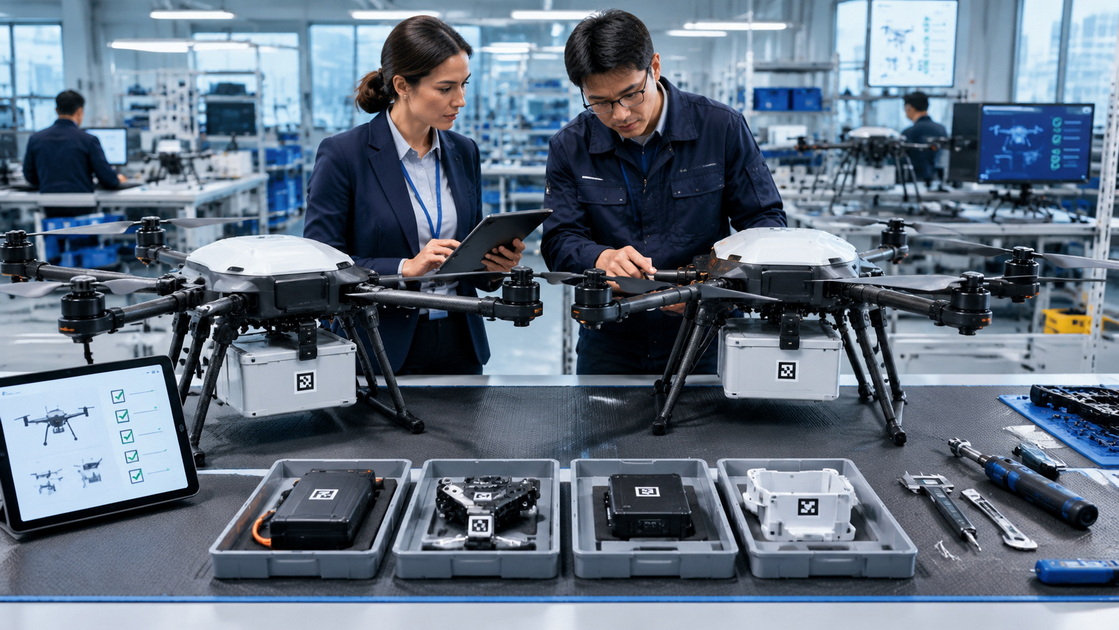
A less visible risk is approving one configuration and receiving another.
An acceptance aircraft might use one battery supplier, firmware version, antenna arrangement, or container latch. Later deliveries may contain substitutions that appear minor commercially but affect performance or invalidate the basis of earlier tests.
Treat this as a procurement risk to control, not an allegation against any company listed here.
Require a configuration baseline covering:
- Aircraft model and hardware revision.
- Battery type and approved cell source.
- Flight-control and dispatch software versions.
- Communications equipment.
- Payload container and locking mechanism.
- Approved accessories and safety equipment.
The contract should define which changes require notification, written approval, or repeat testing.
A related trap is confusing net medical cargo with total payload. The aircraft must carry the specimen or medicine plus packaging, insulation, coolant, logger, restraint, and any adapter. Evaluate the fully loaded assembly—not the medicine alone.
| Purchasing Mistake | Commercial or Operational Risk | Practical Control |
|---|---|---|
| Accepting vague material descriptions | Uncontrolled component substitutions | Specify traceable materials and approved alternatives |
| Comparing empty-aircraft range | Overestimated mission capability | Test the complete loaded configuration |
| Treating a demonstration as routine service | Hidden staffing and intervention costs | Request normal-operation logs and intervention records |
| Assuming temperature control from an insulated box | Unverified shipment protection | Validate packaging against the actual route and delay conditions |
| Accepting certificates for another entity or model | Misleading compliance evidence | Match legal name, site, model, scope, and status |
| Buying aircraft without software access terms | Dependence on unavailable cloud services | Contract for licensing, data access, continuity, and support |
| Ignoring rejected or diverted deliveries | Underestimated logistics cost | Include failed missions and fallback transport in evaluation |
Certificate verification should include current status, scope, and covered locations rather than relying only on the expiry date printed on a PDF. IAF CertSearch provides tools for these checks.
The companies in this shortlist address different purchasing needs.
Antwork and Fengyi provide documented medical logistics relevance. DJI offers a standardized cargo-platform option. SIDT merits evaluation for integrated, scenario-specific systems. ZIYAN and AutoFlight address different payload and operating categories, while Meituan represents a service-network model. JOUAV, EHang, and United Aircraft require closer scrutiny of medical-specific suitability.
For buyers considering SIDT, begin with a mission brief rather than a general price inquiry. Specify the payload, route, destination market, integration requirements, and planned deployment scale. Request a technical proposal, document package, and staged pilot quotation with measurable acceptance criteria.
That process provides a stronger basis for a long-term partnership than a low unit price or an impressive demonstration flight.
Search the exact legal entity and certificate number through IAF CertSearch where available, then verify unresolved details with the issuing certification body.
Check the certificate's current status, covered sites, and scope. A certificate covering sales activities does not necessarily cover aircraft manufacturing. IAF's verification guidance distinguishes active, suspended, withdrawn, and expired certificates.
Make certificate verification a prepayment condition and repeat it before significant repeat orders.
No automatic equivalence should be assumed.
Destination authorities determine local requirements. In Europe, EASA identifies BVLOS and certain other operations as falling within the specific-category framework, with authorization or another applicable regulatory pathway required. In the United States, the FAA provides a separate framework for package delivery by drone, including Part 135 certification requirements for relevant operations.
Obtain a jurisdiction-specific compliance plan before committing to fleet quantities.
Start with the exact shipment type rather than a generic "medical cargo" category.
Have the hospital, laboratory, or pharmaceutical quality team define acceptable handling and temperature conditions. Then test the complete packaging system over representative routes, including realistic delays and receiving procedures.
For infectious substances, classification, packaging, labeling, documentation, and training must align with applicable transport requirements. The WHO's 2025–2026 guidance provides an authoritative starting point.
A successful flight alone does not establish medical shipment suitability.
Do not assume that all customization is merely cosmetic.
Ask the supplier and relevant authority whether the proposed change affects conformity documentation, airworthiness evidence, or operational authorization. Changes to communications, batteries, payload installation, or control software should receive particular scrutiny.
Require a change-control process that identifies who evaluates the change, updates documentation, and pays for any necessary retesting. Product conformity and operational authorization remain separate questions.
Use a controlled quotation process with an identical mission profile and commercial scope.
Request separate prices for aircraft, containers, batteries, docking equipment, software, integration, training, spare parts, and maintenance. Ask each supplier to commit to delivery milestones and explain production bottlenecks.
Compare total deployment cost and cost per successfully accepted shipment, including failed missions, fallback ground delivery, and replacement batteries. Where a supplier will not disclose a precise capacity figure, seek auditable schedule commitments and evidence of actual acceptance throughput instead.


