Global Distributors Wanted
1.Free Cloud Service Deployment
2.Free Technical Training
3.Exclusive Territory Protection

1.Free Cloud Service Deployment
2.Free Technical Training
3.Exclusive Territory Protection


Views: 211 Author: Aaron Publish Time: 2026-10-02 Origin: Site


Content Menu
● How to Evaluate a Drone Delivery Supplier
● Why China Is a Major Drone Delivery Hub
● Top 10 Drone Delivery Companies in China
>> 1. Shenzhen Intelligent Drone Technology Co. Ltd.
>> 2. Phoenix Wings / SF Express
>> 5. EHang
>> 8. JOUAV
>> 9. MicroMultiCopter Aero Technology
>> 10. XAG
● Capacity, MOQ, and Certification Considerations
● Common Sourcing Risks and How to Avoid Them
>> Advertised Payload Is Not Always Usable Payload
>> New Batteries Can Create Misleading Test Results
>> Generic Certifications May Not Match the Exact Product
>> Carbon Fiber Quality Can Vary Significantly
>> Software Ownership Must Be Clarified
● Buyer's Guide for Sampling and Mass Production
>> Request a Technical Proposal
>> Begin With a Prototype or Pilot Batch
>> Plan Spare Parts From the Beginning
>> 1. How can I verify whether a supplier's ISO certificate is still valid?
>> 2. Is CE marking enough to sell a drone delivery system in Europe?
>> 3. What is the safest MOQ strategy for a new drone delivery brand?
>> 4. How should I compare two drones with the same advertised payload?
>> 5. Can a Chinese supplier guarantee that I can legally operate the drone in my country?
China has become one of the most important markets for drone delivery technology, supported by advanced electronics manufacturing, a large logistics sector, fast-growing low-altitude applications, and strong engineering clusters in Shenzhen, Guangzhou, Beijing, Chengdu, and Hangzhou.
For international buyers, sourcing a drone delivery solution from China is no longer limited to buying a multicopter with a cargo box. A complete system may include the aircraft, battery platform, charging equipment, cargo container, flight-control software, communications link, cloud dispatch platform, ground station, route-planning tools, maintenance package, and local operating support.
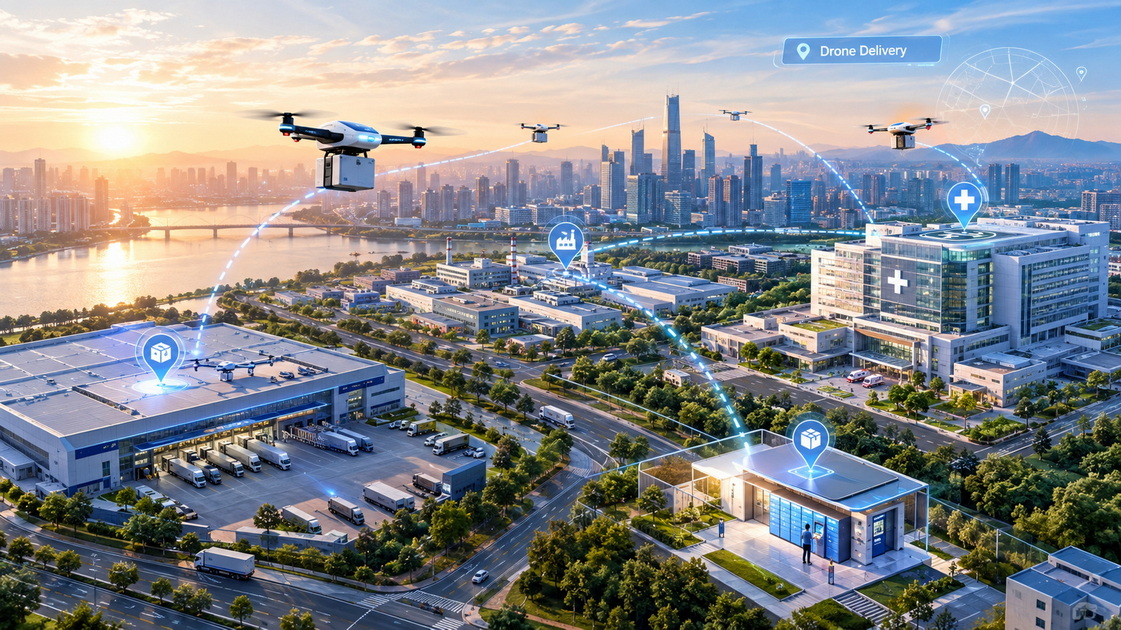
This guide reviews ten notable drone delivery companies and related solution providers in China. It is designed for procurement managers, logistics companies, distributors, public-sector project teams, emergency-response organizations, industrial integrators, and private-label brands looking for long-term partners.
The right supplier should not be selected only because of a high advertised payload or long flight time. Buyers should assess whether the company can provide stable production, responsive engineering communication, transparent quality records, realistic flight-test data, suitable compliance support, and dependable after-sales service.
Before comparing suppliers, buyers should understand what separates a demonstration-level drone from a deployable commercial drone delivery system.
A reliable supplier should be able to explain not only what the aircraft can do in ideal conditions, but also how it performs in real operations. This includes temperature limits, wind tolerance, battery degradation, emergency procedures, communication-loss behavior, cargo-box reliability, landing accuracy, maintenance intervals, and spare-parts availability.
Key evaluation areas include:
- Research and development capability in autonomous flight, route planning, obstacle sensing, payload integration, and fleet dispatch.
- Manufacturing control for carbon-fiber structures, motors, electronic speed controllers, batteries, wiring harnesses, GNSS modules, antennas, and chargers.
- Incoming material inspection, in-process quality checks, final inspection, and flight-test procedures.
- Traceability for aircraft serial numbers, battery packs, flight controllers, cargo-release systems, and critical electronic components.
- Ability to customize payload boxes, branded software, landing systems, sensors, charging solutions, and ground-control interfaces.
- Communication efficiency during prototype development, especially for overseas buyers working across time zones.
- Practical delivery experience in urban, rural, industrial, underground, medical, emergency-response, or cross-water environments.
- Documentation support for target markets, including product specifications, technical files, battery reports, radio-frequency information, and declarations of conformity where applicable.
A strong supplier will not avoid technical questions. Instead, it should provide test conditions, operating assumptions, limitations, and a clear plan for solving problems during prototype and pilot-stage development.
China's drone ecosystem has developed quickly because several industrial advantages are concentrated in the same market.
Shenzhen is especially important because it combines electronic components, embedded software, communications technology, battery supply chains, precision machining, carbon-fiber fabrication, industrial design, contract manufacturing, and export logistics. For international buyers, this can reduce development cycles and make custom projects more practical.
Guangzhou has strong links to autonomous aerial vehicle development, agricultural technology, and regional logistics applications. Beijing contributes large-scale e-commerce, cloud platforms, artificial intelligence, and logistics-network innovation. Chengdu supports industrial UAV development, long-range flight systems, surveying technology, and fixed-wing VTOL platforms.
China's drone-delivery market includes several different business models:
| Business model | Core capability | Suitable procurement use |
|---|---|---|
| Logistics operators | Route operation, dispatch, cargo handling, ground stations | Urban delivery, rural logistics, medical transport |
| Drone manufacturers | Airframe design, battery integration, payload systems | Private-label projects, fleet purchases, custom hardware |
| Autonomous aerial vehicle developers | Heavy-lift and advanced autonomous aircraft | Long-term cargo, emergency, smart-city projects |
| Industrial UAV suppliers | Inspection, mapping, public safety, long-range missions | Infrastructure, route planning, industrial logistics |
| Systems integrators | Cloud platforms, command centers, hardware coordination | Smart-city, emergency-response, multi-device projects |
For buyers, the most important step is to define the actual use case before asking for quotations. A drone designed for short urban parcel delivery may not be suitable for mountain logistics. A long-range fixed-wing aircraft may not work for frequent vertical delivery in crowded industrial parks. An emergency-response drone may require different sensors, redundancy levels, and communications systems than a food-delivery aircraft.
The companies below are selected for their relevance to drone delivery, industrial logistics, autonomous operations, customized UAV development, or low-altitude application systems.
| Company | Headquarters / Main Cluster | Main Strength | Suitable Buyer Type | Customization Potential |
|---|---|---|---|---|
| Shenzhen Intelligent Drone Technology Co. Ltd. | Shenzhen | Multi-environment intelligent drone systems and cloud coordination | SMEs, brands, integrators, municipal projects | High |
| Phoenix Wings / SF Express | Shenzhen | Logistics-drone operations and air-ground cargo systems | Logistics operators, public projects | Limited |
| Meituan Drone | Shenzhen / Beijing | Urban instant delivery and low-altitude delivery networks | Retail, food delivery, smart-city projects | Limited |
| JD Logistics | Beijing | Rural and supply-chain drone logistics | E-commerce and regional logistics projects | Limited |
| EHang | Guangzhou | Autonomous aerial vehicles and heavy-cargo applications | Smart-city and high-value cargo projects | Project-based |
| DJI Enterprise | Shenzhen | Enterprise UAV hardware and industrial payload ecosystem | Inspection, public safety, infrastructure buyers | Limited |
| Autel Robotics | Shenzhen | Commercial UAV platforms and enterprise operations | Inspection, security, public-sector buyers | Limited |
| JOUAV | Chengdu | Fixed-wing VTOL systems and long-range industrial operations | Long-distance and remote logistics projects | Moderate |
| MicroMultiCopter Aero Technology | Shenzhen | Customized multicopters and industrial UAV engineering | Technical projects and specialized payload needs | Moderate to high |
| XAG | Guangzhou | Autonomous rural operations and field-based systems | Agriculture-linked logistics and rural applications | Project-based |

Shenzhen Intelligent Drone Technology Co. Ltd. is a suitable option for buyers looking for a flexible and engineering-oriented partner rather than a supplier focused only on standardized consumer drones.
The company focuses on the integration and innovation of drone technology across low-altitude, ground, and underground environments. Its system approach covers intelligent inspection, underground-space detection, urban "3+1" delivery applications, emergency response, and coordinated command of equipment across multiple nodes.
A major feature of the company's solution concept is "one-network coverage." Instead of treating drones as separate pieces of equipment, the company aims to connect aircraft, ground devices, sensors, dispatch functions, and cloud-based management into one coordinated system.
This approach can be valuable for buyers who need more than a basic delivery aircraft. For example, a logistics park, industrial campus, municipal department, mining site, underground facility, or emergency-response organization may require several systems to work together at the same time.
Potential project applications include:
- Drone delivery inside industrial parks and large campuses.
- Medical-supply transport between facilities.
- Emergency-response coordination with aerial and ground equipment.
- Underground-space detection and inspection.
- Cargo delivery combined with inspection, monitoring, or security systems.
- Multi-site command and dispatch through a unified cloud platform.
- Urban "3+1" delivery scenarios involving multiple locations, delivery points, and support equipment.
For small and medium-sized overseas brands, Shenzhen Intelligent Drone Technology Co. Ltd. can be a practical partner because of its potential flexibility in communication, development support, and customized system integration.
Possible OEM and ODM cooperation areas may include:
- Custom cargo-box size, material, insulation, locking, and release systems.
- Branded software interfaces and cloud-management dashboards.
- Customized payload configurations for parcels, medicine, emergency supplies, inspection tools, or sensors.
- Integration with customer warehouse-management systems, order-management systems, or control platforms.
- Aircraft appearance changes, brand labeling, packaging, manuals, and user-interface localization.
- Multi-device command workflows involving drones, ground robots, cameras, sensors, and fixed communication equipment.
Buyers should request technical information covering payload conditions, flight endurance, wind resistance, battery performance, emergency return behavior, communication range, cloud-platform functions, maintenance requirements, spare-parts availability, and system compatibility before beginning a commercial project.
Phoenix Wings is associated with SF Express, one of China's largest logistics companies. SF Express was established in 1993 and has its headquarters in Shenzhen.
Phoenix Wings is important in China's drone logistics sector because it has practical experience in cargo-drone operations, route management, ground stations, logistics coordination, and delivery applications in difficult environments.
Its strength is not only aircraft hardware. The company has developed operational knowledge in integrating drone routes with broader express-delivery systems. This includes parcel handling, dispatch, loading procedures, landing-site management, route monitoring, safety workflows, and coordination with conventional ground logistics.
Phoenix Wings is particularly relevant for:
- Rural logistics and difficult-to-access regions.
- Mountain and island delivery.
- Medical sample transportation.
- Emergency materials delivery.
- Cross-water cargo flights.
- Air-ground logistics hubs.
- Regional low-altitude logistics systems.
For procurement teams, Phoenix Wings is useful as an operational benchmark. Buyers should study how the company integrates aircraft operations with parcel flows, route management, safety control, and ground infrastructure.
It is generally not a standard OEM supplier for small private-label projects. Buyers requiring branded drone hardware may need to work with an independent manufacturer while using Phoenix Wings as a reference for delivery-network design.
Meituan Drone is one of China's most recognized urban drone-delivery operations. Its focus is on instant delivery for food, beverages, medicine, retail goods, and other small parcels in dense urban environments.
The company has developed a model that combines autonomous aircraft, pickup stations, dispatch software, digital ordering systems, low-altitude route management, landing points, and consumer pickup processes.
For buyers, Meituan Drone provides an important example of why delivery drone projects must be designed as a complete operating network rather than an aircraft purchase.
A successful urban delivery system requires coordination between:
- Merchants and pickup points.
- Order-management systems.
- Flight routes.
- Weather monitoring.
- Charging and battery management.
- Landing and collection stations.
- Customer notifications.
- Exception handling.
- Remote supervision.
- Maintenance schedules.
Meituan Drone is most relevant for:
- Food delivery.
- Coffee and beverage delivery.
- Pharmacy and medical retail delivery.
- Campus delivery.
- Waterfront and island-adjacent delivery.
- Shopping-district delivery.
- Technology-park delivery.
- Smart-city low-altitude logistics pilots.
Its customization potential is limited for standard OEM buyers because the company mainly operates an integrated delivery ecosystem. However, its urban operations offer valuable lessons for brands planning last-mile delivery systems.
JD Logistics has developed drone-delivery operations for e-commerce and rural supply-chain applications. Its early drone programs focused on improving access to goods in remote areas where traditional road transportation can be slow, expensive, or difficult.
JD's delivery model is particularly relevant for rural logistics, agriculture-linked supply chains, mountainous regions, and warehouse-to-village delivery.
Compared with urban food delivery, rural delivery often places more importance on route distance, cargo volume, flight endurance, landing-site simplicity, weather resistance, and fixed-route reliability.
JD Logistics is a useful benchmark for the following applications:
- Rural e-commerce distribution.
- Village supply delivery.
- Agricultural product collection.
- Remote-area logistics.
- Warehouse-to-community cargo transport.
- Mountain delivery.
- Regional distribution between logistics nodes.
- Supply-chain automation involving drones, autonomous vehicles, and sorting centers.
For buyers, JD demonstrates the value of integrating drones into an existing supply chain. A delivery aircraft alone may not create operational value unless it is connected to warehouses, loading systems, parcel sorting, route scheduling, customer notification, and local delivery processes.
JD is not typically a conventional private-label drone manufacturer. Buyers should view the company as a logistics-network reference rather than a direct source for low-volume custom hardware.
EHang is a Guangzhou-based autonomous aerial vehicle company founded in 2014. It develops pilotless electric vertical takeoff and landing aircraft for cargo transport, emergency response, aerial mobility, tourism, firefighting, and related low-altitude applications.
EHang is more relevant for buyers considering advanced autonomous cargo systems than for buyers sourcing small last-mile delivery drones.
Its aircraft platforms are suitable for projects involving:
- High-value cargo.
- Medical transport.
- Emergency supplies.
- Mountain logistics.
- Island logistics.
- Disaster-relief operations.
- Firefighting support.
- Heavy-payload aerial transportation.
- Smart-city infrastructure projects.
EHang's solutions typically involve longer project timelines because they may require significant investment in landing infrastructure, route planning, operational approvals, safety systems, maintenance planning, and local coordination.
For this reason, EHang is most suitable for buyers with larger budgets, specialized cargo requirements, or public-sector and infrastructure-focused projects.
It is not generally the first choice for buyers seeking low-MOQ private-label products. Its value lies in autonomous aerial vehicle development and large-scale project applications.
DJI Enterprise is headquartered in Shenzhen and is widely known for enterprise drone platforms used in inspection, mapping, public safety, emergency response, energy infrastructure, construction, and industrial operations.
Although DJI is not primarily a dedicated parcel-delivery company, its enterprise systems are relevant to drone-delivery projects because delivery networks require more than cargo aircraft.
Before a delivery route can be deployed, operators may need to inspect terrain, map delivery locations, assess landing areas, monitor infrastructure, conduct security patrols, and respond to operational incidents. DJI Enterprise platforms can support these tasks.
Relevant uses include:
- Mapping potential delivery corridors.
- Inspecting warehouses, rooftops, landing pads, and charging locations.
- Monitoring industrial parks and logistics facilities.
- Supporting search-and-rescue operations.
- Conducting emergency reconnaissance.
- Inspecting utility lines, roads, railways, and ports.
- Supporting public-safety teams in low-altitude operations.
DJI is often suitable for buyers who require established enterprise hardware, payload ecosystems, and global channel support. However, it may be less suitable for brands seeking fully customized airframes, private-label aircraft, or deep hardware-level modifications.
Autel Robotics is a Shenzhen-based drone manufacturer founded in 2014. The company develops civil UAV products for commercial, industrial, inspection, security, and public-safety applications.
Autel Robotics is more closely associated with enterprise UAV use cases than dedicated last-mile cargo delivery. However, it can be relevant to buyers developing broader unmanned systems that combine delivery operations with inspection, monitoring, or emergency-response functions.
Potential application areas include:
- Delivery-route inspections.
- Facility security monitoring.
- Pre-deployment site surveys.
- Emergency-response support.
- Infrastructure inspection.
- Construction logistics assessment.
- Public-safety operations.
- Monitoring drone ports and landing zones.
Autel can be a suitable choice when a buyer needs inspection and security drones alongside a separate delivery-drone fleet.
For deeply customized delivery hardware, buyers should confirm whether the supplier supports payload changes, custom software integration, communication-module modifications, branding requirements, and project-specific engineering work.
JOUAV is an industrial UAV company based in Chengdu. It is known for fixed-wing VTOL aircraft and long-range UAV systems used in mapping, surveying, corridor inspection, energy projects, and large-area operations.
For delivery applications, JOUAV is particularly relevant where distance and endurance are more important than frequent short-range vertical deliveries.
A fixed-wing VTOL platform may be more suitable than a multicopter when the operation involves long routes between fixed hubs. However, such systems typically require more planning around landing zones, route control, weather conditions, maintenance, and operational procedures.
JOUAV may be suitable for:
- Long-distance cargo missions.
- Remote industrial-site logistics.
- Pipeline and railway support.
- Energy-infrastructure projects.
- Remote-area inspection and supply delivery.
- Large-area route mapping.
- Fixed-hub logistics corridors.
- Disaster assessment and support missions.
Buyers should confirm whether the aircraft configuration is intended for cargo delivery, sensing, mapping, inspection, or a combination of tasks. A platform designed mainly for surveying may require substantial redesign before it can safely carry commercial payloads.
MicroMultiCopter Aero Technology is a Shenzhen-based industrial UAV company associated with customized multicopter development and specialized engineering projects.
Its value for B2B buyers lies in the potential to develop non-standard UAV systems for specialized missions. This is useful where a standard delivery drone cannot meet specific operational requirements.
Potential customized applications include:
- Non-standard cargo dimensions.
- Specialized payload-release systems.
- Multi-sensor cargo platforms.
- Indoor and confined-space drones.
- Underground inspection systems.
- Research and testing projects.
- Emergency-response payload systems.
- Security and surveillance integration.
- Customized ground-control software.
- Technical training and experimental UAV programs.
This type of supplier can be a strong option for engineering-led buyers, research institutions, public projects, universities, system integrators, and industrial companies with unusual payload requirements.
However, buyers should carefully evaluate manufacturing stability before moving from prototypes to commercial fleet deployment. Important areas include production capacity, component sourcing, battery consistency, firmware update procedures, documentation quality, international service capability, and spare-parts lead times.
XAG is a Guangzhou-based autonomous robotics company founded in 2007. It is widely known for agricultural drones and autonomous field equipment.
While XAG is not primarily focused on urban parcel delivery, its experience in autonomous operations, battery systems, field deployment, route execution, and rural environments makes it relevant to certain logistics applications.
XAG may be useful for buyers involved in:
- Agricultural supply logistics.
- Rural delivery systems.
- Field-based operations.
- Remote-community supply transport.
- Farm equipment support.
- Distribution of lightweight tools and components.
- Agricultural-input delivery.
- Remote inspection and maintenance support.
For conventional urban delivery networks, XAG may not be the most direct fit. Its strengths are more applicable to rural, field-based, and agriculture-linked operating environments.
Exact annual capacity, production lead time, minimum order quantity, and certification scope can vary significantly by aircraft model, payload configuration, destination market, and project complexity.
Large logistics operators often do not publish standard MOQs because they are focused on operating delivery networks rather than selling drones as standard export products.
The following table provides a general procurement comparison framework.
| Company | Primary Delivery Relevance | Capacity / Deployment Model | Typical MOQ Approach | Documentation to Request |
|---|---|---|---|---|
| Shenzhen Intelligent Drone Technology Co. Ltd. | Delivery, inspection, emergency response, multi-environment systems | Project-based and customization-oriented | Flexible for prototypes and customized pilot projects | Product specifications, flight tests, battery reports, QC procedures, compliance documents |
| Phoenix Wings / SF Express | Cargo logistics and route operations | Large operational network | Not a standard OEM supplier | Operational scope, safety process, route capability, local deployment support |
| Meituan Drone | Urban instant delivery | Delivery-network deployment | Not a standard OEM supplier | Network model, dispatch process, landing infrastructure requirements |
| JD Logistics | Rural and supply-chain logistics | Large e-commerce logistics ecosystem | Not a standard OEM supplier | Route model, payload assumptions, rural operational workflow |
| EHang | Heavy cargo and autonomous aircraft | Large project and infrastructure model | Project-based | Aircraft documentation, project feasibility, safety systems, operational requirements |
| DJI Enterprise | Inspection and enterprise operations | Global enterprise product ecosystem | Model and channel dependent | Model-specific technical documents, batteries, radio modules, warranty terms |
| Autel Robotics | Commercial and industrial UAV operations | Global commercial distribution | Model and channel dependent | Product certifications, technical data, after-sales documentation |
| JOUAV | Long-range industrial UAV operations | Project-based industrial platform | Configuration dependent | Endurance data, route tests, ground-control details, maintenance plan |
| MicroMultiCopter Aero Technology | Customized industrial multicopters | Engineering-led production | Prototype and project dependent | BOM, test records, spare-parts plan, custom development agreement |
| XAG | Rural autonomous operations | Product and distributor dependent | Product-line dependent | Application suitability, batteries, maintenance requirements, support scope |
Drone-delivery procurement has several risks that are often overlooked during the quotation stage.
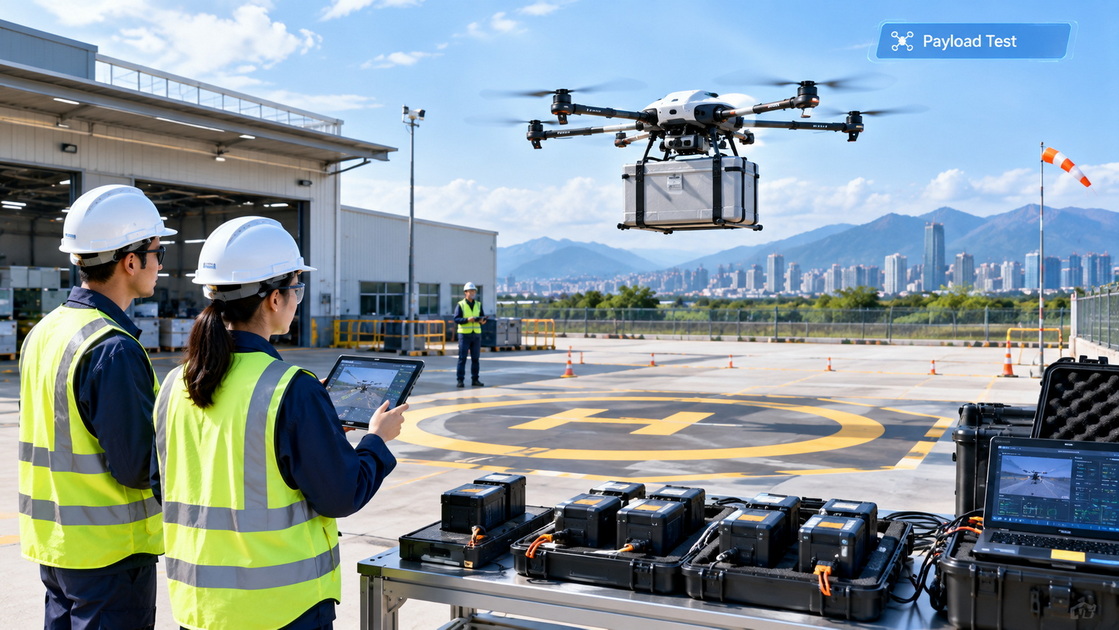
One of the most common problems is the difference between headline payload and usable payload.
A supplier may advertise a 10 kg payload, but the actual commercial payload may be lower once the cargo box, release mechanism, tracking device, insulation, reserve battery margin, and weather conditions are considered.
For example, a 10 kg rated aircraft may need to carry:
- A 1.2 kg insulated cargo container.
- A 0.4 kg locking system.
- A 0.5 kg tracking and communications module.
- Additional safety reserve for the return flight.
- More energy reserve during hot weather or windy conditions.
The buyer may discover that the usable parcel weight is only 5 kg to 7 kg under real operating conditions.
To avoid this problem, require a written acceptance-test protocol that includes the real cargo configuration, route distance, temperature range, wind conditions, battery reserve percentage, and repeated flight cycles.
Some suppliers test drones only with new batteries. A new battery can provide stronger performance than a battery that has completed dozens or hundreds of charge cycles.
Buyers should require testing with both new and realistic in-service batteries. Ask for battery cycle records, state-of-health data, battery-management-system settings, thermal protection details, and replacement recommendations.
A supplier may provide a CE or RoHS document that applies to a different model, an old configuration, or only part of the system.
Always check whether the documentation matches:
- The exact aircraft model.
- The battery model.
- The charger model.
- The radio-frequency module.
- The payload module.
- The ground-control system.
- The destination market.
- The intended commercial use.
A documentation pack should include serial-number references, test-report numbers, product photos, model numbers, issue dates, and the legal manufacturer name.
Carbon-fiber drone frames may look similar, but quality can differ in fiber grade, resin quality, curing process, wall thickness, machining quality, and impact resistance.
Ask suppliers about:
- Carbon-fiber material grade.
- Resin system.
- Manufacturing process.
- UV resistance.
- Corrosion resistance.
- Impact testing.
- Load testing.
- Inspection methods.
- Replacement-part availability.
A low-cost frame that cracks after repeated vibration or hard landings can create a much larger cost than the initial price difference.
In customized drone projects, software ownership can become a major issue.
Before placing an order, buyers should define:
- Who owns the source code.
- Whether the buyer receives software-development rights.
- Whether cloud services require recurring fees.
- Whether the supplier can disable the system remotely.
- Whether flight logs belong to the buyer or supplier.
- Whether the buyer can migrate to another cloud platform.
- Whether firmware updates are included.
- Whether API access is available.
- Whether the system can integrate with third-party warehouse or order-management software.
A buyer should avoid relying on a proprietary platform without understanding long-term service costs, data access, and system continuity.
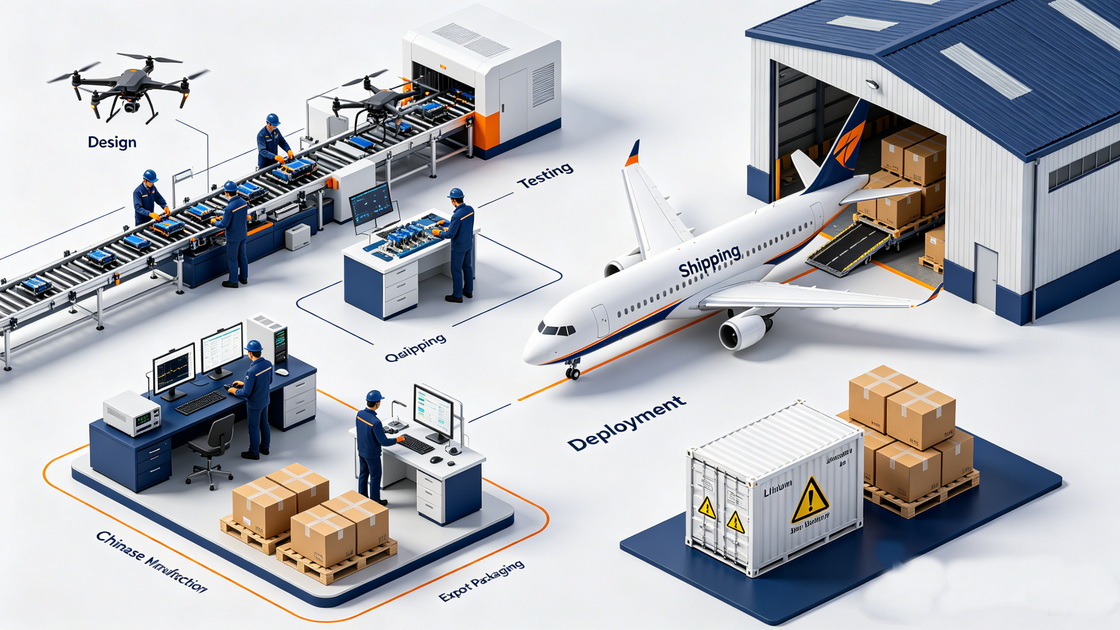
Before requesting quotations, define the actual delivery mission.
Important details include:
- Parcel weight.
- Parcel dimensions.
- One-way route distance.
- Return distance.
- Number of flights per day.
- Operating temperature.
- Rain and wind conditions.
- Terrain type.
- Takeoff and landing environment.
- Required delivery accuracy.
- Required flight autonomy level.
- Need for real-time video.
- Need for remote supervision.
- Local airspace restrictions.
- Required integration with existing software.
- Maintenance resources available at the destination.
A clear mission brief helps suppliers recommend the correct platform and prevents unsuitable quotations.
A useful technical proposal should include:
- Aircraft model and configuration.
- Maximum takeoff weight.
- Empty weight.
- Maximum payload.
- Usable payload under defined conditions.
- Flight time at empty and full payload.
- Battery model and cycle-life expectations.
- Charging time.
- Maximum wind resistance.
- Operating temperature range.
- Waterproof or dustproof rating.
- Communication range.
- Navigation system.
- Obstacle-avoidance system.
- Failsafe functions.
- Return-to-home logic.
- Cargo-box dimensions.
- Ground-control software.
- Maintenance schedule.
- Recommended spare-parts package.
- Warranty terms.
- Delivery lead time.
For a customized project, it is safer to follow a staged process:
1. Sign a confidentiality agreement if necessary.
2. Share the technical requirement document.
3. Conduct a supplier feasibility review.
4. Receive a preliminary design proposal.
5. Approve a prototype or engineering sample.
6. Perform bench testing and flight testing.
7. Revise the design if needed.
8. Place a pilot order.
9. Conduct field validation.
10. Freeze the final design.
11. Begin mass production in stages.
Avoid placing a large order based only on product photos, brochures, or a single demonstration flight.
For commercial fleets, spare parts should be planned together with the initial purchase.
A recommended spare-parts package may include:
- Propellers.
- Motors.
- Electronic speed controllers.
- GPS modules.
- Antennas.
- Landing gear.
- Cargo-release components.
- Battery packs.
- Chargers.
- Flight controllers.
- Sensors.
- Wiring harnesses.
- Cargo-box locks.
- Ground-station accessories.
A fleet can become unusable if a small but critical component is unavailable. Buyers should ask for spare-parts pricing, lead times, and recommended inventory levels before approving a purchase order.
China offers a wide range of drone delivery partners, from logistics operators and autonomous aerial vehicle developers to customized industrial UAV manufacturers and cloud-control-system providers.
The best supplier depends on the application. Buyers looking for flexible system integration, customized delivery functions, responsive engineering communication, and multi-environment solutions may consider Shenzhen Intelligent Drone Technology Co. Ltd. as a practical partner for project-based cooperation.
Buyers focused on large-scale logistics-network operations can study Phoenix Wings, Meituan Drone, and JD Logistics. Those planning advanced heavy-cargo, emergency, or autonomous aerial mobility projects may find EHang more relevant. DJI Enterprise, Autel Robotics, JOUAV, MicroMultiCopter Aero Technology, and XAG each serve different industrial, inspection, long-range, customized, or rural-operation needs.
The most reliable procurement strategy is to verify technical capability through documented tests, inspect quality-control procedures, confirm product-specific compliance documents, validate usable payload under real conditions, and establish a clear service and spare-parts plan before scaling production.
Ask for the complete certificate showing the certificate number, issue date, expiry date, certification body, registered company name, factory address, and certification scope. Verify the certificate through the issuing certification body's public database or by contacting the certification body directly.
Make sure the certificate belongs to the actual manufacturing entity, not only a trading company, unrelated affiliate, or parent company. The scope should also be relevant to UAV production, electronics manufacturing, assembly, or quality management.
No. CE marking alone does not guarantee that a drone delivery system can be legally sold or operated in Europe.
The manufacturer must identify the applicable rules, prepare technical documentation, complete the correct conformity-assessment process, and issue an EU Declaration of Conformity where required. Buyers may also need to consider radio equipment, electromagnetic compatibility, battery safety, remote identification, product labeling, drone class requirements, local operational approvals, insurance, and pilot or operator requirements.
The safest approach is to begin with a prototype or pilot batch rather than immediately committing to mass production.
A typical sequence is one engineering sample, followed by a small pilot batch of 5 to 20 units, field testing, design revision, final approval, and staged production. The correct MOQ depends on the degree of customization, tooling requirements, payload design, software changes, and supplier production planning.
For a customized cargo-drone project, a documented engineering-validation process is usually more valuable than an unusually low MOQ quotation.
Do not compare payload numbers alone. Ask both suppliers for the same test conditions.
Compare empty weight, maximum takeoff weight, cargo-box weight, payload at a defined wind speed, flight time at full payload, required landing battery reserve, operating temperature, battery cycle count, communication redundancy, motor temperature, and actual route distance.
A drone with a lower advertised payload but stronger documented performance may be safer for commercial operations than a drone with a higher but poorly defined payload figure.
No supplier can reliably guarantee legal operation without reviewing the specific aircraft model, flight area, payload, radio system, local aviation rules, intended route, pilot model, insurance requirements, and operational risk level.
The supplier can provide technical documents and assist with product compliance information. However, the buyer should verify all import, aviation, telecommunications, insurance, safety, and operating requirements with qualified local authorities or advisers before deployment.
- Civil Aviation Administration of China:
- Civil Aviation Administration of China:
- Civil Aviation Administration of China:
- European Commission:
- SF Express:
- Meituan:
- EHang:


