Global Distributors Wanted
1.Free Cloud Service Deployment
2.Free Technical Training
3.Exclusive Territory Protection

1.Free Cloud Service Deployment
2.Free Technical Training
3.Exclusive Territory Protection


Views: 211 Author: Aaron Publish Time: 2026-09-06 Origin: Site


Content Menu
● Why Congested Cities Challenge Last-Mile Delivery
● Logistics Drone vs Delivery Van: Key Differences
● When a Logistics Drone Is the Better Choice
>> Urgent Delivery of Lightweight Packages
>> Short-Distance Point-to-Point Routes
>> Road Disruptions and Emergency Conditions
>> Service Areas With Controlled Landing Zones
● When a Delivery Van Is the Better Choice
>> High-Volume Multi-Stop Delivery Routes
>> High-Rise Buildings and Complex Urban Destinations
>> Unfavorable Weather Conditions
● Cost Comparison: Focus on the Total Delivery Mission
● Environmental Impact: A More Balanced View
● Safety, Public Trust, and Urban Operations
● Building a Hybrid Drone-and-Van Delivery Network
>> A Practical Hybrid Delivery Workflow
● One-Network Coverage for Smart City Logistics
● How to Select the Right Delivery Method
>> 1. What is the main difference between a logistics drone and a delivery van?
>> 2. Are logistics drones faster than delivery vans in congested cities?
>> 3. Can logistics drones replace delivery vans completely?
>> 4. What packages are suitable for drone delivery?
>> 5. Are logistics drones environmentally friendly?
>> 6. How do drones and delivery vans work together in one logistics network?
>> 7. What does one-network coverage mean in city logistics?
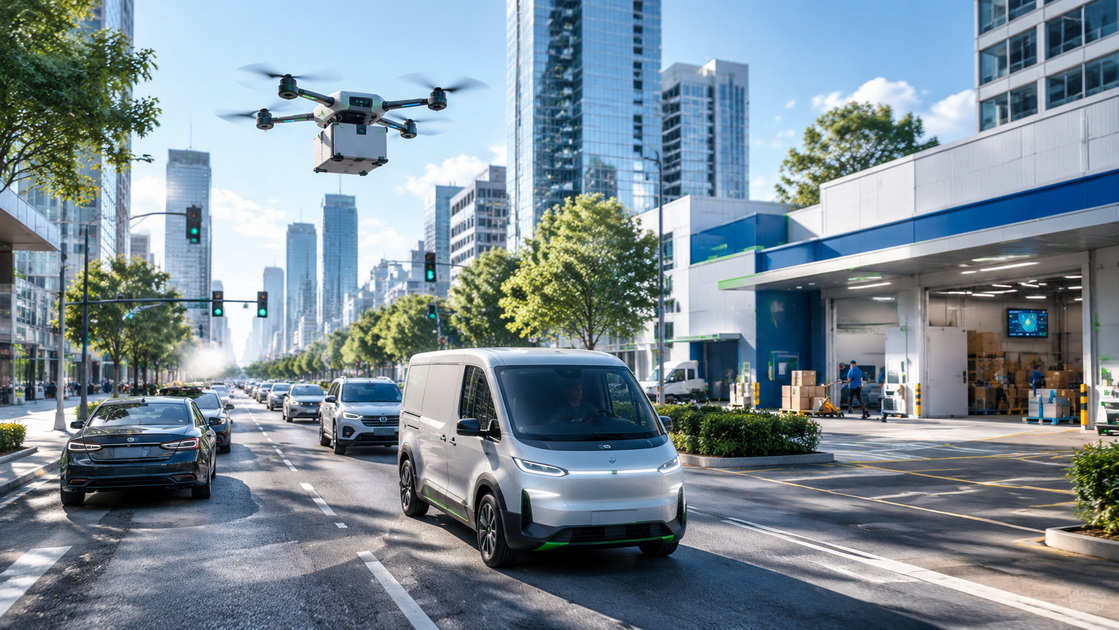
Urban last-mile delivery is under increasing pressure. Customers expect faster service. Businesses need predictable delivery windows. Cities need fewer traffic disruptions, lower emissions, and better use of limited curbside space.
For logistics operators, the final kilometer is often the most expensive and unpredictable part of the delivery chain.
A parcel may move efficiently from a factory to a warehouse, from a warehouse to a distribution center, and from a distribution center to a local hub. However, the final delivery route can be delayed by traffic jams, limited parking, road closures, access restrictions, construction zones, and unsuccessful delivery attempts.
This is why the comparison between a logistics drone and a delivery van has become increasingly important.
A logistics drone can move small parcels through low-altitude airspace, avoiding many road-based obstacles. A delivery van can carry large volumes of packages, serve multiple stops, and reach customers in locations where aerial delivery may be difficult.
The best solution is rarely a choice between one or the other.
In congested cities, the most effective model is often a hybrid last-mile delivery network. Logistics drones handle urgent, lightweight, point-to-point missions. Delivery vans manage consolidated, high-volume, and complex deliveries. An intelligent cloud control platform connects both systems, allowing operators to make better routing and dispatch decisions in real time.
For Shenzhen Intelligent Drone Technology Co. Ltd. (SIDT), this model aligns with the concept of one-network coverage: a unified management system that connects low-altitude aircraft, ground resources, sensing devices, emergency teams, and multiple logistics nodes through one integrated cloud platform.
Congested cities create a difficult environment for conventional delivery operations.
A delivery van may only need to travel a few kilometers, but the journey can take much longer than expected. Heavy traffic, traffic lights, pedestrians, road restrictions, loading-zone limitations, and parking delays all reduce delivery efficiency.
In many urban areas, delivery drivers spend significant time searching for legal parking or walking packages from distant curbside locations to building entrances. This reduces the number of successful deliveries a van can complete during a shift.
The problem becomes more complex during peak delivery periods.
Morning traffic, lunch-hour congestion, evening commuter flows, holiday shopping seasons, severe weather, public events, and road construction can quickly disrupt delivery schedules. For businesses offering same-day, on-demand, or time-critical delivery, these disruptions can damage customer satisfaction and increase operational costs.
A logistics drone offers a different route.
Instead of entering congested streets, a drone can travel directly from a local hub to a qualified destination through low-altitude airspace. It does not need to wait at traffic lights, find parking, or compete for curbside access.
However, drone delivery is not suitable for every package, every location, or every city.
Weather conditions, payload limits, airspace requirements, destination access, battery range, building density, and operational safety all affect whether a drone is the right choice. This is why urban logistics requires intelligent task allocation rather than a one-size-fits-all transportation model.
A logistics drone and a delivery van are designed for different types of delivery missions.
A drone is typically best for direct, lightweight, urgent, and short-range delivery. A van is typically best for high-volume, heavy, multi-stop, and complex delivery routes.
| Comparison Factor | Logistics Drone | Delivery Van |
|---|---|---|
| Primary transport route | Low-altitude airspace | Urban roads and streets |
| Best for | Lightweight, urgent, point-to-point deliveries | High-volume, multi-stop, heavy, and oversized deliveries |
| Exposure to traffic | Avoids road congestion | Directly affected by traffic congestion |
| Parcel capacity | Limited payload capacity | Large payload capacity |
| Route model | Direct hub-to-destination route | Multi-stop delivery route |
| Parking requirement | No curbside parking required | Often requires loading or parking access |
| Weather sensitivity | More sensitive to wind, rain, visibility, and temperature | More resilient in most weather conditions |
| Destination access | Requires safe and approved delivery or collection zone | Can access buildings, loading docks, lockers, and business entrances |
| Operational speed | Fast for short direct routes | Depends on traffic, stops, parking, and route density |
| Best operational role | Premium, emergency, or time-sensitive small packages | Standard parcel distribution and bulk delivery |
| Fleet management need | Requires flight management, battery monitoring, and airspace coordination | Requires route planning, vehicle tracking, and driver management |
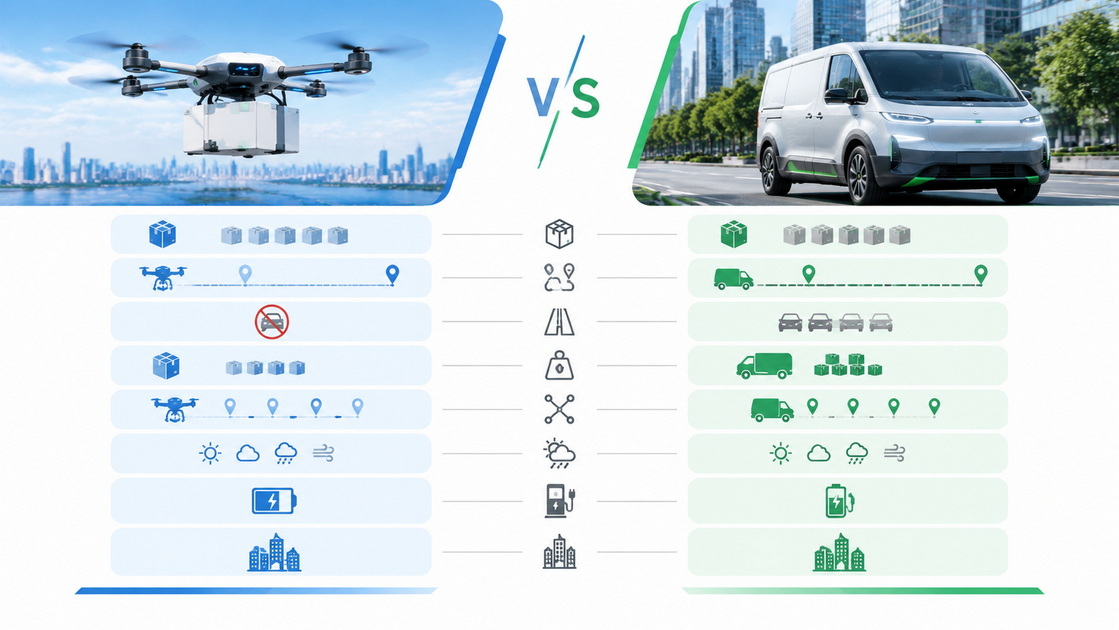
The key difference is simple.
A logistics drone is a precision delivery asset.
A delivery van is a consolidation delivery asset.
A drone creates value by moving an urgent parcel directly to its destination. A van creates value by carrying many packages and completing multiple deliveries within one route.
A logistics drone becomes especially valuable when road congestion, delivery urgency, or access challenges make traditional ground transportation inefficient.
The strongest use case for a logistics drone is a small parcel with a high time value.
Examples include:
- Medical supplies and urgent pharmacy orders.
- Laboratory samples and diagnostic materials.
- Industrial spare parts.
- Emergency response equipment.
- Small electronic components.
- Important documents.
- Food and beverage orders.
- High-priority e-commerce parcels.
- Time-sensitive maintenance tools.
- Small safety equipment for field teams.
Consider an industrial maintenance scenario.
A factory machine may stop operating because a small sensor, connector, or control component fails. The replacement part may be physically small, but the cost of downtime can be significant. A delivery van carrying the item through congested streets may face delays caused by traffic and restricted access.
A logistics drone can provide a more direct route from a nearby warehouse, distributor, or service hub to the industrial site.
In this situation, the value of the drone is not only speed. It is operational continuity.
Logistics drones are most attractive when roads are the primary delivery bottleneck.
In congested downtown areas, a van may travel slowly, stop frequently, and spend additional time searching for parking. A drone can avoid many of these obstacles by flying above the road network.
This does not mean every drone mission will be faster than every van route.
Drone missions still require parcel loading, pre-flight system checks, safe takeoff procedures, flight monitoring, landing or handoff processes, and return operations. Yet when road congestion is severe, the drone can provide a more reliable delivery time for qualified shipments.
For premium logistics services, predictable delivery time can be more valuable than average speed.
A logistics drone is most effective when the origin and destination are close enough for efficient battery use and direct operation.
Short-range delivery corridors can include:
- A pharmacy to a residential community.
- A local distribution hub to a hospital.
- A warehouse to an industrial park.
- A retail store to a nearby customer collection point.
- A command center to an emergency-response location.
- A logistics facility to a port, campus, or business district.
The direct flight path reduces the need for detours caused by one-way streets, road construction, bridge congestion, or limited vehicle access.
A short, direct drone mission may be particularly valuable when a road delivery would require a long detour around a congested urban block or restricted transport corridor.
Drone delivery can improve operational resilience when the ground network is interrupted.
Potential situations include:
- Flooded roads.
- Traffic accidents.
- Earthquakes or other natural disasters.
- Major public events.
- Security restrictions.
- Infrastructure failures.
- Construction-related road closures.
- Remote or difficult-to-access urban zones.
In emergency response scenarios, a drone can transport small essential supplies while ground teams focus on moving larger equipment, personnel, and materials.
This creates a coordinated response system rather than a single-mode delivery process.
Drone delivery is easier to deploy when destinations have safe, predictable, and controlled handoff locations.
Suitable examples may include:
- Hospitals.
- University campuses.
- Industrial parks.
- Warehouses.
- Logistics hubs.
- Business campuses.
- Residential communities with designated collection areas.
- Smart lockers.
- Rooftop collection zones.
- Secure delivery pads.
A clear delivery zone improves safety, customer experience, package security, and operational consistency.
Delivery vans remain essential in urban logistics. Their role will continue to be important even as drone delivery expands.
A van can carry dozens or hundreds of parcels during one delivery route.
This makes vans highly efficient for areas with many deliveries close together. A driver can deliver packages to apartments, offices, retail stores, lockers, warehouses, and loading docks without returning to the hub after each parcel.
The more packages a van can deliver on one route, the more efficient its operating cost per parcel can become.
A logistics drone generally carries one package or a small payload for each mission. Even if multiple drones operate from the same hub, each flight requires loading, dispatch, monitoring, battery management, and recovery.
For dense parcel routes, a van often remains the better option.
Common van-dominant delivery scenarios include:
- E-commerce parcels for apartment communities.
- Retail replenishment.
- Grocery orders.
- Business-to-business shipments.
- Bulk parcel delivery.
- Scheduled commercial routes.
- Multi-box orders.
- Large customer deliveries.
Payload limitations are one of the most important differences between logistics drones and delivery vans.
A van can carry large boxes, multiple parcels, bulk supplies, temperature-controlled goods, equipment, furniture, and industrial materials. A logistics drone is limited by its aircraft design, battery capacity, safety margins, and operating conditions.
A package may be too heavy, too large, too fragile, or too difficult to secure for drone transportation.
Examples of cargo better suited to vans include:
- Furniture.
- Large appliances.
- Bulk grocery orders.
- Heavy industrial components.
- Palletized materials.
- Large electronic devices.
- Multiple-box shipments.
- Temperature-sensitive cargo requiring advanced refrigeration.
- Construction materials.
- Large commercial supplies.
High-rise buildings can be difficult for drone delivery.
Tall structures create wind turbulence, signal interference, narrow flight corridors, rooftop obstacles, and complex customer handoff requirements. Many buildings also lack suitable landing zones or secure aerial collection points.
A delivery van may face traffic and parking challenges, but it can still deliver to:
- Building reception areas.
- Package rooms.
- Smart lockers.
- Retail back doors.
- Loading docks.
- Apartment entrances.
- Concierge desks.
- Security gates.
- Internal mailrooms.
For dense apartment districts, a van-to-locker or van-to-building-hub model may be more practical than individual drone delivery.
Weather can affect both road and air delivery, but drones are generally more sensitive to changing conditions.
Strong winds, heavy rain, snow, lightning, low visibility, high temperatures, and severe cold can reduce flight safety or limit operational performance.
A professional delivery network should not treat drones as an always-available delivery option.
Instead, the system should automatically assess weather conditions and transfer unsuitable drone missions to a delivery van, ground courier, or customer collection point.
This requires real-time coordination between aircraft operations, ground logistics, weather monitoring, and customer service systems.
The question is not simply whether logistics drones are cheaper than delivery vans.
The better question is:
Which delivery method creates the best value for a specific parcel, customer, location, and service level?
The total cost of last-mile delivery includes many factors.
For logistics drones, these may include:
- Aircraft purchase or leasing.
- Battery systems.
- Charging infrastructure.
- Maintenance.
- Spare parts.
- Flight management software.
- Remote operations support.
- Launch and recovery infrastructure.
- Package handling.
- Safety systems.
- Insurance.
- Network connectivity.
- Mission monitoring.
- Customer handoff equipment.
For delivery vans, the cost structure may include:
- Vehicle purchase or leasing.
- Fuel or electricity.
- Driver labor.
- Vehicle maintenance.
- Parking.
- Traffic delays.
- Route optimization.
- Insurance.
- Loading and unloading time.
- Depot operations.
- Failed delivery attempts.
- Curbside access costs.
A van can be highly cost-effective when it carries many parcels along one route.
A drone can be highly valuable when it prevents an expensive, slow, low-density, or time-critical ground delivery.
For example, sending a van through heavy traffic to deliver one urgent 1 kg spare part may be inefficient. Sending a drone for that specific task may be more economical when the time saved prevents a larger business loss.
However, sending one drone per parcel for hundreds of standard deliveries may be less efficient than routing a well-loaded electric van through a dense delivery area.
The strongest operational strategy is to use dynamic parcel assignment.
Each package should be evaluated according to:
- Weight.
- Dimensions.
- Delivery urgency.
- Distance.
- Weather conditions.
- Traffic conditions.
- Airspace availability.
- Customer location.
- Landing or collection-zone suitability.
- Vehicle capacity.
- Battery status.
- Delivery density.
- Service-level requirement.
Logistics drones can support lower-emission urban delivery, but only when they are used appropriately.
Because drones use electricity, they do not produce direct tailpipe emissions during flight. They can also avoid traffic congestion and reduce the need for some short road-based trips.
However, environmental performance depends on more than the drone itself.
It depends on:
- The electricity source used for charging.
- Drone size and aircraft weight.
- Package weight.
- Delivery distance.
- Battery production and replacement.
- Flight frequency.
- Hub energy consumption.
- Additional warehouse or microhub requirements.
- The delivery method being replaced.
- The efficiency of the existing van route.
A small electric drone carrying a lightweight package over a short route can reduce energy use and emissions compared with a diesel van making a dedicated delivery trip.
However, a drone may offer less environmental benefit if it carries a heavy package, flies long distances, uses carbon-intensive electricity, or requires substantial additional infrastructure.
Similarly, an electric delivery van serving many customers in one dense route can be highly efficient.
The most responsible approach is to measure environmental performance per successful delivery.
Operators should track:
- Energy use per parcel.
- Emissions per parcel.
- Average package weight.
- Delivery distance.
- Vehicle and drone utilization.
- Failed delivery rate.
- Battery lifecycle performance.
- Route density.
- Hub energy use.
- Renewable electricity share.
The objective should not be to claim that drones are always greener than vans.
The objective should be to build a logistics network that uses the lowest-impact delivery method for each mission.
A logistics drone operating in a city must be part of a mature operational system.
It is not enough to have an aircraft capable of carrying a package. Operators also need reliable communication, dynamic route planning, flight monitoring, safety procedures, maintenance processes, incident response plans, customer handoff systems, and public engagement.
Urban drone delivery should consider several critical factors:
- Safe takeoff and landing procedures.
- Reliable command-and-control connectivity.
- Accurate positioning and navigation.
- Obstacle awareness.
- Weather monitoring.
- Emergency landing options.
- Battery-health monitoring.
- Noise management.
- Privacy protection.
- Package security.
- Cybersecurity.
- Community communication.
- Ground-risk management.
- Airspace coordination.
- Integration with local logistics operations.
Public trust is especially important.
People need to understand where drones fly, when they fly, how safety is managed, how noise is reduced, and how personal privacy is protected. Transparent operating practices can help cities, businesses, and communities build confidence in drone-enabled logistics.
A successful urban drone program should begin with clearly defined routes, qualified delivery zones, limited operating hours, strong safety controls, and measurable performance targets.
The future of urban delivery is not a fleet of drones replacing every van.
It is a coordinated network in which every delivery asset has a defined role.
A hybrid network can combine:
- Logistics drones.
- Delivery vans.
- Electric vehicles.
- Smart lockers.
- Micro-fulfillment centers.
- Local warehouses.
- Customer collection points.
- Urban logistics hubs.
- Real-time traffic data.
- Weather data.
- Low-altitude route data.
- Ground sensors.
- Emergency-response systems.
- Intelligent cloud dispatch platforms.
A unified control platform can receive delivery orders and evaluate the best available transport method.
For each package, the system can assess real-time conditions and assign the delivery to the most suitable resource.

1. A customer, business, hospital, or emergency team requests a delivery.
2. The intelligent cloud platform receives the parcel details, destination data, urgency level, inventory location, traffic conditions, weather conditions, and delivery requirements.
3. The platform evaluates whether the package is suitable for drone transport.
4. If the parcel is lightweight, urgent, within range, and directed to a safe delivery zone, the system assigns a logistics drone.
5. If the parcel is heavy, oversized, part of a multi-stop route, affected by poor weather, or destined for a complex building, the system assigns a delivery van.
6. During the mission, the platform monitors the aircraft, vehicle, parcel status, battery health, route conditions, weather changes, and customer delivery availability.
7. If operating conditions change, the system can reassign the delivery to another drone, van, hub, collection point, or emergency resource.
This type of intelligent orchestration is essential for real-world urban logistics.
A drone network without ground coordination can become fragmented. A van fleet without low-altitude delivery capability can remain vulnerable to congestion. A unified platform allows both systems to support each other.
For SIDT, the value of this approach extends beyond commercial parcel delivery.
The same cloud-based coordination capability can support intelligent inspection, underground-space detection, emergency response, urban airspace delivery, and ground-air collaborative operations.
"One-network coverage" means that different devices, vehicles, teams, and operational nodes can work together through one integrated system.

In a city logistics environment, this may include:
- Delivery drones in low-altitude airspace.
- Delivery vans on urban roads.
- Smart lockers at customer collection points.
- Warehouse and microhub systems.
- Ground robots or inspection equipment.
- Emergency-response vehicles.
- Surveillance and sensing devices.
- Underground detection systems.
- Traffic monitoring platforms.
- Weather monitoring tools.
- Operations centers.
- Remote supervisors.
- Business and public-sector users.
The goal is not simply to connect equipment.
The goal is to create seamless operational coordination.
For example, an emergency-response mission may require a drone to inspect a blocked road, a van to transport heavy equipment, a low-altitude aircraft to deliver urgent medical supplies, and underground monitoring systems to assess tunnel or pipeline risks.
A unified cloud platform can coordinate these resources in real time.
This creates a more responsive, resilient, and intelligent urban logistics network.
Before assigning a parcel to a logistics drone or a delivery van, operators should use a clear decision framework.
| Delivery Decision Factor | Choose a Logistics Drone When | Choose a Delivery Van When |
|---|---|---|
| Package weight | Lightweight and within approved payload limits | Heavy or close to payload limits |
| Package dimensions | Small and easy to secure | Large, irregular, fragile, or multi-box |
| Urgency level | Critical, immediate, or premium delivery | Standard or scheduled delivery |
| Delivery distance | Short and direct | Long, indirect, or multi-stop |
| Traffic condition | Roads are heavily congested | Roads are flowing or route density is high |
| Weather condition | Flight conditions are safe and stable | Weather limits drone operations |
| Destination | Approved delivery pad, campus, secure collection point | High-rise, apartment building, loading dock, complex access location |
| Delivery volume | Single urgent parcel | Multiple parcels on one route |
| Airspace status | Route is available and operationally suitable | Flight route is restricted or unsuitable |
| Customer service need | Fast direct delivery is required | Indoor handoff, bulky delivery, or scheduled delivery is required |
A successful operator does not treat this table as a fixed rulebook.
The decision should be updated continuously based on live conditions.
Traffic changes. Weather changes. Customer availability changes. Battery conditions change. Parcel demand changes. Vehicle capacity changes.
The intelligent delivery network must be able to respond quickly.
A logistics drone is better than a delivery van when the package is lightweight, urgent, short-range, and suitable for safe low-altitude delivery.
A delivery van is better than a logistics drone when the shipment is heavy, large, high-volume, multi-stop, weather-sensitive, or destined for a complex urban building.
The strongest solution for congested cities is a hybrid delivery model.
Logistics drones can reduce dependence on roads for high-priority small parcels. Delivery vans can efficiently manage larger shipments and dense multi-stop routes. An intelligent cloud control platform can coordinate both, helping businesses make faster, safer, and more cost-effective delivery decisions.
For organizations building next-generation urban logistics systems, the real advantage comes from connecting airspace, ground operations, delivery hubs, sensing systems, and emergency resources into one coordinated network.
SIDT supports this vision through full-stack intelligent drone solutions, low-altitude application platforms, dynamic perception, accurate data collection, intelligent analysis, and unified cloud control. By enabling coordinated operations across low-altitude, ground, and underground environments, SIDT helps transform advanced technology into practical value for logistics operators, cities, enterprises, and emergency-response teams.
Build a more responsive, resilient, and intelligent last-mile delivery network by combining the right aerial and ground resources for every mission.
A logistics drone uses low-altitude airspace to transport lightweight packages directly between locations. A delivery van uses urban roads to carry larger volumes of parcels across multiple stops. Drones are best for urgent small deliveries, while vans are best for bulk, heavy, and multi-stop routes.
Logistics drones can be faster for short, lightweight, and urgent deliveries because they avoid road traffic, traffic lights, parking delays, and curbside restrictions. However, actual delivery time depends on flight preparation, weather, destination access, operating conditions, and package handoff requirements.
No. Logistics drones cannot fully replace delivery vans because they have limited payload capacity and may face weather, airspace, destination-access, and operational constraints. Vans remain necessary for large packages, high-volume routes, apartment deliveries, commercial freight, and multi-stop distribution.
Suitable drone-delivery packages are typically lightweight, compact, urgent, and easy to secure. Examples include medical supplies, laboratory samples, small spare parts, documents, electronics, food, pharmacy orders, emergency equipment, and high-priority e-commerce parcels.
Logistics drones can reduce local tailpipe emissions and may lower energy use for certain short, lightweight delivery missions. Their environmental performance depends on factors such as electricity source, battery lifecycle, package weight, flight distance, drone size, hub operations, and the type of vehicle delivery they replace.
An intelligent cloud platform can evaluate each parcel based on weight, urgency, route distance, weather, traffic, airspace availability, battery status, destination type, and vehicle capacity. It can then assign the delivery to a drone, van, smart locker, microhub, or another available resource.
One-network coverage means that drones, delivery vans, warehouses, smart lockers, sensing devices, emergency teams, and operational platforms are connected through one unified management system. This allows real-time dispatch, monitoring, coordination, and resource sharing across low-altitude, ground, and underground environments.
1. Federal Aviation Administration. "Package Delivery by Drone (Part 135)."
2. Federal Aviation Administration. "Unmanned Aircraft System Traffic Management (UTM)."
3. World Economic Forum. "The Future of the Last-Mile Ecosystem."
4. World Economic Forum. "The Future of the Last-Mile Ecosystem" Report.
5. Stolaroff, J. K., Samaras, C., O'Neill, E. R., Lubers, A., Mitchell, A. S., & Ceperley, D. "Energy Use and Life Cycle Greenhouse Gas Emissions of Drones for Commercial Package Delivery." *Nature Communications*, 2018.
6. European Union Aviation Safety Agency. "EASA Publishes Regulatory Framework for Drone Service Deliveries."


