Global Distributors Wanted
1.Free Cloud Service Deployment
2.Free Technical Training
3.Exclusive Territory Protection

1.Free Cloud Service Deployment
2.Free Technical Training
3.Exclusive Territory Protection


Views: 213 Author: Aaron Publish Time: 2026-10-09 Origin: Site


Content Menu
● Heavy Lift Drone vs All-Terrain Vehicle: A Practical Comparison
● Payload Capacity: Evaluate the Complete Shipment
>> Heavy Lift Drone Payload and Flight Endurance
>> ATV Carrying Capacity and Towing Capacity
● Terrain Access: Air Routes and Ground Routes Solve Different Problems
>> Where Heavy Lift Drone Delivery Makes Sense
>> Where an ATV Remains More Practical
● Delivery Speed: Measure Time to Usable Equipment
● Weather, Safety, and Operating Permissions
>> Drone Delivery Requires Defined Operating Limits
>> ATV Delivery Requires Load and Route Controls
>> Confirm Permissions Before Deployment
● Cost Comparison: Focus on Successful Deliveries
● A Hypothetical Remote Maintenance Delivery
● A Six-Step Trial Before Fleet Investment
>> 3. Inspect Receiving and Recovery Locations
>> 4. Check Equipment Limits and Permissions
>> 5. Conduct Authorized Trials
>> 6. Compare Measured Results
● Coordinating Heavy Lift Drones and Ground Vehicles
● Conclusion: Select the Delivery Method Around the Mission
>> 1. s a Heavy Lift Drone Than an ATV for Remote Equipment Delivery?
>> 2. How Much Equipment Can a Heavy Lift Drone Carry?
>> 3. Can an ATV Carry Its Advertised Towing Weight?
>> 4. Can a Cargo Drone Deliver Without Landing?
>> 5. Does Maximum Drone Range Equal Delivery Radius?
>> 6. When Should a Remote Site Consider Both Technologies?
A heavy lift drone vs all-terrain vehicle comparison becomes useful when it focuses on the delivery mission rather than the machine. Both can support remote equipment delivery, but they solve different access problems.
A cargo drone can bypass a river, damaged road, or long ground detour. An all-terrain vehicle can carry an operator, follow suitable trails, and support repeated equipment movements without requiring an aerial receiving area.
The deciding factor is mission suitability. Equipment weight, cargo dimensions, terrain, urgency, weather, operating permissions, and receiving conditions all influence the right choice.
For zhenShen Intelligent Drone Technology Co. Ltd. (SIDT), this decision also fits a broader approach: coordinating low-altitude and ground resources through a unified intelligent cloud control platform. In many projects, the best solution is not exclusively aerial or ground-based. It is a carefully planned combination.
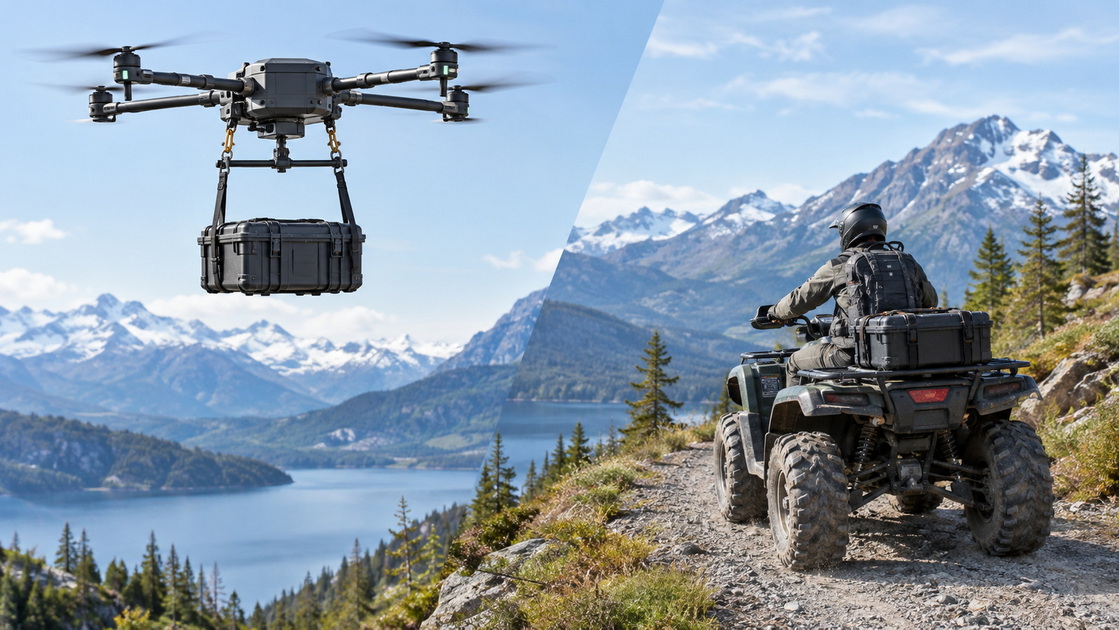
A heavy lift drone carries cargo through the air. A utility all-terrain vehicle transports equipment on approved racks or tows a compatible trailer over suitable ground routes.
In this article, ATV refers to a rider-operated utility quad, not a larger side-by-side vehicle.
| Comparison Factor | Heavy Lift Drone | Utility All-Terrain Vehicle |
|---|---|---|
| Access requirements | Suitable air route and receiving area | Traversable trail or ground route |
| Cargo suitability | Equipment within aircraft weight and dimensional limits | Equipment within vehicle, rack, hitch, and trailer limits |
| Operator movement | Cargo aircraft do not carry technicians | Transports the operator; passenger capacity varies |
| Main constraints | Weather, energy, communications, and aviation requirements | Traction, slope, stability, braking, and route access |
| Strongest application | Targeted deliveries across difficult ground obstacles | Ground transport, repeated trips, and operator access |
| Potential system role | Aerial delivery between selected nodes | Staging, consolidation, and local distribution |
Neither technology eliminates the need for route assessment. A capable vehicle can still be unsuitable for a particular shipment or destination.
Drone payload capacity should be assessed using the packaged shipment, not the equipment's bare weight.
Protective cases, restraints, and delivery hardware may affect available capacity. Cargo shape and balance also matter. A compact motor component and a long pipe assembly can create different handling challenges even when they weigh the same.
As an industry reference, DJI lists the FlyCart 30 with a 30 kg payload in dual-battery configuration and 40 kg in single-battery configuration. Its published maximum loaded flight distances are 16 km and 8 km, respectively, under specified test conditions.
These figures illustrate a trade-off: a configuration offering greater payload does not necessarily provide greater mission endurance. They are not SIDT aircraft specifications or guaranteed delivery distances.
Before selecting a heavy lift drone for equipment transport, confirm:
- Total packaged weight.
- External cargo dimensions.
- Center of gravity and restraint requirements.
- Delivery-system compatibility.
- Route elevation and expected conditions.
- Energy requirements for the complete mission.
ATV towing capacity is not the same as onboard carrying capacity.
Vehicle weight capacity, front and rear rack limits, hitch capacity, and trailer requirements must be checked separately. The operator, accessories, cargo, and applicable trailer tongue weight all affect the loading assessment.
A large towing rating should never be interpreted as permission to place an equivalent load on the racks.
For remote equipment delivery by ATV, the practical question is whether the fully loaded vehicle and trailer can safely negotiate the route. A load that is manageable on level ground may become unsuitable on a steep, narrow, or uneven trail.

Aerial delivery deserves consideration when ground access creates a substantial obstacle.
Examples include:
- Moving a replacement component across a river.
- Delivering equipment beyond damaged access infrastructure.
- Supporting an isolated maintenance team.
- Serving a designated receiving point reached only by a long detour.
However, the straight line on a map is not automatically the operational flight path.
Terrain may obstruct communications. The destination may lack a suitable receiving area. Airspace restrictions or operational requirements may require a different route.
The advantage of a drone must therefore be demonstrated through route-specific assessment rather than assumed from distance alone.
An ATV can be a strong option when an established trail reaches the worksite and the operator needs to accompany the equipment.
It can also support repeated movements between a staging location and several nearby work areas.
Yet "all-terrain" does not mean unrestricted access. Cargo changes handling, stability, and braking. Rough surfaces, side slopes, mud, and steep grades require careful assessment.
Ground-route planning should identify narrow sections, turning areas, unloading points, and locations where a loaded vehicle could become immobilized.
Comparing drone speed with ATV speed overlooks much of the delivery process.
A fast flight does not guarantee a fast handover. Likewise, a slower ground journey may still produce an efficient result if loading and receiving are straightforward.
Measure the complete sequence:
1. Confirm the equipment request.
2. Locate, package, and weigh the shipment.
3. Complete inspections and authorization checks.
4. Load and dispatch the vehicle.
5. Travel to the receiving location.
6. Unload and verify equipment condition.
The most useful measure is request-to-handover time.
For a drone mission, staging, battery preparation, and receiving arrangements may dominate the schedule. For an ATV delivery, loading, trail conditions, and unloading may account for most of the elapsed time.
Record these stages separately during trials. This reveals where improvements are possible and prevents a favorable travel-time comparison from hiding operational delays.
Aircraft specifications provide boundaries for assessment, not permission to operate near every published limit.
DJI lists maximum wind resistance of 12 m/s for the FlyCart 30. Its loaded flight-distance figures were measured under controlled conditions, including no wind and zero altitude.
Those distances should not be treated as guaranteed delivery radii.
A mission assessment should address:
- Wind and visibility along the route.
- Elevation and environmental conditions.
- Battery condition and energy reserves.
- Communications reliability.
- Safe cargo release or landing.
- Recovery and cancellation procedures.
Winch delivery can reduce the need to land, but it does not remove the need for a controlled receiving area and an appropriate handover procedure.
Ground delivery introduces different risks.
Loads should be secured and positioned according to the applicable vehicle instructions. Operators must allow for altered handling and longer braking distances.
Polaris advises reducing speed and cargo weight on rough or hilly terrain. Its general towing guidance specifies lower speeds for rough surfaces, corners, and hills, while the selected model's manual remains the governing reference.
Remote operations should also include communication arrangements, scheduled check-ins, and a practical response to breakdown or immobilization.
Drone requirements vary by jurisdiction, aircraft weight, operating method, and the nature of the transport service.
In the United States, transporting another party's property for compensation beyond visual line of sight can involve Part 135 certification. Aircraft outside applicable small-drone weight limits may require additional certification or exemption arrangements.
Not every internal equipment movement follows the same approval pathway.
Ground delivery also requires lawful route access. Confirm relevant permissions before investing in a route-dependent transport system.
There is no universal basis for claiming that a heavy lift drone costs less than an ATV.
A useful assessment includes the complete operating system.
| Cost Category | Items to Include |
|---|---|
| Equipment | Vehicle, cargo hardware, trailer, batteries, charging equipment |
| Personnel | Training, preparation, operation, supervision, receiving |
| Maintenance | Inspections, servicing, repairs, and consumables |
| Infrastructure | Staging areas, fuel or charging provision, receiving facilities |
| Compliance | Applicable approvals, insurance, and documentation |
| Disruption | Cancellations, recovery, damaged cargo, and backup transport |
Calculate relevant costs per successfully completed delivery over a defined evaluation period.
Then assess the business consequence separately. An urgent component that restores a remote asset may justify a higher transport cost. Routine shipments may benefit more from consolidation.
Use supplier quotations, operating records, and site trials. Avoid relying on a purchase-price comparison alone.
Consider a maintenance team waiting for a 20 kg packaged replacement component.
The illustrative aerial route is 4 km. The accessible ground trail is 18 km because it follows a bridge crossing and a mountain approach.
This makes drone delivery worth evaluating, but does not establish feasibility.
The chosen aircraft must support the shipment, route, receiving method, recovery plan, and operating permissions. The complete mission must remain within an acceptable operating envelope.
An ATV may still be preferable if a technician needs to accompany the component and bring additional tools.
If the technician is already onsite and only the replacement part is missing, aerial delivery may offer a more compelling option.
These figures illustrate a planning method. They are not SIDT field-test results.
A structured trial turns a promising concept into evidence for procurement.
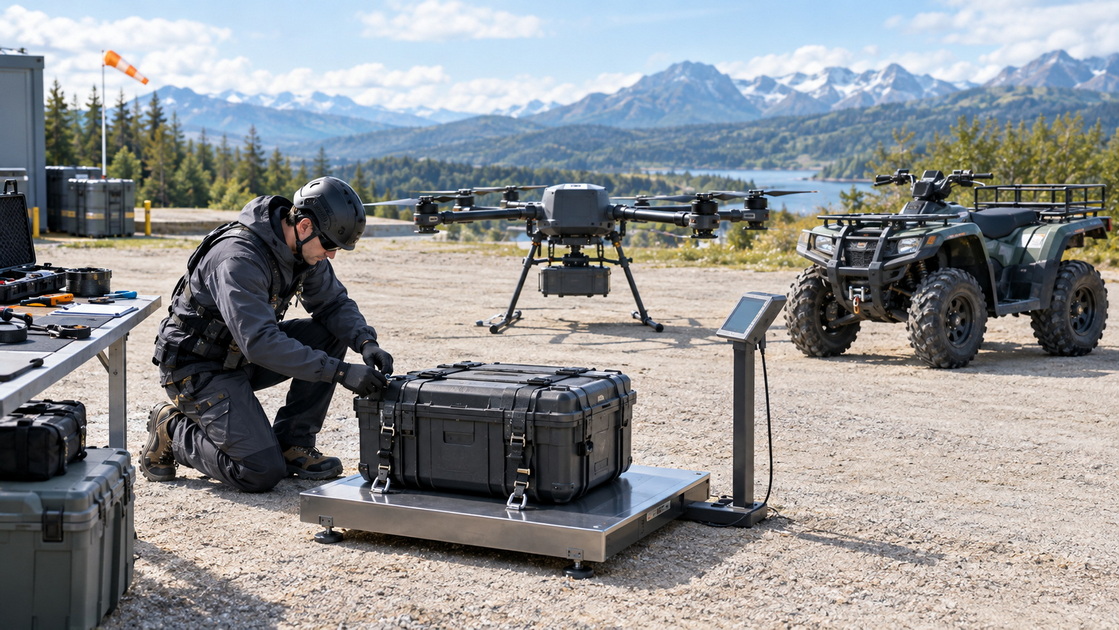
Record packaged weight, dimensions, fragility, restraint needs, and handling requirements.
Assess the actual ground route and proposed aerial route. Identify obstacles rather than relying only on map distances.
Confirm unloading space, cargo acceptance arrangements, communications, and fallback locations.
Use the selected model's instructions and the applicable operating requirements.
Test under defined conditions with clear cancellation criteria. Avoid expanding the mission during a demonstration.
Record handover time, labor, energy use, cargo condition, unsuccessful attempts, and recovery effort.
Set acceptance criteria before the trial. Otherwise, an impressive demonstration can be mistaken for a dependable delivery service.
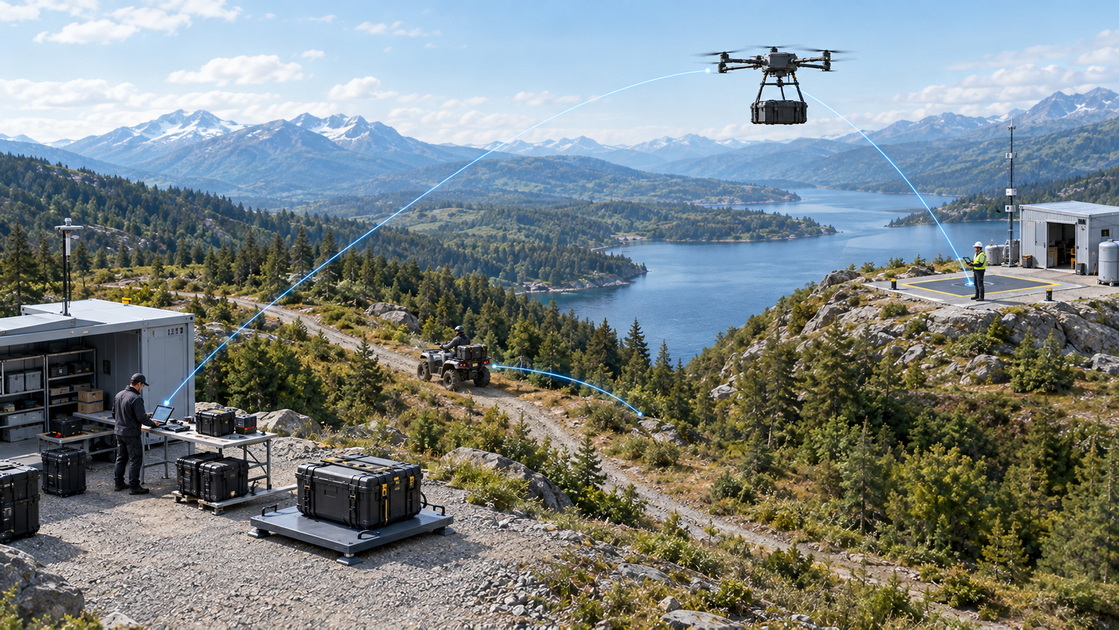
A hybrid workflow can separate bulk transport from urgent delivery.
Ground transport can move consolidated equipment to a staging node. An ATV can support accessible trails and operator movement. A drone can serve selected aerial legs where the payload and route are suitable.
The handover between these resources deserves as much attention as vehicle selection.
A shared dispatch process should establish:
- Which equipment is ready for movement.
- Who authorizes each delivery.
- Where custody changes.
- How recipients confirm acceptance.
- What happens when a route becomes unavailable.
SIDT describes "one-network coverage" through unified command, dispatch, and management across spaces and multiple nodes.
This provides a basis for discussing coordinated workflows. Compatibility with specific vehicles, aircraft, and third-party systems should still be verified project by project.
Heavy lift drones are worth evaluating when suitable aerial routes bypass difficult ground access and the equipment fits the aircraft's operating envelope.
ATVs remain valuable when trails are accessible, operators must accompany equipment, or ground transport supports the shipment more effectively.
A coordinated system can combine these strengths, but its value should be demonstrated through successful handovers, dependable procedures, and measurable operating results.
Share your packaged equipment weight, dimensions, route map, delivery frequency, receiving conditions, and urgency with SIDT. Request a route-specific feasibility assessment and acceptance-test proposal covering aerial, ground, and hybrid options before committing to deployment.
It can be better when an aerial route avoids a major ground obstacle and the shipment fits the aircraft's operating limits. An ATV may be preferable when accessible trails, operator movement, or shipment requirements favor ground transport.
Capacity depends on the aircraft and configuration. Evaluate packaged weight, dimensions, delivery hardware, and mission conditions together. An advertised maximum payload is not a guarantee that the same load is suitable for every route.
No. Towing capacity and onboard carrying capacity are separate limits. Rack capacity, total vehicle loading, and hitch requirements must also be checked using the exact model's instructions.
Some aircraft support winch delivery. Suitability depends on the equipment configuration, cargo, receiving area, procedures, and operating permissions. A safe, controlled handover is still necessary.
No. Published distance must be interpreted alongside its test conditions and the complete mission. Return or recovery requirements, weather, elevation, and energy reserves can change the usable route.
Consider a hybrid system when shipments differ in size, urgency, or destination access. Test whether coordination improves delivery outcomes enough to justify the added equipment and management requirements.
1. DJI. "DJI FlyCart 30 Specifications." Manufacturer specifications supporting the reference payload configurations, loaded flight distances, test conditions, wind resistance, and optional winch system. These are not SIDT product specifications.
2. Polaris. "Polaris ATV Hauling and Towing Guide." Manufacturer guidance supporting the distinctions between carrying and towing limits, cargo-loading precautions, handling considerations, and towing-speed guidance. The selected vehicle's manual takes precedence.
3. Federal Aviation Administration. "Package Delivery by Drone (Part 135)." Official U.S. guidance supporting the discussion of commercial package delivery, beyond-visual-line-of-sight operations, and certification or exemption considerations.
4. Shenzhen Intelligent Drone Technology Co. Ltd. Company background supplied for this article. Source for the descriptions of SIDT's intelligent flight platform, unified cloud control platform, cross-scenario applications, and "one-network coverage." No public company-page link was supplied.
5. Original editorial analysis. The hypothetical maintenance scenario, cost-comparison framework, acceptance-trial checklist, and proposed hybrid workflow were developed for this article. They are not presented as published research, firsthand operating experience, or verified SIDT customer results.


