Global Distributors Wanted
1.Free Cloud Service Deployment
2.Free Technical Training
3.Exclusive Territory Protection

1.Free Cloud Service Deployment
2.Free Technical Training
3.Exclusive Territory Protection


Views: 213 Author: Aaron Publish Time: 2026-09-20 Origin: Site


Content Menu
● Why Regional Emergency Transport Needs More Than One Delivery Method
● Drone Logistics Solution vs Traditional Air Freight: Key Differences
● When a Drone Logistics Solution Is the Better Choice
>> Time-Critical Medical Delivery
>> Road Closures and Isolated Locations
>> Delivery and Situational Awareness in One Mission
>> Distributed Drone Network Coverage
● When Traditional Air Freight Is the Better Choice
>> Heavy and Large Emergency Cargo
>> Long-Distance Regional Transport
>> Evacuation and Human Transport
● Speed, Payload, and Cost: The Emergency Decision Framework
>> Use a Drone When Urgency Is Higher Than Payload Demand
>> Use Traditional Air Freight When Capacity Is More Important
>> Use Both Systems for Major Emergencies
● Safety, Compliance, and Operational Readiness
>> Airspace and Route Planning
>> Cargo Security and Delivery Confirmation
● The One-Network Emergency Logistics Model
>> Example: Flood Response in a Regional City
● How to Build a Regional Emergency Drone Logistics Program
>> 1. Identify High-Priority Emergency Cargo
>> 2. Map the Emergency Coverage Area
>> 3. Design Hybrid Transport Workflows
>> 4. Test Realistic Emergency Scenarios
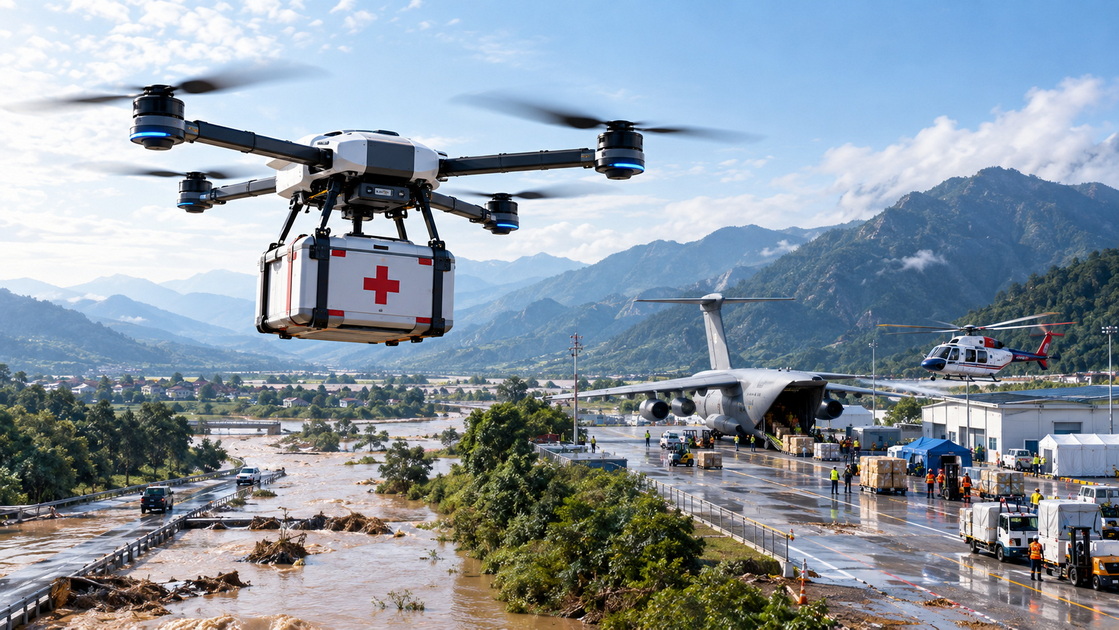
When a regional emergency disrupts roads, isolates communities, damages infrastructure, or creates urgent medical demand, transportation decisions cannot depend on distance alone. Emergency managers must consider payload weight, time sensitivity, route accessibility, weather, operating permissions, infrastructure availability, and the consequences of delay.
A drone logistics solution can deliver lightweight, high-priority supplies directly to a destination that may be unreachable by road. Traditional air freight, including helicopters and fixed-wing cargo aircraft, can transport large quantities of equipment, relief materials, and personnel across a much wider area.
The practical question is not whether drones will replace traditional air freight. The stronger question is how both systems can operate together to create faster, safer, and more resilient regional emergency transport.
Regional emergencies rarely follow predictable transport routes.
Floods can cut off roads. Wildfires can close highways. Earthquakes can damage bridges. Industrial accidents can restrict access to key facilities. Severe weather can isolate hospitals, utility sites, emergency shelters, and remote communities.
In these situations, a conventional supply chain can become fragmented. A truck may be delayed by damaged infrastructure. A helicopter may be needed for evacuation or large equipment. A fixed-wing cargo aircraft may reach a regional airport but still leave a difficult final-mile delivery problem.
This is where a multi-layer emergency logistics model becomes valuable.
A resilient model can include:
- Traditional air freight for large cargo and long-distance transport
- Cargo drones for lightweight and time-sensitive delivery
- Ground vehicles for local distribution and heavy freight
- Ground robots for indoor, underground, or hazardous environments
- Inspection drones for route assessment and situational awareness
- A unified command platform for mission dispatch and fleet coordination
The goal is not to replace one transport method with another. The goal is to match every emergency mission with the most suitable delivery method.
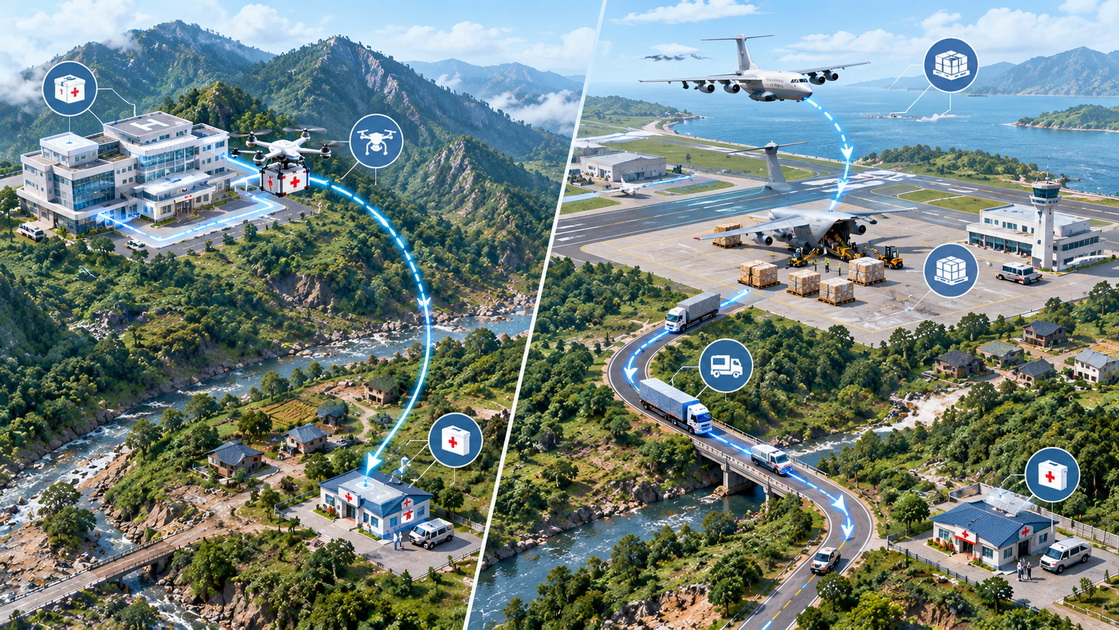
For example, a fixed-wing aircraft may transport emergency supplies from a central warehouse to a regional airport. A helicopter may move a rescue team to a remote area. A cargo drone may then deliver blood products, communication batteries, or medical supplies directly to an isolated clinic.
This integrated approach improves response speed while reducing unnecessary pressure on high-cost manned aviation assets.
The following comparison shows how drone logistics and traditional air freight perform across the main requirements of regional emergency transport.
| Factor | Drone Logistics Solution | Traditional Air Freight |
|---|---|---|
| Primary mission | Fast, lightweight, point-to-point delivery | Heavy cargo, long-range transport, personnel movement |
| Typical cargo | Medicines, blood products, samples, AEDs, batteries, radios, repair parts | Water, food, generators, fuel, rescue equipment, pallets, medical teams |
| Payload capacity | Limited by drone design and energy capacity | High, especially for helicopters and cargo aircraft |
| Route flexibility | Very high in difficult terrain or damaged road conditions | Moderate, depending on airports, helipads, and landing zones |
| Launch location | Can operate from distributed drone stations or mobile bases | Requires airport, runway, helipad, or prepared landing area |
| Last-mile capability | Strong for remote, isolated, or road-blocked locations | Often requires additional ground transport after landing |
| Speed for short urgent routes | Often very fast | May involve scheduling, loading, crew preparation, and landing coordination |
| Speed for long-distance transport | Limited by flight range and payload | Strong for intercity and regional bulk transport |
| Data collection | Can combine delivery with live video, mapping, and sensor data | Primarily focused on transport and personnel movement |
| Operating cost | Can be efficient for repeated small-payload missions | Can be expensive for urgent charter or helicopter missions |
| Weather tolerance | Depends on aircraft design, wind limits, and mission conditions | Usually stronger, but still limited by severe weather and airspace restrictions |
| Best emergency role | Urgent last-mile delivery and rapid assessment | Large-scale resupply, evacuation, and heavy equipment transport |
The biggest difference is simple.
A drone logistics solution is designed for agility, direct access, and rapid response. Traditional air freight is designed for payload capacity, range, and operational strength at scale.
A drone logistics solution is most valuable when the shipment is light, urgent, and difficult to deliver by road.

Medical emergencies are among the strongest use cases for drone logistics.
In many cases, the value of a delivery is not determined by the size of the package. It is determined by how quickly the item reaches the patient, clinic, emergency responder, or laboratory.
Drones can support delivery of:
- Blood products and plasma
- Vaccines and temperature-sensitive medicines
- Emergency antidotes
- Laboratory samples
- Diagnostic test kits
- Automated external defibrillators
- Small medical devices
- Surgical or trauma kits
- Portable oxygen accessories
- Emergency communication devices
For a rural clinic affected by flooding, a small medical package may be impossible to deliver by road within a critical timeframe. A cargo drone can fly directly from a nearby hospital, drone station, or emergency logistics hub to a secure delivery point.
This type of mission is especially suitable when the payload is compact but the consequences of delay are severe.
In a disaster, the last few kilometers are often the hardest part of the delivery route.
A truck may reach the edge of a flooded area but be unable to cross a damaged bridge. A helicopter may land at a regional airport but still need ground transport to reach the final destination. A drone can potentially bypass these obstacles and travel directly to an approved delivery location.
Drones can help overcome:
- Flooded roads
- Landslides
- Collapsed bridges
- Wildfire-related road closures
- Traffic congestion
- Mountain terrain
- Forest access limitations
- Remote industrial sites
- Restricted disaster zones
This does not mean drones can operate without planning. The receiving location must have a safe landing area, drop zone, delivery container, or trained staff member who can receive the cargo.
The most reliable drone delivery operations are based on predefined routes, delivery procedures, and emergency response plans.
A cargo drone can support more than transportation.
When equipped with cameras, thermal sensors, mapping tools, or environmental sensors, it can collect useful operational data during the mission. This gives emergency teams a better understanding of the situation before sending additional equipment or personnel.
A drone mission can help answer questions such as:
- Is the delivery point safe?
- Is the access route still blocked?
- Are people gathered at the emergency shelter?
- Is there visible fire, flooding, smoke, or structural damage?
- Has the emergency package been received?
- Is the landing area clear of obstacles?
- Are there signs of hazardous materials or infrastructure failure?
This combination of logistics and intelligence gathering can reduce unnecessary risk for first responders.
Instead of dispatching a separate aircraft for inspection and another vehicle for delivery, one connected drone system can complete both tasks in a single operation.
The greatest value of emergency drone logistics comes from network coverage rather than a single aircraft.
A regional drone network can include multiple launch locations, charging stations, battery-swap facilities, drone docking stations, delivery lockers, mobile command units, and cloud-connected control centers.
Possible network nodes include:
- Hospitals and medical centers
- Emergency operations centers
- Fire and rescue stations
- Utility substations
- Industrial parks
- Logistics warehouses
- Remote clinics
- Disaster relief shelters
- Transportation hubs
- Border and coastal areas
A distributed network reduces response time because aircraft do not need to travel from one distant central base for every mission.
Instead, the nearest available drone can be assigned to the emergency task.
This supports a "one-network coverage" approach, where multiple drones, ground devices, sensors, and operators work through one connected management platform.
Traditional air freight remains essential for emergency transport. Its strength lies in carrying people, heavy equipment, bulk supplies, and large volumes of cargo that drones cannot realistically handle.
Many emergency response materials are too large or too heavy for cargo drones.
Traditional aircraft are better suited for transporting:
- Portable generators
- Fuel supplies
- Water treatment equipment
- Large medical devices
- Emergency shelters
- Food and drinking water
- Rescue boats
- Heavy repair tools
- Firefighting equipment
- Communication towers
- Construction materials
- Relief pallets
- Large battery systems
A drone may deliver a replacement battery to a field communication unit. A helicopter may deliver the generator needed to power the whole emergency site.
Both missions are valuable. They simply require different transportation capabilities.
For long-distance or cross-regional transport, fixed-wing cargo aircraft are usually more practical.
A traditional air freight system can move large loads from a central distribution center to a regional airport. From there, cargo can be transferred to trucks, helicopters, drones, or other local transport systems.
This creates an effective layered model:
1. Fixed-wing cargo aircraft transport large quantities of emergency supplies to a regional hub.
2. Helicopters deliver heavy supplies or personnel to locations without road access.
3. Cargo drones complete urgent lightweight delivery missions to isolated sites.
4. Ground vehicles distribute remaining supplies across accessible routes.
This approach uses each transport method where it performs best.
Traditional air freight is also necessary when people must be transported.
Helicopters and aircraft can move:
- Medical personnel
- Search-and-rescue teams
- Firefighters
- Utility repair crews
- Emergency coordinators
- Injured patients
- Evacuated residents
Cargo drones cannot replace aircraft for medical evacuation, patient transport, or the rapid deployment of specialist teams.
However, drones can support these missions by surveying landing zones, identifying hazards, delivering small critical items ahead of the crew, and sending live video to the command center.
Comparing drones and traditional air freight only by delivery cost can lead to the wrong decision.
In an emergency, the real question is often: what is the cost of delay?
A delayed delivery can lead to:
- Longer patient waiting times
- Greater risk to emergency personnel
- Wider infrastructure damage
- Extended power outages
- Delayed evacuation
- Loss of critical communications
- Higher operational costs later in the response
- Greater impact on communities and businesses
A drone delivery may cost more than a normal road shipment. However, it may be justified if it reaches an isolated site quickly and prevents a serious operational failure.
Drone logistics is usually the better option when:
- The cargo is lightweight
- The package is urgently needed
- The route is short or medium distance
- Road access is blocked or unreliable
- The delivery point is difficult to reach
- The mission requires live video or sensor data
- A safe delivery point is available
- The operation fits within approved flight conditions
Traditional air freight is usually the better option when:
- The shipment is heavy or bulky
- Multiple pallets are required
- The route is long-distance
- Personnel need transportation
- Medical evacuation is required
- The operation requires stronger weather tolerance
- The destination has an airport, helipad, or suitable landing zone
- Bulk resupply is more important than rapid final-mile delivery
The strongest emergency logistics model uses both systems.
For example, after a regional flood:
- A cargo aircraft transports water, food, portable power equipment, and relief materials to the regional airport.
- Helicopters move rescue teams and heavy equipment to inaccessible areas.
- Cargo drones deliver insulin, blood samples, medical kits, radios, and batteries to isolated clinics.
- Inspection drones map floodwater, damaged bridges, and accessible routes.
- Ground vehicles distribute supplies in areas where roads remain open.
This coordinated approach avoids forcing one platform to perform tasks beyond its natural capability.
Emergency drone transport requires more than a capable aircraft.
A reliable operation depends on flight planning, communication systems, trained personnel, maintenance, weather monitoring, cargo security, risk assessment, and coordination with local authorities.
Longer-range drone missions may require beyond visual line of sight operations. These missions need robust procedures because the remote pilot cannot always see the aircraft directly throughout the full route.
A mature emergency drone logistics program should address the following areas.
Every emergency flight route should consider:
- Nearby airports and heliports
- Emergency aircraft activity
- Temporary restricted areas
- Population density
- Buildings, power lines, towers, and other obstacles
- Terrain changes
- Flight corridors
- Takeoff and landing areas
- Alternate landing locations
Emergency conditions can change quickly. Routes should be updated based on real-time information from command teams and field personnel.
Drones need reliable command-and-control communication.
A strong system should include:
- Redundant communication links
- Real-time aircraft status monitoring
- Lost-link procedures
- Automatic return or landing protocols
- Geofencing
- Remote identification capability where required
- Mission logging
- Secure data transmission
The command center must know where the drone is, what it is carrying, how much energy remains, and whether the mission can be completed safely.
Weather is one of the most important limits in drone logistics.
Operators should establish clear operating limits for:
- Wind speed
- Wind gusts
- Rainfall
- Fog
- Visibility
- Temperature
- Lightning risk
- Icing conditions
- Air quality and smoke
- Extreme heat or cold
Smaller drones may be more sensitive to wind and rain than traditional aircraft. This means an emergency network should always have alternative transport options.
Emergency cargo must be protected throughout the delivery process.
Good cargo procedures include:
- Tamper-resistant containers
- Temperature monitoring for medicines
- Secure packaging
- Weight and balance verification
- Chain-of-custody records
- Delivery confirmation
- Receiving staff verification
- Safe landing, lowering, or release methods
For medical and hazardous items, the delivery process should be designed with clear accountability from dispatch to final handoff.
A connected emergency logistics system should not treat drones, ground equipment, sensors, and command teams as separate tools.
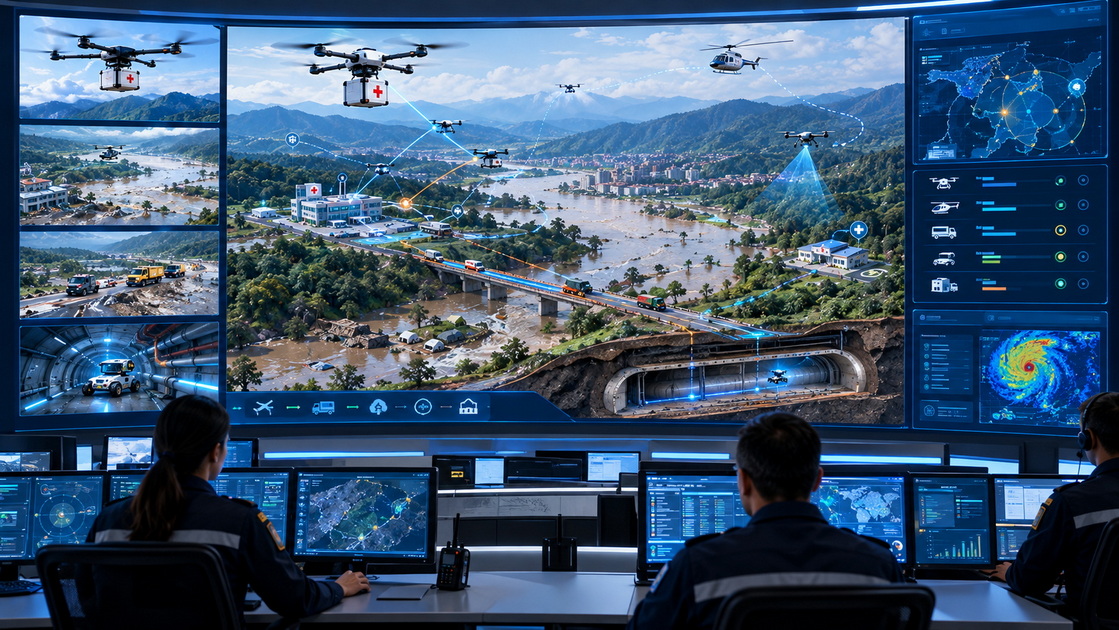
They should operate as part of one network.
A unified cloud control platform can connect:
- Cargo drones
- Inspection drones
- Indoor drones
- Underground detection devices
- Ground robots
- Field personnel
- Emergency vehicles
- Cameras and sensors
- Delivery lockers
- Weather monitoring systems
- Dispatch centers
- Data analysis tools
This creates one operational view across low-altitude airspace, ground environments, and underground locations.
Imagine a regional city facing severe flooding after continuous heavy rainfall.
Several roads are closed. One bridge has been damaged. Three rural clinics are isolated. A utility substation has lost communication access. Emergency shelters need medical supplies and portable power equipment.
A coordinated response could work as follows:
1. A fixed-wing cargo aircraft transports bulk emergency supplies to the regional airport.
2. Trucks move accessible cargo to local distribution centers.
3. Helicopters transport rescue personnel and heavy equipment to remote locations.
4. Inspection drones assess road conditions, floodwater depth, damaged bridges, and safe landing zones.
5. Cargo drones deliver medical packages, communication batteries, portable radios, and diagnostic supplies directly to isolated clinics.
6. Ground robots support indoor or underground inspection where human access is dangerous.
7. A unified command platform monitors aircraft, personnel, routes, deliveries, and incident updates in real time.
This model improves speed, visibility, and resource allocation. It also reduces the risk of sending responders into areas without sufficient operational information.
Organizations should begin with emergency mission planning rather than aircraft procurement.
The first step is to identify the delivery missions where drone logistics can create clear operational value.
Start with lightweight items that become critical when delayed.
Examples include:
- Blood and medical supplies
- Medicines and vaccines
- Diagnostic samples
- Communication equipment
- Replacement batteries
- Small repair components
- Emergency sensors
- Portable power accessories
- Field documentation devices
Create a regional map that includes:
- Hospitals
- Clinics
- Emergency operation centers
- Fire and rescue stations
- Warehouses
- Airports and heliports
- Utility sites
- Industrial facilities
- High-risk zones
- Flood-prone roads
- Mountain or forest areas
- Emergency shelters
This map helps determine where drone stations and delivery points should be located.
A drone should not operate as an isolated system.
Each emergency workflow should define:
- Where cargo begins
- Who approves the mission
- Which transport method handles the first stage
- Where cargo is transferred
- How the final delivery is completed
- Who receives the package
- How delivery confirmation is recorded
- What happens if weather or communication conditions change
Emergency plans should be tested before a real incident occurs.
Useful drills include:
- Flood-related clinic resupply
- Wildfire emergency communication delivery
- Industrial site equipment failure
- Mountain rescue supply delivery
- Remote utility repair support
- Hospital-to-clinic medical sample transfer
- Underground inspection and hazard detection
- Multi-agency emergency dispatch coordination
The goal is to identify operational gaps before they affect a real mission.
A mature emergency logistics program should track clear performance indicators.
Useful metrics include:
- Dispatch time
- Flight preparation time
- Delivery completion time
- Mission success rate
- Weather-related cancellation rate
- Delivery accuracy
- Cargo integrity
- Response coverage area
- Cost per urgent mission
- Road distance avoided
- Safety events
- Equipment availability
These measurements help organizations improve their network over time.
Drone logistics solutions and traditional air freight should be viewed as complementary tools for regional emergency transport.
Drones deliver speed, direct access, flexible routing, and real-time information. They are especially valuable for lightweight, urgent cargo when roads are blocked or communities are isolated.
Traditional air freight delivers payload capacity, long-range coverage, personnel transport, and large-scale emergency support. It remains essential for major relief operations, evacuation, heavy equipment movement, and bulk resupply.
The strongest emergency transport strategy combines both systems through one connected operational network. Bulk supplies can move through traditional air freight. Priority items can move through cargo drones. Ground and underground equipment can support inspection, distribution, and access in complex environments.
A unified intelligent cloud control platform can bring these resources together, enabling coordinated command, dispatch, monitoring, and management across multiple emergency locations.
SIDT supports this future-ready model by integrating intelligent flight platforms, dynamic perception, precise data collection, and intelligent analysis across low-altitude, ground, and underground environments. The result is a more connected, responsive, and resilient emergency logistics system for regional operations.
1. Federal Aviation Administration.
2. Federal Aviation Administration.
3. U.S. Department of Transportation Office of Inspector General.
4. Oakey, A. et al.
5. Edwards, D. et al.
6. FireRescue1.
7. A2Z Drone Delivery.


