Global Distributors Wanted
1.Free Cloud Service Deployment
2.Free Technical Training
3.Exclusive Territory Protection

1.Free Cloud Service Deployment
2.Free Technical Training
3.Exclusive Territory Protection


Views: 211 Author: Aaron Publish Time: 2026-10-01 Origin: Site


Content Menu
● Why Logistics Is Harder at Isolated Construction Sites
● Drone Large Cargo Transport vs Road Freight: Main Differences
● When Drone Large Cargo Transport Makes Sense
>> Urgent Spare Parts for Equipment Maintenance
>> Difficult Terrain and Unreliable Roads
>> High-Value and Low-Volume Cargo
>> Emergency Response and Site Safety
● When Road Freight Is Still the Better Choice
>> Heavy and High-Volume Materials
>> Planned and Consolidated Deliveries
>> Operating in Challenging Weather
>> How a Ground-Air Logistics Network Works
>> Benefits of an Integrated Platform
● A Better Way to Compare Costs
● Practical Decision Process for Construction Teams
>> Step 2: Measure the Cost of Delay
>> Step 3: Compare Ground and Aerial Routes
>> Step 4: Confirm Operational Readiness
>> Step 5: Apply a Hybrid Dispatch Rule
● Safety, Compliance, and Reliability
● Expert View: Response Time Is the Real Advantage
● Summary
● FAQ
>> 1. What is drone large cargo transport?
>> 2. Can cargo drones replace road freight for construction projects?
>> 3. What items can a cargo drone deliver to a remote construction site?
>> 4. Is drone cargo transport cost-effective?
>> 5. What are the main challenges of cargo drone delivery?
>> 6. How can drones help during a construction emergency?
>> 7. Why is a cloud control platform important for drone logistics?
For isolated construction projects, drone large cargo transport can significantly improve the delivery of urgent, lightweight, and high-value materials, while road freight remains essential for bulk supplies, heavy machinery, and scheduled deliveries.
The most effective approach is not choosing drones or trucks exclusively. It is building a coordinated ground-air logistics system in which each transport method is used for the job it performs best. Road freight provides scale and carrying capacity. Cargo drones provide speed, direct access, and rapid response when roads are slow, damaged, unsafe, or unavailable.
Remote construction sites often operate in difficult environments. Mountain roads, forest tracks, islands, mining areas, tunnels, rural infrastructure corridors, and disaster-affected locations can create major transport challenges. A missing spare part, a damaged sensor, or an urgent safety item may be small in size, but its absence can stop an entire work crew.
This is where drone large cargo transport creates practical value. By moving selected cargo directly from a logistics hub to a work zone, cargo drones can reduce response time, support maintenance activities, and improve project continuity.
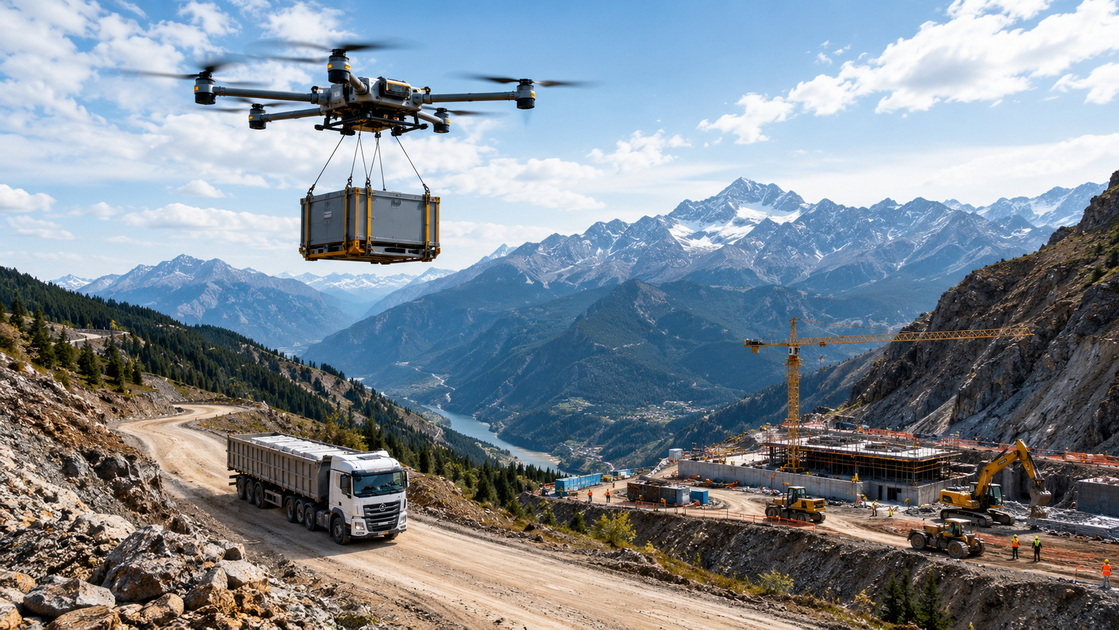
Construction logistics in cities usually benefits from nearby suppliers, paved roads, large warehouses, and predictable delivery routes. Isolated projects work under very different conditions.
A remote hydropower station, mining site, wind farm, transmission-line project, mountain tunnel, rural telecommunications build, or emergency reconstruction project may be located far from the nearest logistics center. Even when the site is not far in a straight line, the available road route may be long, indirect, unstable, or seasonally inaccessible.
Project managers must consider more than the transportation price shown on a freight quotation. The real impact of delayed delivery can include:
- Equipment standing idle while waiting for a replacement part.
- Construction workers unable to continue a task.
- Delayed inspections and maintenance activities.
- Unplanned overtime and labor costs.
- Missed project milestones.
- Higher inventory levels stored on site.
- Increased safety risks for drivers using difficult roads.
- Greater fuel use and road wear from repeated small deliveries.
A construction site does not always need a full truckload. Sometimes it needs one urgent item delivered safely and quickly. That distinction is central to the decision between drone large cargo transport and road freight.
Drone cargo transport and road freight serve different operational purposes. The right choice depends on cargo weight, urgency, route conditions, delivery frequency, weather, regulation, and the cost of delay.
| Comparison Factor | Drone Large Cargo Transport | Road Freight |
|---|---|---|
| Best application | Urgent, lightweight, high-value, time-sensitive cargo | Heavy materials, bulk loads, regular scheduled deliveries |
| Route type | Direct aerial route over difficult terrain | Road-based route using available transport infrastructure |
| Payload capacity | Limited by aircraft design, range, energy, and operating conditions | High capacity for heavy, oversized, and mixed cargo |
| Delivery speed | Often faster for urgent last-mile deliveries | Can be slow when roads are indirect, damaged, or congested |
| Terrain impact | Can bypass rivers, steep slopes, road closures, and rough tracks | Strongly affected by road conditions, bridge limits, and access restrictions |
| Infrastructure requirement | Launch area, landing zone, cloud platform, communication network, trained operators | Roads, vehicles, drivers, loading equipment, fuel, and maintenance facilities |
| Weather impact | More sensitive to wind, rain, low visibility, and temperature | Also affected by weather, but can operate in a wider range of conditions |
| Cost efficiency | Strong value for urgent and low-volume missions | Strong value for high-volume and heavy freight |
| Safety focus | Flight planning, cargo security, emergency landing procedures, airspace management | Driver safety, vehicle condition, route planning, traffic management |
| Operational role | Rapid response, emergency supply, inspection support, urgent spare parts | Supply chain backbone for materials, machinery, fuel, and inventory |
The comparison shows that cargo drones are not designed to replace truck fleets. They are designed to solve time-sensitive delivery problems that trucks cannot always solve efficiently.
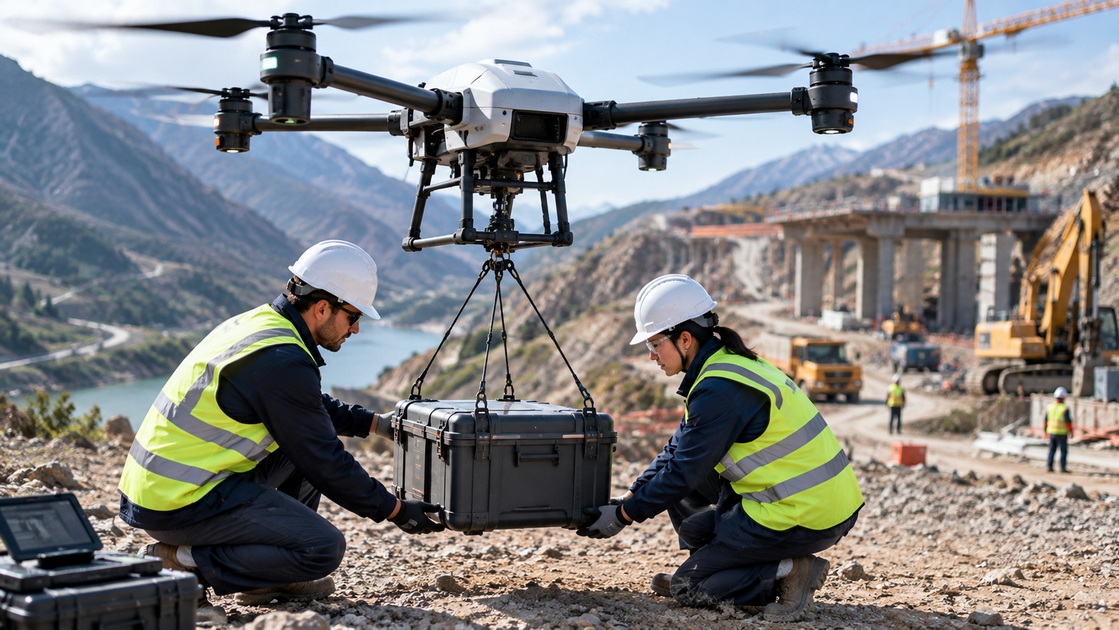
Remote construction sites often rely on heavy machinery, monitoring systems, generators, surveying tools, communications equipment, and inspection devices. A small mechanical or electronic component can be critical to project continuity.
For example, a failed sensor module, hydraulic fitting, electrical relay, battery pack, tool insert, or GPS device may weigh only a few kilograms. However, if that item is unavailable, an excavator, inspection team, or power system may remain out of service.
A cargo drone can be particularly useful when the nearest logistics hub is close in aerial distance but far away by road. Instead of sending a truck on a multi-hour trip through mountainous or unstable terrain, a drone may complete the urgent mission in a much shorter time.
Suitable items for drone delivery can include:
- Mechanical spare parts.
- Electrical components.
- Sensors and monitoring devices.
- Batteries and communication equipment.
- Surveying instruments.
- Fasteners and specialized tools.
- Safety equipment.
- Medical kits.
- Inspection accessories.
- Emergency repair materials.
The central question is not simply whether a drone can carry the item. The question is whether the item's urgent arrival can prevent costly downtime.
Remote construction sites can be affected by terrain that makes road freight unreliable. A single landslide, flood, damaged bridge, fallen tree, or severe weather event can block access to a site for hours or days.
Aerial routes can provide an alternative when ground routes are restricted. This is valuable for projects located in:
- Mountain areas.
- Forest regions.
- Islands and coastal zones.
- Mining and quarry operations.
- Rural energy projects.
- Power transmission corridors.
- Disaster recovery zones.
- Remote utility installations.
- Tunnel and underground construction locations.
A cargo drone can bypass many obstacles that slow road freight. It can fly directly over rivers, uneven terrain, inaccessible valleys, and temporary road closures, provided that the operation is properly planned and conducted within applicable aviation and safety requirements.
Cargo drones are most valuable when time matters more than volume.
A truck is usually the better choice for transporting large quantities of materials. A drone can be the better choice when one urgent item prevents a major delay.
Consider a construction project where an inspection system cannot operate because of one replacement component. The component may have a low purchase price, but the delay may affect labor, equipment, inspection schedules, and project deadlines.
In this situation, the transportation decision should be based on total operational impact:
Delivery Value=Avoided Downtime Cost+Avoided Risk Cost−Transport Cost
If the avoided downtime cost is much higher than the cost of a drone mission, aerial transport can be a practical decision.
Remote projects need fast access to emergency supplies. Cargo drones can support site safety by delivering first-aid materials, communication devices, small rescue tools, protective equipment, or urgent maintenance supplies.
This is especially useful when road access is delayed or when workers are located in difficult-to-reach zones. In a large remote project, a fast delivery system can improve response coordination and reduce the time required to bring essential items to the work area.
An integrated control platform can support this process by connecting aerial delivery missions with site monitoring, team locations, equipment status, and emergency dispatch procedures.
Road freight remains the main logistics solution for most construction materials. Its greatest advantage is capacity.
Road freight is the practical choice for transporting:
- Cement, sand, gravel, and aggregate.
- Steel beams and reinforcement bars.
- Pipes and cable reels.
- Heavy machinery and construction equipment.
- Generators and compressors.
- Fuel and water supplies.
- Precast components.
- Large tools and containers.
- Bulk consumables.
- Prefabricated building modules.
These materials are too heavy, too large, or too numerous for routine drone transportation. Even where heavy-lift drones are technically available, trucks generally offer better capacity and lower cost per kilogram for large shipments.
Road freight works best when a project has accurate material planning. Scheduled deliveries allow companies to consolidate multiple items into one shipment, reduce empty vehicle movements, and improve delivery efficiency.
A well-planned truckload is usually more economical than multiple small urgent trips.
Construction teams should therefore improve material forecasting, inventory planning, and supplier coordination. The better a project predicts its routine needs, the more efficiently it can use road freight.
Cargo drone operations are more sensitive to wind, rain, visibility, temperature, and communication conditions. A drone system should always include clear weather limits and mission-abort procedures.
Road freight can also face weather-related risks, especially in mountains or flood-prone locations, but trucks can generally operate in a wider range of conditions than drones.
For this reason, a reliable logistics system should never depend on a single transport method. Road freight should remain available as a backup and as the primary transport method for major deliveries.
The most effective solution for isolated construction projects is usually a hybrid logistics model.
In this approach, trucks handle the large-scale movement of materials, while cargo drones handle urgent deliveries between a regional hub and the site.

1. Road freight delivers bulk inventory to a regional warehouse or forward logistics hub.
2. The logistics hub stores frequently needed spare parts, tools, safety supplies, and inspection equipment.
3. Site supervisors, maintenance teams, and field workers submit urgent delivery requests through a unified operations platform.
4. The system checks cargo weight, urgency, drone availability, weather conditions, flight route, road access, and delivery priority.
5. A cargo drone delivers the selected item directly to the remote work zone when aerial transport is faster or safer than ground transport.
6. Ground personnel confirm receipt of the cargo through a digital process.
7. The platform records delivery status, equipment data, mission history, and inventory movement.
This model creates a more responsive supply chain. Trucks establish the logistics backbone. Drones provide a rapid response layer for urgent needs.
For companies operating across low-altitude, ground, and underground environments, the ability to manage multiple assets through one cloud control platform is especially valuable. A unified system can coordinate equipment, routes, personnel, emergency procedures, data collection, and operational reporting.
An intelligent cloud control platform can help project teams manage:
- Real-time delivery requests.
- Cargo mission scheduling.
- Drone flight status.
- Weather monitoring.
- Route planning.
- Equipment location tracking.
- Inventory movement.
- Maintenance records.
- Emergency response workflows.
- Ground-air communication.
- Delivery confirmation.
- Operational data analysis.
Instead of using separate tools for drones, vehicles, inspection teams, and inventory, a unified platform allows different project resources to work as one connected system.
A simple comparison between the price of one truck trip and one drone mission does not provide a complete answer. Construction managers should measure the total operating impact of each transport decision.
Direct cost includes fuel or electricity, labor, maintenance, loading, unloading, insurance, dispatch, and equipment operation.
Road freight normally offers better cost efficiency for high-volume cargo. Drone delivery can be more suitable for small urgent loads where mobilizing a truck would create unnecessary delay or expense.
Downtime is often the largest hidden cost in remote construction logistics.
A failed component may stop a machine, delay inspection work, or prevent a crew from completing a scheduled task. The financial loss from several hours of downtime can be far greater than the cost of an urgent aerial delivery.
This is why projects should calculate the cost of delay before rejecting drone transport based only on freight price.
Remote sites often hold extra inventory because managers are concerned about delivery delays. This can protect operations, but it also increases storage needs, capital tied up in stock, and the risk of obsolete parts.
A reliable drone delivery system may allow some projects to reduce selected emergency inventory levels. Instead of storing every possible spare part at the site, the project can maintain critical stock at a nearby forward hub and deliver it on demand.
Road deliveries to isolated sites may expose drivers to steep roads, unstable terrain, night driving, poor visibility, and long travel times. Cargo drones do not eliminate operational risks, but they can reduce the number of urgent vehicle trips required under difficult conditions.
Repeated vehicle trips can increase fuel consumption, dust, noise, road damage, and emissions. Drone operations also require responsible planning, especially regarding noise, wildlife, and nearby communities.
The best approach is not to assume that one mode is automatically more sustainable. Project teams should evaluate total energy use, mission frequency, route distance, vehicle loading, and the environmental sensitivity of the site.
Before choosing drone large cargo transport or road freight, construction managers can follow a clear decision process.
Start by identifying the cargo type.
Ask the following questions:
- What is the weight and volume?
- Is the item urgent?
- Is it high-value?
- Is it fragile?
- Does it require temperature control?
- Is it hazardous or restricted?
- Can it be securely packaged for aerial delivery?
- Does it require specialized handling?
This step helps determine whether the cargo is suitable for road transport, drone transport, or a combination of both.
The next step is to estimate what happens if the item arrives late.
A low-cost part may be highly important if it is needed to restart equipment, complete an inspection, or maintain safe operations. The urgency should be measured by its effect on the project schedule, not only by its purchase price.
Evaluate both delivery paths.
For the road route, consider:
- Total driving distance.
- Road condition.
- Travel time.
- Fuel consumption.
- Driver availability.
- Weather exposure.
- Road closure risk.
- Bridge and weight restrictions.
For the aerial route, consider:
- Direct flight distance.
- Terrain conditions.
- Weather limits.
- Communication coverage.
- Launch and landing zones.
- Payload capacity.
- Emergency landing locations.
- Airspace conditions.
A site that is 20 kilometers away by road may be only 7 kilometers away by air. This difference can make drone delivery highly valuable for urgent cargo.
A cargo drone program requires more than an aircraft. It also requires disciplined procedures and reliable infrastructure.
Key operating requirements include:
- Suitable cargo drone capacity.
- Secure payload attachment.
- Approved launch and landing areas.
- Real-time communications.
- Weather monitoring.
- Route-planning capability.
- Emergency procedures.
- Trained personnel.
- Cargo handover process.
- Maintenance planning.
- Digital mission records.
- Clear site safety rules.
A drone should be treated as part of a complete logistics system, not as an isolated device.
A simple operational rule can help teams make consistent decisions:
- Use road freight for heavy, bulky, planned, and consolidated shipments.
- Use cargo drones for urgent, lightweight, high-value, and time-sensitive cargo.
- Use both transport methods when trucks can supply a forward hub and drones can complete urgent final delivery.
This approach helps construction projects gain the strengths of both systems without forcing one technology to perform a task it was not designed to handle.
Cargo drone operations must be planned with the same level of care as any other industrial transport activity.
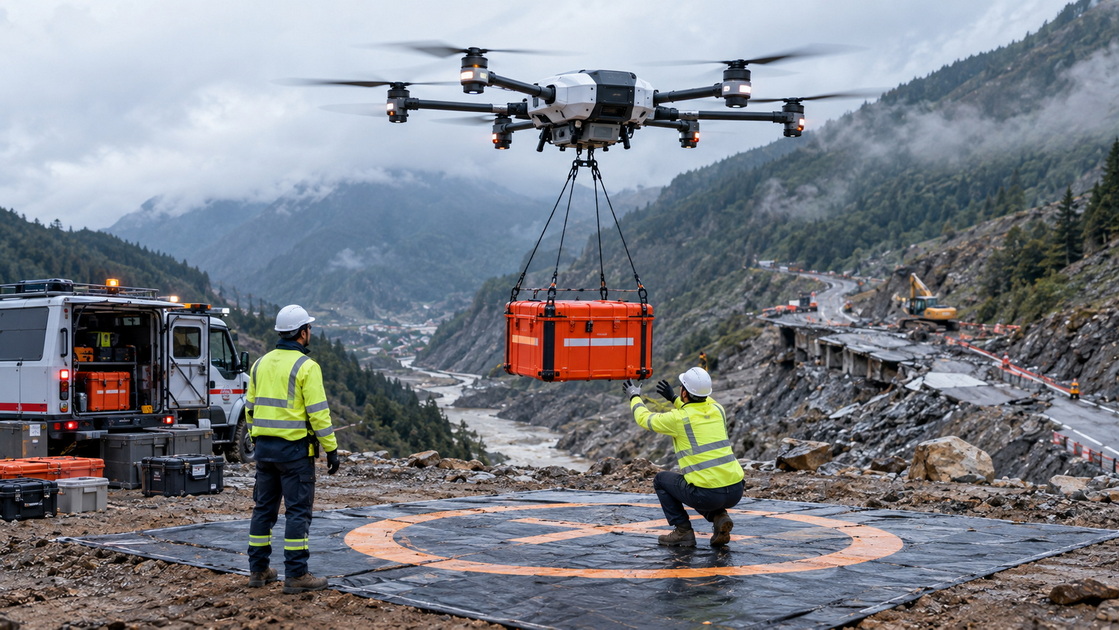
A professional program should include:
- Clear cargo weight limits.
- Secure packaging procedures.
- Pre-flight inspection checklists.
- Flight route risk assessments.
- Weather operating limits.
- Restricted-zone management.
- Emergency landing procedures.
- Communication failure procedures.
- Ground crew training.
- Delivery verification.
- Data recording and mission reporting.
- Regular equipment maintenance.
Hazardous materials require particularly careful evaluation. Many jurisdictions have strict rules for dangerous goods, battery transport, fuel, chemicals, and other regulated cargo. Construction companies should confirm local aviation, safety, customs, privacy, and land-use requirements before beginning cargo drone operations.
Reliable operations depend on repetition, testing, documentation, and continuous improvement. A successful cargo drone program should begin with a focused pilot project, then expand only after it has demonstrated safe and measurable operational value.
The greatest value of drone large cargo transport is not that it can carry everything a truck carries. It cannot.
Its true advantage is response time.
Construction projects are often affected by unexpected events:
- Equipment failure.
- Road closures.
- Severe weather.
- Urgent inspection findings.
- Safety incidents.
- Missing components.
- Communication failures.
- Sudden changes to the work schedule.
Traditional logistics systems are designed mainly for planned movement. Cargo drone networks add a rapid-response capability that can help teams manage unplanned events.
The most capable remote construction logistics network is one that can answer two questions quickly:
1. What does the site need now?
2. What is the safest and fastest way to deliver it?
When drone operations, road freight, site monitoring, inventory data, emergency procedures, and dispatch decisions are connected through one platform, the project becomes more resilient.
For isolated construction projects, this can mean fewer delays, better visibility, faster maintenance support, and stronger coordination between low-altitude operations and ground teams.
Drone large cargo transport and road freight are both important tools for isolated construction projects, but they perform different roles.
Road freight remains essential for transporting heavy machinery, bulk materials, fuel, structural components, and planned shipments. It provides the scale required to keep a construction site supplied.
Drone large cargo transport is most valuable when the cargo is urgent, lightweight, high-value, and difficult to deliver by road. It can help projects overcome terrain barriers, reduce response time, support emergency deliveries, and minimize costly equipment downtime.
The strongest logistics strategy is a hybrid model. Trucks create the supply foundation, while cargo drones provide rapid delivery for time-sensitive needs. A unified cloud control platform can coordinate the movement of people, equipment, data, and cargo across low-altitude and ground environments.
For remote construction projects seeking greater resilience, the goal should not be to replace one transport method with another. The goal should be to create an intelligent logistics network where every delivery uses the most effective route, vehicle, and operational process.
Explore how an integrated ground-air logistics solution can improve urgent material delivery, construction-site response time, equipment availability, and operational visibility across your isolated projects.
Drone large cargo transport refers to the use of industrial cargo drones to carry materials, tools, equipment, spare parts, or emergency supplies between logistics hubs and remote locations. The available payload capacity depends on the drone model, mission range, weather conditions, and operating approval.
Cargo drones cannot fully replace road freight for most construction projects. Trucks remain the preferred transport method for bulk materials, heavy machinery, steel, fuel, aggregate, and large equipment. Drones are more suitable for urgent, lightweight, and high-value cargo.
A cargo drone may deliver spare parts, sensors, batteries, tools, surveying equipment, communication devices, safety supplies, medical kits, fasteners, inspection components, and emergency repair materials. Each item must meet the aircraft's weight, size, packaging, and safety requirements.
Drone cargo transport can be cost-effective when it prevents expensive downtime, avoids unsafe vehicle travel, or reduces the time needed to deliver urgent items. It is generally less cost-effective than road freight for large-volume or heavy shipments.
The main challenges include payload limitations, flight range, weather conditions, airspace restrictions, communication reliability, landing-zone requirements, cargo security, and operating approvals. Successful deployment requires careful planning and clear operating procedures.
Drones can quickly transport first-aid supplies, communication equipment, small tools, repair components, and emergency materials when road access is delayed. They can also support site awareness by providing aerial views and real-time information to operational teams.
A cloud control platform helps manage cargo missions, drone status, weather, route planning, inventory data, delivery confirmation, maintenance records, and emergency response. It connects aerial and ground resources through one coordinated operational system.
1. Federal Aviation Administration. "Package Delivery by Drone (Part 135)."
2. Federal Aviation Administration. "Unmanned Aircraft System (UAS) or Drone Operations."
3. Federal Aviation Administration. "Small Unmanned Aircraft Systems Regulations (Part 107)."
4. U.S. Department of Transportation Intelligent Transportation Systems Knowledge Resources. "Model Results Showed that Depot-Based Drone Delivery Led to up to 60 Percent Cost Savings Compared to Truck-Only Delivery When Servicing Low Demand in Small Areas."
5. World Economic Forum. "Here's How Drone Delivery Will Change the Face of Global Logistics."
6. World Economic Forum. "Autonomous Drone Networks Are a Faster Route to Sustainable Supply Chains."


