Global Distributors Wanted
1.Free Cloud Service Deployment
2.Free Technical Training
3.Exclusive Territory Protection

1.Free Cloud Service Deployment
2.Free Technical Training
3.Exclusive Territory Protection


Views: 221 Author: Aaron Publish Time: 2026-10-17 Origin: Site


Content Menu
● Drone Food Delivery vs Traditional Courier Platforms: Key Differences
● Delivery Speed: Measure the Complete Journey
>> Flight Time Is Not Order-to-Door Time
>> What Recent Industry Data Actually Shows
● Meal Quality: Fast Delivery Still Needs Protective Packaging
>> Temperature and Texture Require Different Controls
>> Shorter Travel Does Not Automatically Mean Safer Food
● Reliability: Compare Difficult Deliveries, Not Just Successful Ones
>> Drone Food Delivery Depends on Route Eligibility
>> Traditional Couriers Offer Greater Handoff Flexibility
● Payload and Access: Which Meals Fit Each Model?
>> Drone Eligibility Extends Beyond Weight
>> Building Access Can Reverse the Speed Advantage
● Delivery Economics: Compare Cost per Successful Meal
● Safety, Regulation, and Community Acceptance
>> Flight Capability Is Not Operating Permission
>> Responsible Deployment Includes the Receiving Area
● A More Useful Decision Model: Match Each Order to Its Quality Deadline
● How SIDT's "One-Network Coverage" Fits Meal Delivery
● A Practical Pilot for Restaurants and Delivery Operators
● Build a Delivery Network Around the Meal
>> 1. Is drone food delivery always faster than traditional couriers?
>> 2. Which meals are best suited to drone delivery?
>> 3. Can drones deliver food to apartment buildings?
>> 4. Is drone food delivery cheaper for restaurants?
>> 5. Can restaurants use drones and traditional couriers together?
>> 6. What should a restaurant verify before choosing SIDT?
Drone food delivery vs traditional courier platforms is not simply a contest between aircraft and drivers. For time-sensitive meals, the better option is the one that delivers food within its quality window, reaches the customer reliably, and handles exceptions without creating another delay.
My assessment is straightforward: drones are a strong option for lightweight meals traveling along approved routes to suitable receiving areas. Traditional couriers remain more flexible for large orders, complicated buildings, and deliveries outside drone operating conditions.
The most practical strategy is often coordination: using aerial and ground delivery together rather than expecting either to handle every order.
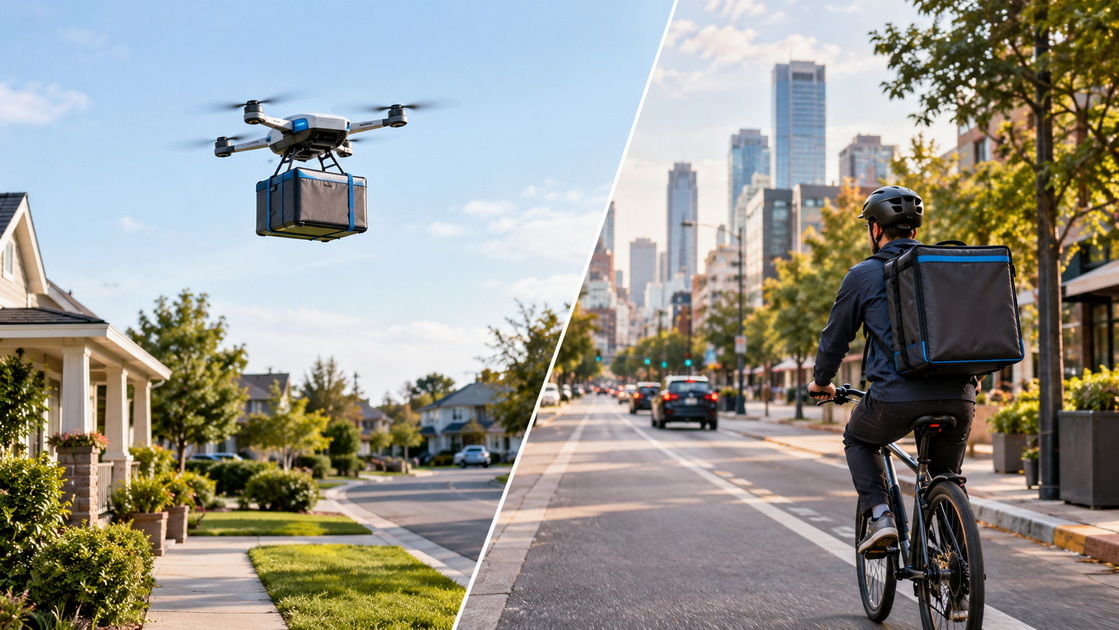
One distinction matters before comparing performance. A drone is a transportation method; a courier platform is a system for ordering, payment, dispatch, tracking, and customer support. Platforms can integrate drones alongside human couriers.
For this comparison, "traditional courier platforms" means app-based services that primarily assign meal deliveries to drivers, cyclists, or riders.
| Decision factor | Drone food delivery | Traditional courier platforms |
|---|---|---|
| Strongest application | Lightweight orders on eligible routes | Diverse orders and complex destinations |
| Travel constraints | Airspace, weather, aircraft limits | Traffic, road access, parking |
| Customer handoff | Approved receiving area | Entrance, reception, or agreed meeting point |
| Order capacity | Aircraft-specific weight and volume limits | Depends on vehicle and courier equipment |
| Building access | Usually requires a separate ground solution | Can accommodate building instructions where permitted |
| Operating flexibility | Depends on flight approvals and conditions | Depends on courier availability and local conditions |
| Cost assessment | Requires full system and utilization analysis | Requires total fees and service-performance analysis |
These are operating tendencies, not universal performance guarantees. Local conditions determine which option works better.

The useful measurement begins when the customer orders and ends when the customer receives the meal.
That journey includes:
1. Restaurant preparation.
2. Dispatch and vehicle availability.
3. Packaging and loading.
4. Transportation.
5. Drop-off and customer retrieval.
A faster transportation stage cannot eliminate a kitchen backlog. Likewise, a short flight offers limited value if the customer must leave an office tower and search for the receiving point.
I would therefore compare both order-to-receipt time and ready-to-receipt time. The first reflects customer experience; the second helps isolate delivery performance.
In its September 30, 2026 announcement, DoorDash reported initial-test delivery times averaging under five minutes from restaurant to customer door for its purpose-built drone system.
That figure needs context. It came from a sample of deliveries with limited distances and sizes, and DoorDash explicitly stated that delivery times were not guaranteed. It does not establish a universal five-minute ordering experience or prove superiority over every courier route.
The useful takeaway is narrower: drones can make the transportation stage very short under suitable conditions. Buyers should request comparable route-level evidence before setting customer promises.
Food quality involves more than warmth. Fried food can lose crispness through trapped moisture. Drinks can spill. Cold desserts can soften while waiting for dispatch.
Both delivery methods need packaging appropriate to the menu and expected journey. Drone delivery adds aircraft-specific loading and attachment requirements; courier delivery adds its own handling and vehicle-storage considerations.
Before approving a menu item, test:
- Temperature at packing and receipt.
- Leakage and container movement.
- Texture after the complete delivery cycle.
- Separation of hot and cold items.
- Packaging weight and usable dimensions.
A meal should qualify because it survives the process, not merely because it fits.
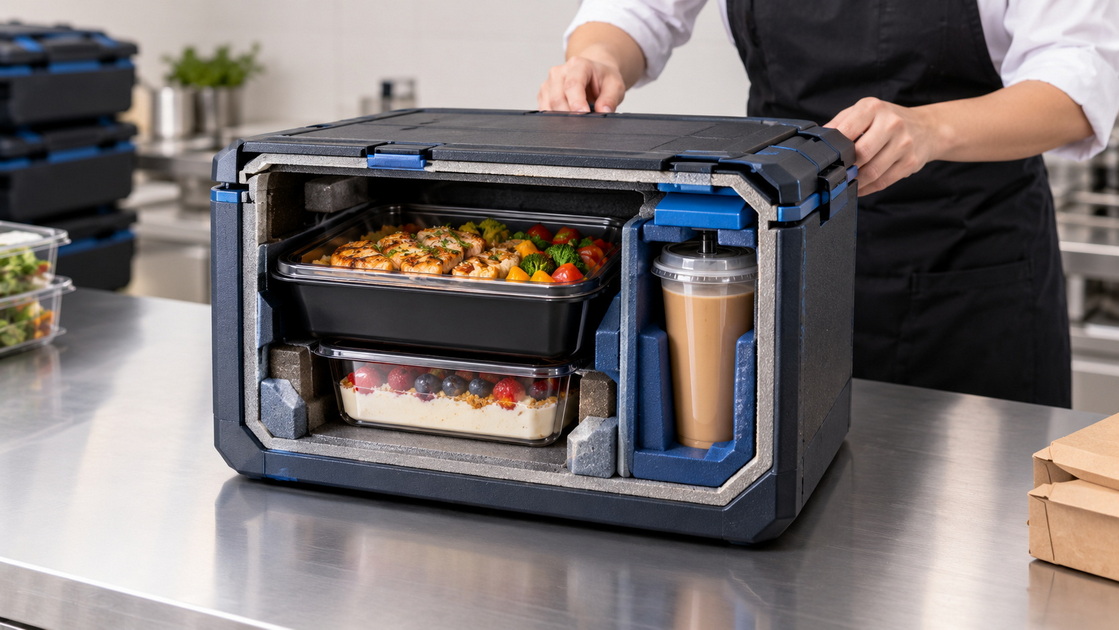
USDA consumer guidance recommends keeping hot food at 140°F or above and cold food at 40°F or below. It also advises discarding perishable food left at room temperature for more than two hours, or one hour when temperatures exceed 90°F.
These are consumer safe-handling guidelines, not a substitute for applicable commercial food-service requirements. Restaurants must follow their jurisdiction's rules and validated procedures.
A drone should therefore be evaluated as part of a food-handling system—not treated as a replacement for temperature control.
DoorDash's customer guidance identifies several practical restrictions: address eligibility, designated delivery zones, weight and volume limits, and weather-related interruptions. Its drone service is generally available during daylight hours, although hours can vary.
Aircraft and operator capabilities differ. Procurement teams should request the specific operating envelope rather than assuming that every drone has the same weather tolerance or payload capacity.
Required questions include:
- Is the complete route approved?
- Is the receiving area suitable?
- What conditions trigger a suspension?
- What happens after a failed delivery attempt?
Human couriers can communicate about entrances, reception desks, and meeting points. That adaptability is valuable for hospitals, offices, apartment buildings, and unfamiliar addresses.
However, flexibility does not guarantee speed. Road congestion, access restrictions, and courier availability still need measurement.
For time-sensitive meals, evaluate the 90th-percentile delivery time: the time within which 90% of orders arrive. This reveals slow deliveries that an attractive average can conceal.
Also track cancellations, failed handoffs, refunds, and reassignment delays.
DoorDash reported that approximately 80% of typical restaurant orders were small and light enough for its announced aircraft. Its estimate was based on deliveries with limited distance, size, and measurement periods.
That is an aircraft-specific estimate—not evidence that 80% of restaurant orders everywhere can immediately switch to drones.
Actual eligibility also depends on:
- Packaging dimensions and total loaded weight.
- Food and beverage configuration.
- Route and weather conditions.
- Aircraft availability.
- A suitable delivery zone.
A single meal may qualify while a family bundle from the same restaurant does not.
A drone reaching a designated outdoor area is not necessarily equivalent to a courier reaching reception.
For an office customer, include the time spent walking downstairs and collecting the meal. For a campus, compare centralized collection against delivery to individual buildings.
This makes "customer retrieval time" an important metric. Fast arrival at the wrong handoff point can produce a slower practical experience.
There is no defensible universal claim that drone food delivery is cheaper than traditional couriers.
Aircraft operations can involve equipment, maintenance, batteries, supervision, insurance, infrastructure, software, and compliance. Courier-platform economics involve their own fees, labor arrangements, support costs, and service conditions.
For an operator-level comparison, use:
> Cost per successful delivery = total attributable operating cost ÷ successfully completed deliveries
For a restaurant choosing between services, compare:
- Total charges per fulfilled order.
- Additional packaging and staff time.
- Refunds, redeliveries, and wasted meals.
- Integration and onboarding expenses.
- Any minimum-volume commitments.
Keep the perspective consistent. A customer's delivery fee, a restaurant's platform charge, and an operator's delivery cost are different figures.
In the United States, the Federal Aviation Administration's package-delivery guidance identifies Part 135 certification, airspace authorization, and applicable exemptions or waivers as central requirements for commercial drone delivery beyond visual line of sight.
Operators must also address relevant environmental review and state and local requirements.
Requirements differ across countries. A technically capable aircraft does not automatically have permission to serve a proposed restaurant or neighborhood.
Assessment should cover loading procedures, communications failures, emergency responses, maintenance, and safe package retrieval.
Noise and neighborhood concerns also matter. The FAA notes that drone noise may affect communities even when it does not meet the threshold for a significant environmental impact.
Restaurants and property managers should therefore evaluate receiving-site suitability and community communication before launch—not after complaints arise.
Rather than asking, "Which vehicle is fastest?", ask, "Which approved method can reliably meet this meal's deadline?"
Consider an illustrative order that must reach the customer within 20 minutes of preparation:
| Stage | Drone scenario | Courier scenario |
|---|---|---|
| Loading or pickup wait | 4 minutes | 2 minutes |
| Transportation | 6 minutes | 12 minutes |
| Handoff and retrieval | 5 minutes | 2 minutes |
| Total after preparation | 15 minutes | 16 minutes |
These are hypothetical planning figures, not measured industry averages.
The example shows why transportation speed alone can mislead. A much faster flight produces only a small overall advantage when loading and retrieval take longer.
Change the destination to a building with difficult outdoor access, and the courier may become the better choice. Change the route to one with severe road congestion and easy receiving access, and the drone may gain more value.
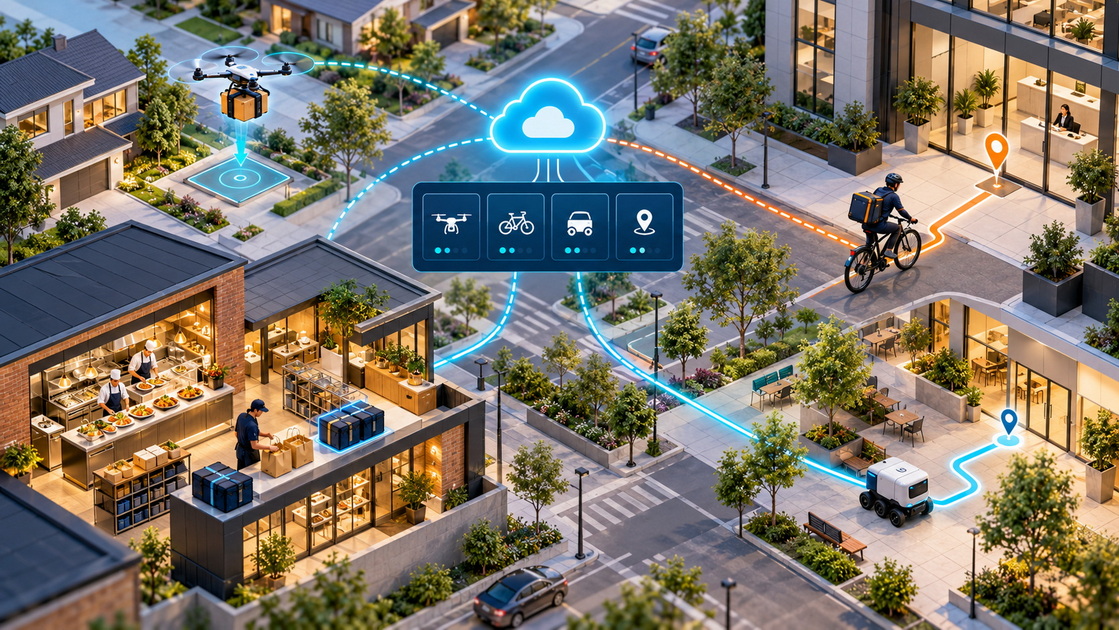
According to the supplied company background, Shenzhen Intelligent Drone Technology Co. Ltd. develops integrated application solutions spanning low-altitude, ground, and underground environments.
Its stated approach combines dynamic perception, data collection, intelligent analysis, and unified cloud-based command and management. SIDT describes "one-network coverage" as coordination across equipment, spaces, and multiple nodes.
For meal delivery, this suggests a useful systems-level direction:
- Connect restaurant readiness with dispatch decisions.
- Coordinate aerial transportation and ground handoffs.
- Share status information across participating nodes.
- Reassign orders when the planned mode becomes unavailable.
These are proposed applications of the stated approach, not independently verified SIDT meal-delivery capabilities.
The supplied background does not establish restaurant integrations, food-temperature monitoring, certified delivery routes, operating costs, or measured delivery performance. Those items require project-specific validation.
A controlled pilot should test complete customer journeys rather than showcase isolated flights.
1. Select comparable routes. Group orders by distance, destination type, and meal category.
2. Establish a courier baseline. Record ready-to-receipt times, failures, costs, and complaints.
3. Validate menu packaging. Test spills, temperature, texture, and aircraft compatibility.
4. Define eligibility rules. Include payload, receiving area, weather, and operating approval.
5. Plan fallback before launch. Specify who reassigns orders and updates customers.
6. Review the full sample. Report failed and cancelled orders, not just completed flights.
Use predefined success criteria. A faster average should not justify expansion if failed handoffs or refund rates increase.
The best choice is the method that meets the meal's quality deadline with a dependable handoff and acceptable total cost.
For restaurants, campuses, and delivery operators evaluating SIDT, the next step is a route-level feasibility discussion. Share order weights, peak-hour volumes, restaurant preparation times, destination types, and current delivery performance. Ask SIDT to define the proposed aerial-ground workflow, responsibilities, and pilot acceptance criteria before committing to deployment.
No. Drones can shorten transportation on suitable routes, but kitchen preparation, loading, aircraft availability, and customer retrieval determine the complete experience.
Start with compact orders that meet the specific aircraft's limits. Approve individual menu items only after testing packaging, handling, temperature, and receipt quality.
Some addresses may support an approved receiving zone. However, delivery to that zone does not necessarily include transport to an individual apartment.
Not automatically. Compare total charges, packaging, staff time, failed orders, and contractual commitments against a courier baseline.
Yes. DoorDash already describes coordinating human couriers and autonomous delivery modes. A mixed system can assign eligible orders to drones while retaining ground options.
Request a site-specific proposal covering operating responsibilities, applicable approvals, integrations, receiving infrastructure, fallback procedures, and measurable pilot criteria.
1. DoorDash. "DoorDash Air Unveils Drone Delivery System for Local Businesses." September 30, 2026. Source for initial-test timing, the qualified 80% order-size estimate, and multimodal dispatch strategy.
2. DoorDash Customer Support. "Drone Delivery." Source for delivery-zone requirements, address eligibility, operating hours, weather interruptions, payload restrictions, and customer retrieval procedures.
3. Federal Aviation Administration. "Package Delivery by Drone (Part 135)." Updated September 3, 2026. Source for U.S. operator certification, airspace authorization, environmental responsibilities, and community-engagement requirements.
4. USDA Food Safety and Inspection Service. "Safe Handling of Take-Out Foods." Source for consumer hot- and cold-food guidance and room-temperature time limits.
5. Shenzhen Intelligent Drone Technology Co. Ltd. Company background supplied for this article. Source for SIDT's stated positioning, integrated application approach, and "one-network coverage" concept. No public webpage was supplied.
Editorial assessment: The quality-deadline framework, hypothetical timing example, cost-comparison method, and pilot checklist are analytical recommendations, not reported research findings.


