Global Distributors Wanted
1.Free Cloud Service Deployment
2.Free Technical Training
3.Exclusive Territory Protection

1.Free Cloud Service Deployment
2.Free Technical Training
3.Exclusive Territory Protection


Views: 212 Author: Aaron Publish Time: 2026-10-15 Origin: Site


Content Menu
● Drone Food Delivery vs Car Delivery: At a Glance
● Delivery Speed: Measure the Entire Customer Journey
>> Where Drone Food Delivery Saves Time
>> Where Car Delivery Remains Competitive
● Cost per Successful Delivery: Look Beyond Energy and Wages
>> An Illustrative Break-Even Test
● Payload, Food Quality, and Office Delivery Experience
>> Match the Delivery Mode to the Meal
>> Validate Food Quality Separately from Flight Performance
>> Treat the Receiving Point as Part of the Product
● Weather, Safety, and Regulatory Constraints
>> Permissions Must Be Verified Locally
● Environmental Impact: Compare Equivalent Deliveries
● Industry Case: What Meituan Demonstrates—and What It Does Not
● A Practical Pilot for Traffic-Congested Business Districts
>> 1. Establish a Comparable Ground Baseline
>> 2. Select One High-Friction Corridor
>> 3. Define Eligibility and Fallback Rules
>> 5. Use Predefined Expansion Gates
● How SIDT's Unified Platform Fits a Hybrid Delivery Network
● Conclusion: Choose the Network That Delivers the Better Outcome
>> 1. Is drone food delivery always faster than car delivery?
>> 2. Can drones deliver food directly to office windows?
>> 3. Which food orders are better suited to cars?
>> 4. Is drone delivery automatically more sustainable?
>> 5. What happens when a drone flight is cancelled?
>> 6. What should a business district test before scaling?
Drone food delivery vs car delivery is not simply a race between aircraft and automobiles. In traffic-congested business districts, the better option depends on order size, building access, weather, operating permissions, and the complete journey from restaurant to customer.
Drone food delivery can bypass road congestion on suitable routes. Car delivery offers greater payload flexibility and access to addresses without aerial receiving infrastructure. For many commercial districts, the strongest solution is a hybrid network that assigns each order to the most suitable mode.
My recommendation is to compare completed deliveries, not headline flight speeds. A fast flight creates little value if lunch waits at a collection point or requires a lengthy final handoff.
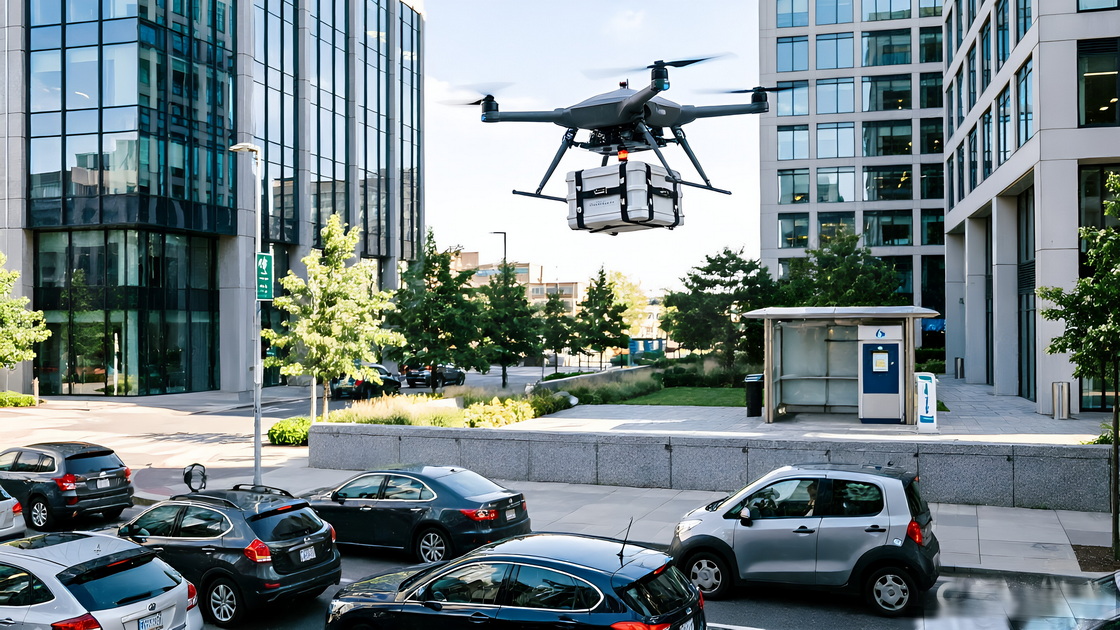
The following comparison is an operational assessment, not a universal performance ranking. Actual results depend on the route, aircraft, vehicle, and delivery model.
| Decision factor | Drone food delivery | Car food delivery |
|---|---|---|
| Congestion exposure | Bypasses road queues during the aerial segment | Directly affected by traffic and curb access |
| Best-fit orders | Lightweight meals within verified payload limits | Larger orders, drinks, and catering |
| Destination access | Requires an approved delivery or receiving arrangement | Uses existing road and building access |
| Weather resilience | Depends on aircraft limits and operating conditions | Often more flexible, but not weather-proof |
| Delivery flexibility | Strongest on established, approved routes | Supports more varied destinations |
| Cost structure | Aircraft, infrastructure, oversight, maintenance, and handling | Drivers, vehicles, energy, parking, and waiting |
| Customer handoff | May require collection from a designated point | Can support reception or door delivery where permitted |
| Main advantage | Avoiding a congested road segment | Flexible capacity and destination coverage |
Drones are most attractive where road travel is disproportionately slow: across waterways, between separated campuses, or along corridors with persistent lunchtime congestion.
However, delivery time includes more than flight:
- Restaurant preparation and dispatch waiting.
- Packaging checks and loading.
- Flight, unloading, and receiving.
- Customer notification and final collection.
A nearby aerial destination may still be inconvenient if customers must leave their building and walk several minutes to retrieve an order.
Cars can collect several orders, carry larger loads, and serve destinations without dedicated drone receiving equipment. Their weakness in dense districts is often access rather than distance.
Parking searches, security procedures, loading restrictions, and elevators can extend the journey. Yet these same building constraints may also affect drone-delivered meals after landing.
For a fair comparison, measure both restaurant-ready-to-receipt time and order-to-receipt time. Report the median and the 90th percentile—the time within which 90% of deliveries finish. This reveals reliability rather than just the fastest result.

Drone delivery is not automatically cheaper because it uses electricity. Car delivery is not automatically more expensive because it requires a driver.
A useful planning calculation is:
Cost per successful delivery = total allocated operating cost ÷ successfully completed deliveries.
For drone food delivery, include:
- Aircraft ownership or leasing and battery replacement.
- Charging, maintenance, communications, and software.
- Operational supervision, insurance, and compliance.
- Launch and receiving infrastructure.
- Loading, collection-point management, and recovery.
- Ground fallback when flights cannot proceed.
For car delivery, include driver compensation, vehicle costs, fuel or charging, insurance, parking, dispatch, waiting, and failed deliveries.
Compare equivalent service levels. A drone delivery to an outdoor collection point is not identical to a car delivery handed to an office receptionist.
Suppose a proposed drone route has $180 in allocated daily fixed costs and $1.50 in variable cost per completed order. Assume comparable car delivery costs $4.50 per order.
Under these simplified assumptions, break-even volume is:
$180 ÷ ($4.50 − $1.50) = 60 completed orders per day.
These figures are hypothetical, not SIDT prices or industry averages. The calculation shows why route density matters. It also needs adjustment for weather cancellations, unsuccessful deliveries, and fallback costs.
Small individual orders may suit drones when their packaged weight, dimensions, and handling requirements fit the aircraft.
Office catering, multiple beverages, and bulky packaging may favor cars. Payload planning must include the food, insulation, containers, seals, and any required transport equipment—not food weight alone.
Aircraft selection should follow the actual menu and route requirements.
Shorter transit can help preserve meal quality, but flight speed does not guarantee safe temperatures or spill-free delivery.
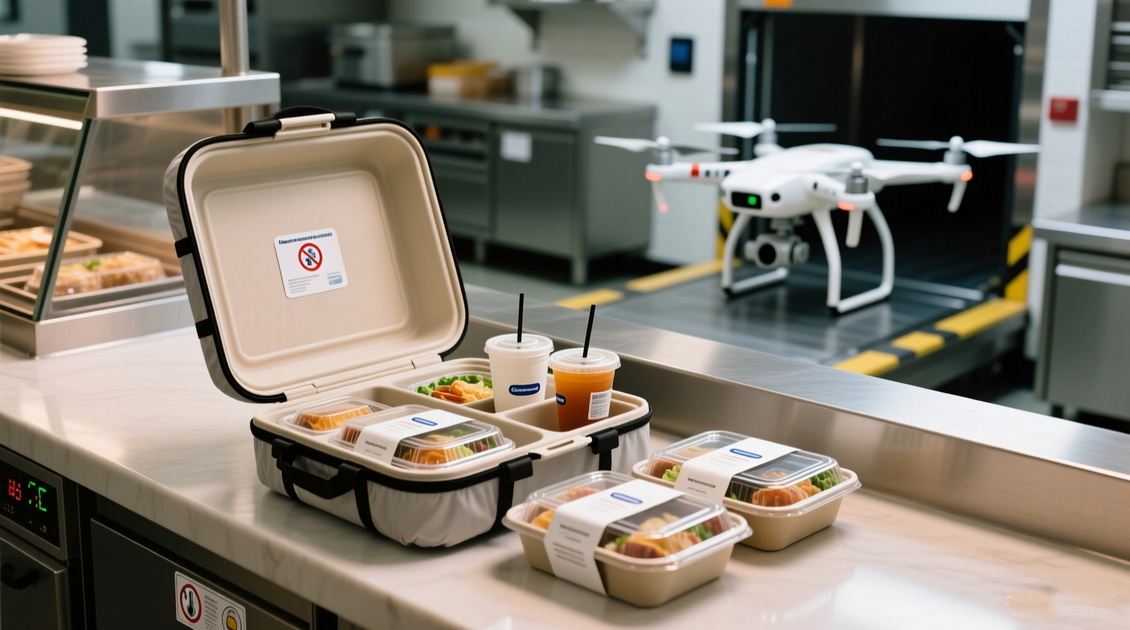
Both modes need:
- Secure, tamper-evident packaging.
- Appropriate hot and cold separation.
- Leak resistance and stable positioning.
- Clear limits for dispatch and collection delays.
- Procedures for damaged or uncollected orders.
Food-safety guidance for delivery services emphasizes packaging, temperature control, contamination prevention, and allergen management. Operators should validate their process against applicable local requirements.
An office worker evaluates convenience, not transport technology.
Is the collection point accessible? Is it sheltered? Can reception accept the order? What happens if the customer is in a meeting?
A reliable business-district service needs clear notifications, accessible collection arrangements, secure handoffs, and a straightforward refund or recovery process.
Urban drone delivery requires more than a capable aircraft. Tall buildings, restricted airspace, communications conditions, and people near receiving areas must enter the operating assessment.
Weather limits are aircraft- and operation-specific. Claims such as "all-weather delivery" require documented evidence and clearly defined limits.
Cars also face weather disruption. Flooding, severe storms, and unsafe roads can interrupt ground service. The practical question is how each mode performs within its approved operating envelope.
In the United States, the FAA identifies Part 135 certification and relevant approvals as the pathway for commercial package delivery beyond visual line of sight. Airspace authorization does not eliminate local infrastructure or land-use considerations.
Other markets have different requirements. A successful operation elsewhere does not establish permission for a new business district.
Before deployment, verify aviation approvals, property agreements, insurance, food-handling responsibilities, privacy measures, and emergency procedures.
Small electric drones can offer environmental advantages for lightweight parcels, but the result depends on what they replace.
A 2022 study modeled a small quadcopter carrying a 0.5-kilogram package. In its assessed scenarios, energy use per package could be up to 94% lower than conventional transportation modes. That is not a universal reduction for food delivery, nor a direct comparison with every passenger car.
Earlier lifecycle research also found that electricity sources and additional warehousing could materially change the outcome.
For a credible drone-versus-car assessment, include:
- Actual packaged payload and route distance.
- Return or repositioning travel.
- Car occupancy and order batching.
- Charging electricity and infrastructure energy.
- Failed attempts and fallback journeys.
A lightly loaded drone replacing a dedicated gasoline-car trip presents a different case from a drone replacing one stop on a well-utilized electric-car route.
An April 2025 report stated that Meituan had opened 53 drone delivery routes and completed more than 450,000 orders by the end of 2024.
These historical figures demonstrate that urban drone delivery has moved beyond isolated demonstrations. They do not establish that every route is profitable or that aerial delivery can replace an entire ground network.
The useful lesson is route-specific deployment. Business districts should identify repeatable demand between suitable origins and receiving points before attempting broad geographic coverage.
A mature network should also be evaluated through independent operating metrics: completion rates, weather availability, customer collection time, food quality, and fully allocated cost.
A structured pilot provides better evidence than a launch demonstration.
Record existing car delivery times, packaged weights, parking delays, building access, failures, and costs.
Separate lunch peaks from quieter periods. Otherwise, an apparent improvement may reflect different demand conditions rather than transport performance.
Choose a route with recurring demand, a meaningful road bottleneck, and feasible receiving infrastructure.
Avoid beginning with unrestricted destination coverage. A controlled corridor makes problems easier to diagnose.
Specify which orders qualify by weight, dimensions, packaging, destination, and operating conditions.
Also define who triggers ground fallback, how customers receive revised estimates, and who pays for recovery.
Where feasible, compare similar meals, distances, destinations, and time windows.
Track complete customer journeys. Record cancelled flights and unsuccessful handoffs rather than excluding them from results.
Agree on acceptance thresholds before the pilot:
- Delivery completion and on-time performance.
- Cost per successful order.
- Food condition and packaging failures.
- Customer walking and collection time.
- Weather-related fallback frequency.
- Complaints and safety events.
Expand only when the service meets commercial, safety, and customer-experience requirements together.
Based on the supplied company background, Shenzhen Intelligent Drone Technology Co. Ltd. focuses on integrating drone technology, dynamic perception, precise data collection, and intelligent analysis.
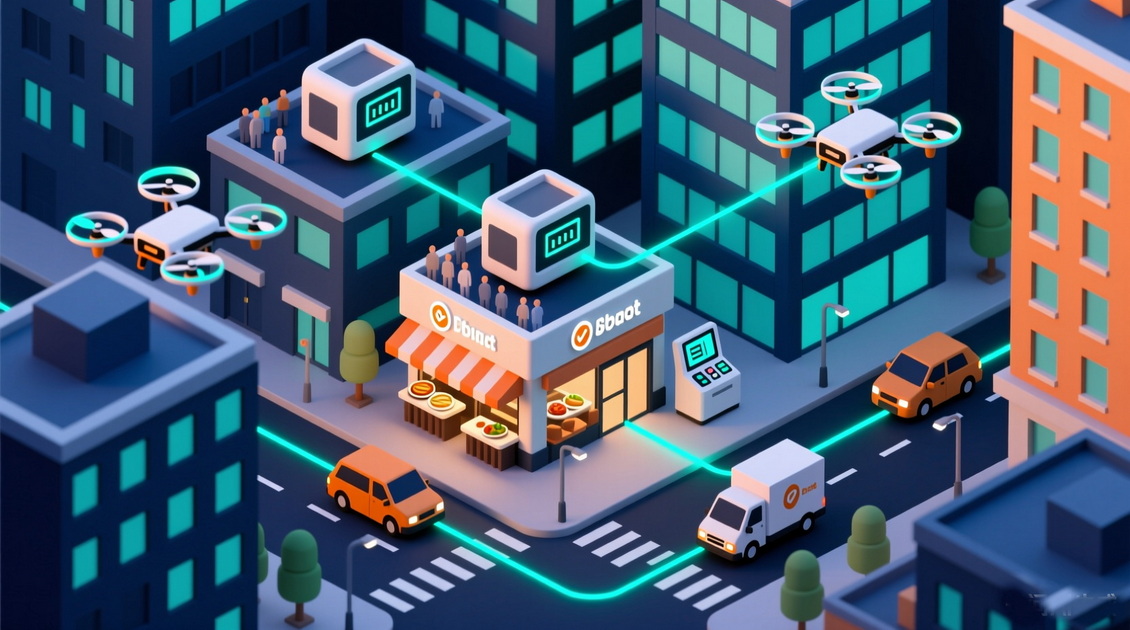
Its "one-network coverage" approach centers on unified command, dispatch, and management across multiple nodes and operating environments.
For congested business districts, this concept is relevant because the aircraft is only one component. Restaurants, launch facilities, receiving points, and ground resources must work together.
A proposed implementation should specify how the platform would:
1. Assess order eligibility and route availability.
2. Coordinate restaurant readiness with dispatch.
3. Monitor equipment and delivery status.
4. Communicate exceptions and trigger ground recovery.
5. Record handoff and service-performance data.
These are implementation requirements to validate, not claims that every function is already deployed. Buyers should request demonstrations and documented responsibilities before procurement.
Drone food delivery is strongest where lightweight orders, suitable receiving points, and approved routes align with serious road congestion. Car delivery remains valuable for larger loads, varied destinations, and operational fallback.
The decision should follow measured customer outcomes—not technology preference.
For a route-specific assessment, share your restaurant locations, office destinations, peak-hour volumes, packaged meal weights, and current delivery performance with SIDT. Request a proposal covering receiving infrastructure, operating permissions, ground coordination, and measurable acceptance criteria.
No. Drones can avoid road congestion, but loading, dispatch queues, receiving procedures, and customer collection can offset the flight-time advantage. Compare complete journeys.
Window delivery should not be assumed. It requires a specifically designed and approved operation. Planning should begin with controlled receiving arrangements.
Large group meals, bulky catering, and orders exceeding an aircraft's packaged payload limits usually favor cars. Packaging stability and temperature requirements also matter.
No. Environmental performance depends on payload, electricity, infrastructure, trip replacement, and ground-vehicle utilization. Compare equivalent completed deliveries rather than vehicle types alone.
A resilient service assigns a ground fallback, updates the customer's estimate, and records the extra cost and delay. These events belong in performance reporting.
Test route permissions, receiving access, demand density, food condition, completion rates, full delivery costs, and customer convenience. Establish acceptable results before expanding.
1. Federal Aviation Administration. Explains the U.S. certification pathway, operating approvals, infrastructure considerations, and environmental review for drone package delivery.
2. Federal Aviation Administration. Explains the relationship between aviation authorization, local approvals, and community considerations.
3. U.S. Food and Drug Administration. Provides the basis for discussion of packaging, temperature control, contamination prevention, and allergen management.
4. Rodrigues et al. (2022). Patterns. Source for the modeled 0.5-kilogram payload and conditional energy comparisons; not a universal food-delivery performance benchmark.
5. Stolaroff et al. (2018). Nature Communications. Examines payload, electricity sources, warehousing, and lifecycle trade-offs.
6. China Daily (April 22, 2025). Source for the historical figures of 53 routes and more than 450,000 completed orders by the end of 2024.
7. Shenzhen Intelligent Drone Technology Co. Ltd. Company background supplied for this article. Basis for the description of SIDT's positioning and "one-network coverage" concept. No public source URL was supplied. The operational comparison, illustrative break-even scenario, and pilot framework are editorial analysis, not independently verified SIDT performance claims.


