Global Distributors Wanted
1.Free Cloud Service Deployment
2.Free Technical Training
3.Exclusive Territory Protection

1.Free Cloud Service Deployment
2.Free Technical Training
3.Exclusive Territory Protection


Views: 221 Author: Aaron Publish Time: 2026-10-12 Origin: Site


Content Menu
● What the Wing and DoorDash Drone Delivery Partnership Demonstrates
>> From an Australian Trial to a US Restaurant Launch
>> Expansion Into a Multi-Restaurant Service
● How Drone Delivery Works—and Where Speed Claims Need Context
● What the Original Announcement Leaves Unanswered
● Integrated Drone Solutions: SIDT's "One-Network Coverage" Approach
>> Connect Mission Planning, Equipment Status, and Field Results
>> Clarify What "Urban Airspace 3+1 Delivery" Means
● Low-Altitude, Ground, and Underground Operations Need Different Designs
● Drone Delivery Safety and Regulatory Requirements
>> Assess the Operation, Not Just the Aircraft
● Are Drone Deliveries More Sustainable?
● A Practical Five-Step Plan for Evaluating Drone Delivery Solutions
>> 1. Select a Narrow, Measurable Use Case
>> 2. Map the Complete Workflow
>> 3. Establish Eligibility and Fallback Rules
>> 5. Expand Only After Reviewing Evidence
● Turn Customer Feedback Into Operational Improvements
● Build a Drone Network Around a Real Operational Need
● Frequently Asked Questions About Drone Delivery Solutions
>> 1. What does the Wing–DoorDash partnership demonstrate?
>> 2. Can drones replace all conventional deliveries?
>> 3. Does a faster drone guarantee faster delivery?
>> 4. What is SIDT's "one-network coverage"?
>> 5. What should businesses verify before a pilot?
>> 6. How should environmental benefits be evaluated?
Drone delivery solutions are moving beyond experimental flights toward connected, customer-facing services. Wing and DoorDash demonstrate how aerial delivery can fit into an existing ordering platform. For businesses evaluating low-altitude logistics, the deeper question is not simply how fast a drone flies. It is how reliably the entire delivery network operates.
That distinction shapes the approach described by Shenzhen Intelligent Drone Technology Co. Ltd. (SIDT). Its company-provided positioning connects intelligent flight, dynamic perception, precise data collection, and intelligent analysis across low-altitude, ground, and underground environments.
From an operational perspective, the strongest opportunity lies in coordination: matching each task to suitable equipment, connecting dispatch with field execution, and maintaining visibility when conditions change.
This article examines what the Wing–DoorDash model demonstrates, where its limitations matter, and how businesses can evaluate a broader, integrated drone application strategy.

On March 21, 2024, Wing announced that its partnership with DoorDash would expand to the United States following a year-long Australian trial. The initial US service launched in Christiansburg, Virginia, with deliveries from one Wendy's restaurant. Customers could select drone delivery through the DoorDash app.
This was a focused launch, not a citywide replacement for conventional delivery. Its significance was the connection between an established ordering channel and an aerial fulfillment service.
Customers did not need to understand aviation systems. They needed a clear ordering option, an eligible delivery address, and a successful handover.
For businesses, the lesson is practical: introducing new transportation technology becomes more useful when it fits an existing customer journey rather than creating a separate, complicated process.
In May 2025, DoorDash and Wing introduced drone delivery in Charlotte, North Carolina. Eligible customers within approximately four miles of The Arboretum Shopping Center could order from participating local and national restaurants. Orders still had to satisfy size and weight requirements.
The customer experience included several defined steps:
1. Find participating restaurants through the app's drone option.
2. Select eligible products.
3. Choose drone delivery during checkout.
4. Confirm the delivery location.
5. Follow live tracking as the aircraft approaches.
This progression adds useful context to the original announcement. The model expanded beyond a single restaurant, while retaining geographic and order-level eligibility controls.
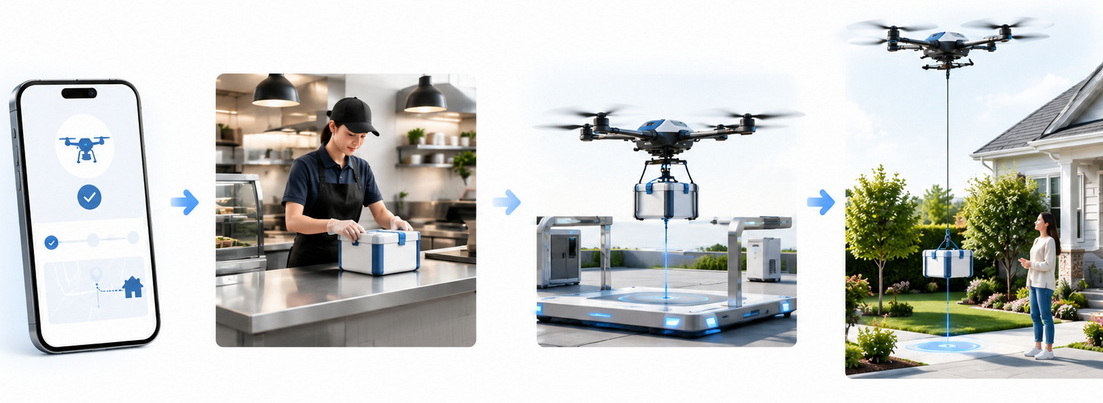
Wing's original announcement described aircraft traveling at approximately 65 mph and lowering orders using a tether while hovering above the delivery location. It also described orders arriving in as little as 30 minutes and mentioned a fastest-ever delivery of under three minutes.
Those figures describe different things.
Aircraft speed measures movement during flight. Total order time also includes preparation, packing, loading, dispatch, and handover. A record delivery is not an average service commitment.
When evaluating a commercial drone delivery solution, ask for the complete timeline:
| Delivery stage | Question to ask | Operational value |
|---|---|---|
| Order acceptance | When is eligibility confirmed? | Reduces rejected orders |
| Preparation | When is the package ready? | Separates merchant delays from transport delays |
| Loading and dispatch | How long does launch preparation take? | Reveals hub bottlenecks |
| Flight | What is the actual route time? | Measures aerial transport performance |
| Handover | When is delivery confirmed? | Establishes the customer's completed service time |
My assessment is that end-to-end consistency matters more than a headline speed. A fast aircraft cannot compensate for unclear loading procedures or repeated delivery-location failures.
The original Wing article effectively explains the launch, customer convenience, and small-order use case. However, it is a partnership announcement rather than a complete procurement guide. It does not establish average delivery performance, independently verified customer satisfaction, or project economics.
A business buyer still needs answers to questions such as:
- What percentage of orders qualify for aerial delivery?
- How often do weather or site conditions interrupt service?
- What happens when an order cannot be delivered?
- What does each completed delivery cost?
- How are complaints, incidents, and refunds handled?
- How much staff time does the service require?
These gaps are not evidence that the service performs poorly. They identify what must be measured before transferring a consumer-delivery example into a different commercial environment.
Similarly, no customer reviews were supplied for this article. Customer testimonials, satisfaction scores, and firsthand operating experiences should therefore not be invented.
SIDT describes "one-network coverage" as a unified approach to command, dispatch, and equipment management across spaces and multiple nodes. Its proposed application areas include intelligent inspection, underground space detection, urban airspace "3+1 delivery," and ground-air coordinated emergency response.
These are company-provided descriptions, not independently verified performance results.
The useful strategic connection is straightforward: delivery, inspection, and emergency missions may require different equipment, but their management workflows can share certain functions.
A unified platform should be evaluated against practical questions:
- Can dispatchers see which equipment is available?
- Are permissions appropriate for each operator and mission?
- Can teams track task progress and exceptions?
- Does collected information reach the people who need it?
- Are actions and decisions recorded for later review?
A common interface is only the beginning. The more meaningful test is whether shared information improves decisions across the operation.
For example, an inspection finding may need to become a maintenance task. A disrupted delivery may need reassignment. An emergency observation may need rapid escalation to a response team.
SIDT's supplied material names "urban airspace 3+1 delivery" but does not define its components.
Businesses should request that definition before comparing proposals. They should also ask which elements are available today, which require third-party integration, and which remain planned.
Clear terminology protects both sides. It turns a broad concept into an assessable scope, with named assets, interfaces, responsibilities, and acceptance criteria.
An integrated strategy should not assume that every environment uses the same navigation, communications, or safety configuration.
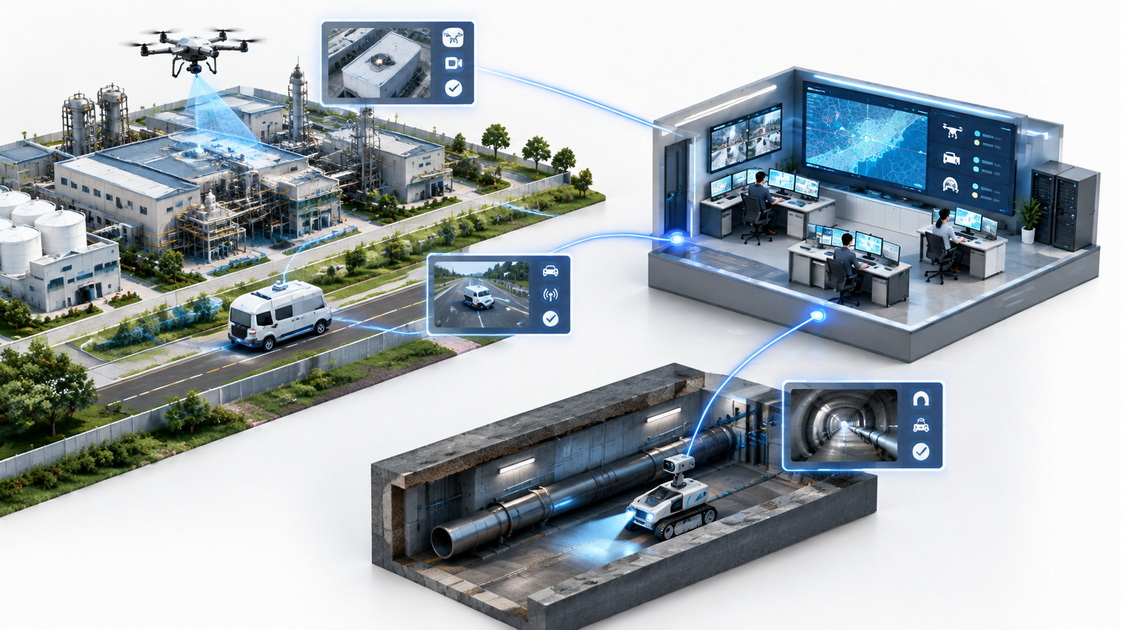
For SIDT's proposed cross-environment applications, a sensible evaluation would separate the following requirements:
| Environment | Proposed application | Questions for technical evaluation |
|---|---|---|
| Low-altitude airspace | Delivery and aerial inspection | What flight permissions, routes, and operating limits apply? |
| Ground environment | Dispatch support and coordinated response | How are people, vehicles, and aerial equipment assigned together? |
| Underground spaces | Detection and inspection | How are positioning, communications, access, and recovery handled? |
| Cross-environment missions | Emergency coordination | How are observations transferred into accountable response actions? |
These are recommended assessment categories, not claims that SIDT has already validated every capability.
The central principle is shared coordination with environment-specific engineering. Buyers should request demonstrations in representative conditions rather than accepting a general platform presentation as proof of field readiness.
For US operations carrying another party's property for compensation beyond visual line of sight, the FAA identifies Part 135 certification as the applicable pathway. Its guidance also describes additional requirements, including relevant exemptions or waivers, airspace authorization, infrastructure, and environmental review.
Beyond visual line of sight means that the operation extends outside the pilot's direct visual observation. It is not simply another name for autonomous flight.
A procurement review should examine:
- The operator's authority for the proposed activity.
- Aircraft and payload suitability.
- Approved operating areas.
- Loading and package-security procedures.
- Weather-related operating limits.
- Exception handling and recovery.
- Staff responsibilities and training.
- Community communication.
The FAA also highlights local requirements and public engagement. This makes deployment a combination of aviation, site planning, and community coordination—not merely an equipment purchase.
US requirements should not be presented as automatically applicable to projects elsewhere. Each deployment needs jurisdiction-specific review.
Research supports the potential for substantial energy savings in specific small-package scenarios. A study combining 188 quadcopter flights with modeling examined payload, speed, and flight phases. Its modeled very-small-package case used a 0.5 kg payload and found potentially significant energy advantages over conventional transport modes.00180-5)
However, those results should not become a universal claim about every aircraft, route, or delivery network.
The research also found that electric cargo bicycles could produce lower greenhouse-gas emissions per package than the modeled drone case. Payload and flight duration were important contributors to energy consumption.
For procurement, request a comparison against the actual alternative:
- A dedicated vehicle trip.
- A consolidated delivery route.
- An electric cargo bicycle.
- A nearby collection point.
A credible environmental assessment should disclose its assumptions. The right question is not whether drones are always cleaner, but whether the proposed service improves the specific operation being replaced.
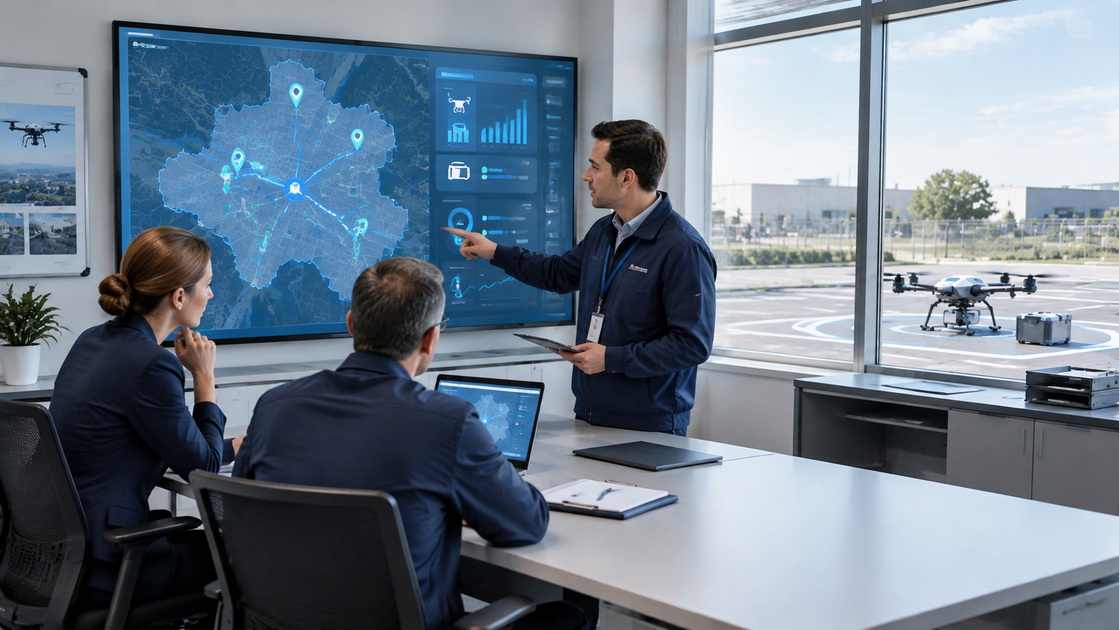
Start with a defined problem: small urgent orders, a difficult transport link, or a repeatable inspection task.
Document the current process before introducing new equipment. Record delivery time, labor involvement, failure reasons, and service expectations.
Identify ordering, preparation, dispatch, transport, handover, and exception handling.
For integrated applications, also map how observations become decisions. Data collection has limited operational value if nobody owns the follow-up action.
Define which packages, destinations, conditions, and missions qualify.
Agree on what happens when aerial service is unavailable. A fallback process should be part of the design, not an improvised response after failure.
Use a limited service area and explicit acceptance criteria.
Measure completed missions, unsuccessful attempts, staff interventions, customer issues, and total costs. Review typical performance as well as exceptional outcomes.
Evaluate whether the pilot met its operational and commercial objectives.
For SIDT's multi-environment positioning, request separate evidence for delivery, inspection, underground detection, and emergency coordination. Success in one application does not establish readiness in all others.
Without supplied customer comments, the responsible approach is to establish a feedback framework rather than manufacture quotations.
Collect feedback around specific moments:
- Was eligibility easy to understand?
- Were tracking updates useful?
- Was the delivery location clear?
- Did the package arrive in acceptable condition?
- Was support effective when something changed?
Separate feedback from customers, merchants, operators, and nearby residents. Their concerns may overlap, but they experience different parts of the service.
Combine comments with operational records. This makes it easier to distinguish communication problems from preparation delays, transport failures, or unsuitable delivery locations.
The Wing–DoorDash example provides a useful starting point: connect aerial transport to a clear customer workflow, control eligibility, and expand through defined service areas.
SIDT's broader positioning proposes connected applications across delivery, inspection, underground detection, and emergency response. Its commercial value should be assessed through representative demonstrations and measurable outcomes.
Contact Shenzhen Intelligent Drone Technology Co. Ltd. with your target application, operating environment, payload or sensing requirements, and existing workflow. Request a scoped feasibility discussion and pilot proposal covering integrations, operating responsibilities, evaluation metrics, and expansion criteria.
It demonstrates how drone fulfillment can connect to an established ordering platform. Customers in eligible service areas can select qualifying orders through DoorDash rather than arranging a separate aviation service.
The cited services focus on eligible smaller orders. Size, weight, and geographic restrictions remain important, so these examples support a complementary delivery model rather than universal replacement.
No. Flight speed is only one part of the workflow. Preparation, loading, dispatch, and handover must also be assessed. Wing's record flight-related delivery claim should not be treated as a standard customer promise.
In the supplied company description, it means unified command, dispatch, and management across equipment, spaces, and multiple nodes. Buyers should confirm the specific integrations and request application-level demonstrations.
Verify the use case, operator permissions, site suitability, package requirements, fallback procedures, support responsibilities, and measurable acceptance criteria. For US compensated beyond-visual-line-of-sight delivery, review the applicable FAA pathway.
Compare the proposed service with the actual delivery alternative. Research supports advantages for some small-package drone scenarios, but the result depends on the operating assumptions and comparison mode.


