Global Distributors Wanted
1.Free Cloud Service Deployment
2.Free Technical Training
3.Exclusive Territory Protection

1.Free Cloud Service Deployment
2.Free Technical Training
3.Exclusive Territory Protection


Views: 215 Author: Aaron Publish Time: 2026-09-22 Origin: Site


Content Menu
● Why Drone Delivery Is Reshaping Modern Logistics
● One-Network Coverage for Connected Operations
● Understanding Urban Airspace 3+1 Delivery
● Where Drone Delivery Can Create Measurable Value
● From Flight Operations to Intelligent Logistics Management
>> Flight Platform and Aircraft Management
>> Ground Infrastructure and Package Handoff
● Building a Safer Drone Delivery Program
● Public Trust and Customer Experience
● A Six-Step Framework for Deployment
>> 2. Evaluate the Operating Environment
>> 3. Select the Right Equipment
>> 4. Design the Delivery Handoff
>> 5. Establish Operating Procedures
>> 6. Measure and Improve Performance
● SIDT's Full-Stack Approach to Complex Environments
● Summary
>> 1. What is a drone delivery solution?
>> 2. What types of goods can be delivered by drone?
>> 3. What is urban airspace 3+1 delivery?
>> 4. Can drone delivery work in rural areas?
>> 5. How does a cloud control platform support drone delivery?
>> 6. What happens if weather conditions change during a flight?
>> 7. Can drone delivery be combined with emergency response?
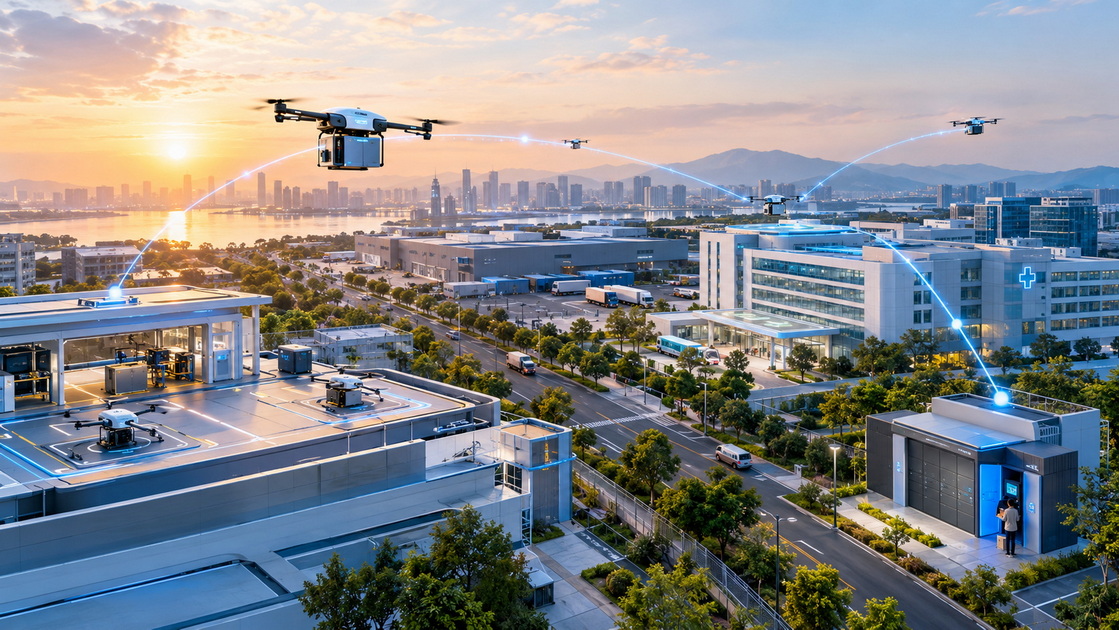
Drone delivery is evolving from limited pilot programs into a practical part of modern logistics networks. For retailers, industrial parks, medical facilities, municipalities, and emergency-response teams, the opportunity is no longer simply to use an aircraft for transporting a package. The real opportunity is to build a connected operating system that links low-altitude air routes, ground resources, underground inspection tools, live data, and centralized command.
Shenzhen Intelligent Drone Technology Co., Ltd. (SIDT) focuses on the deep integration and innovation of drone technology. The company provides full-stack application solutions for low-altitude, ground, and underground environments. Through an independently developed intelligent flight platform, SIDT combines dynamic perception, precise data collection, intelligent analysis, and unified cloud-based management.
This connected approach helps organizations support intelligent inspection, underground-space detection, urban airspace 3+1 delivery, emergency response, and multi-device coordination. Rather than managing isolated drones for isolated tasks, operators can create a single, visible, and manageable network across complex environments.
Last-mile delivery is often the most complex and expensive stage of the supply chain. Conventional delivery vehicles must deal with traffic congestion, long routes, limited driver availability, inaccessible locations, repeated delivery attempts, and unpredictable weather conditions.
Drone delivery can help solve specific logistics challenges by moving lightweight, time-sensitive goods directly between defined points. It can reduce travel distance, improve response time, support difficult-to-reach locations, and provide an additional delivery option when roads are congested or disrupted.
Potential delivery scenarios include:
- Urgent medical supplies and prescriptions
- Food and convenience-goods delivery
- E-commerce parcels and small consumer products
- Industrial spare parts and maintenance tools
- Documents, samples, and laboratory materials
- Emergency supplies for disaster response
- Equipment delivery across large campuses or industrial parks
The value of drone delivery depends on the operating environment. In some urban locations, it may improve service speed and customer convenience. In rural or remote areas, it may reduce the challenge of long road distances and limited transport access. For emergency-response teams, it can help move critical items when conventional access routes are delayed or unavailable.
However, a successful drone delivery operation requires much more than a reliable aircraft. It needs an integrated system for route planning, dispatch, flight monitoring, landing coordination, payload handoff, equipment management, safety procedures, and operational data analysis.
"One-network coverage" is a distinctive feature of SIDT's solution approach. It is designed to overcome the limitations of single-scenario drone applications by connecting multiple devices, environments, and mission types through one unified operating structure.

A traditional drone deployment may focus on one aircraft flying one route for one task. This type of project can demonstrate technical capability, but it may become difficult to scale when more equipment, locations, users, and operational requirements are added.
A connected network can bring together:
- Delivery drones for low-altitude transport
- Inspection drones for infrastructure or site monitoring
- Ground vehicles or robots for local handoff and material movement
- Smart lockers and delivery stations for secure package collection
- Underground detection equipment for confined or complex spaces
- Environmental sensors and dynamic perception devices
- Cloud-based command, dispatch, and management tools
- Data dashboards for mission visibility and operational analysis
SIDT integrates these elements through an intelligent cloud control platform. The platform is designed to support centralized equipment management, real-time mission monitoring, multi-node coordination, dispatch planning, and operational recordkeeping.
For example, a delivery request can be received through a logistics or service-management system. The cloud platform can evaluate the delivery location, assign an available drone, monitor the aircraft during flight, coordinate the handoff point, and record delivery completion. If a flight encounters a weather change, communication interruption, route restriction, or landing-zone issue, the system can provide alerts and support operational adjustment.
This model creates a stronger foundation for complex scenarios such as urban airspace 3+1 delivery and ground-air coordinated emergency response.
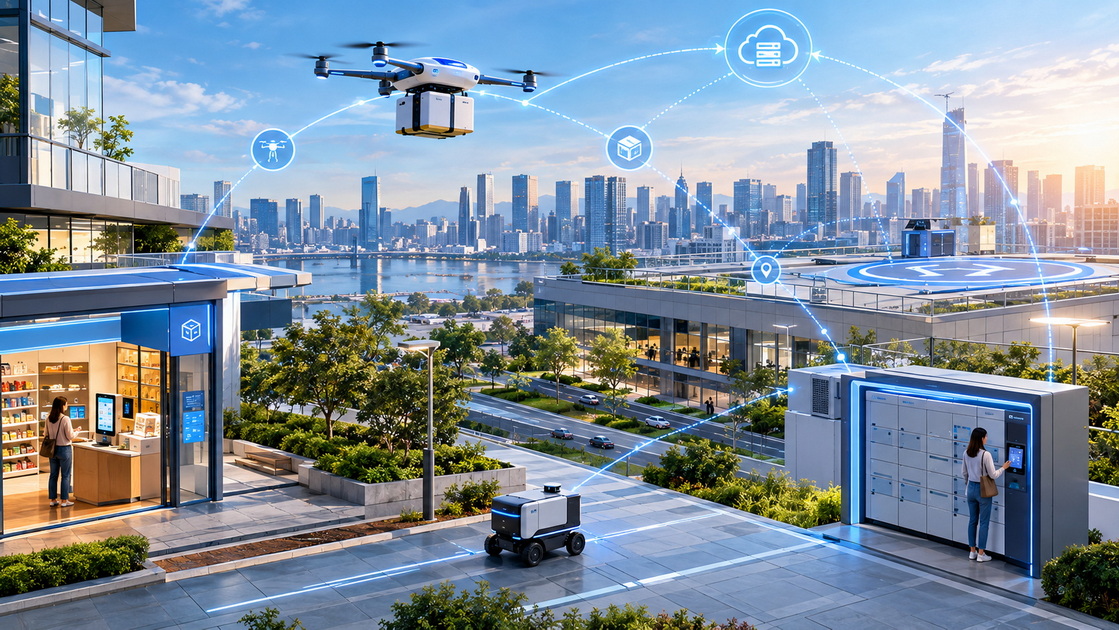
Urban airspace 3+1 delivery describes a connected logistics model that combines aerial delivery with multiple ground-based service points or operational systems. The exact configuration can vary based on the city, facility, customer profile, delivery category, and local requirements.
The "3" may include three coordinated ground-side elements, such as:
- Pickup or dispatch stations
- Smart lockers or package collection cabinets
- Community delivery points
- Ground delivery vehicles
- Building rooftop landing platforms
- Retail pickup counters
- Campus service hubs
The "+1" represents the low-altitude aerial delivery layer, in which drones transport goods between selected nodes. The model is not intended to replace all conventional logistics methods. Instead, it creates a coordinated delivery option for suitable routes, products, and time-sensitive missions.
A practical urban airspace 3+1 delivery system may work as follows:
1. A customer, staff member, or system submits a delivery request.
2. The platform confirms the delivery location, payload requirements, and service priority.
3. A drone is assigned to transport the package from a designated pickup point.
4. The drone flies along an approved route to a secure handoff area.
5. The package is transferred to a smart locker, ground robot, delivery station, or authorized recipient.
6. The platform records the mission status, delivery confirmation, route data, and any exceptions.
7. Operators use the data to improve future route design, asset allocation, and service reliability.
This model can support short-distance deliveries, rapid-response logistics, industrial material movement, community services, and public-safety operations.
Drone delivery is most effective when it addresses a clear operational need. Not every package, location, or customer journey is suitable for aerial transport. Organizations should identify the missions where traditional methods are too slow, too costly, too difficult, or too unreliable.
| Application Scenario | Main Challenge | Connected Delivery Value |
|---|---|---|
| Rural delivery | Long road routes and limited delivery density | Faster point-to-point access between remote locations |
| Medical logistics | Urgent, time-sensitive materials | Rapid dispatch and traceable mission management |
| Retail fulfillment | Customer demand for convenience and speed | Supports short-range delivery from stores or local hubs |
| Industrial parks | Large sites with dispersed workshops and warehouses | Moves small parts, tools, samples, and documents efficiently |
| Emergency response | Road blockages, damaged infrastructure, urgent demand | Supports aerial inspection and fast delivery of critical supplies |
| Campus logistics | Repeated movement across large facilities | Connects laboratories, offices, warehouses, and service points |
| Underground inspection | Low visibility and difficult access | Combines detection data with centralized operational management |
In each case, the goal is not merely to fly a drone. The goal is to improve the complete operating process, from demand generation to dispatch, delivery confirmation, incident response, and data-based optimization.
A drone delivery program should be designed as an operational service, not just a technology demonstration. The aircraft is one part of a much larger system that includes people, processes, infrastructure, data, and safety controls.
A well-designed operation requires coordination across several layers.
The drone platform must match the mission. Key considerations include payload capacity, flight range, battery performance, weather tolerance, flight stability, navigation capability, communication reliability, and maintenance requirements.
Different mission types may require different aircraft configurations:
- Multirotor drones can provide precise takeoff, landing, and hovering performance.
- Vertical takeoff and landing aircraft can combine vertical access with extended-range flight capability.
- Fixed-wing platforms may support longer routes but can require different launch, recovery, and landing arrangements.
- Specialized drones may be required for inspection, mapping, emergency payloads, or underground environments.
The correct choice depends on the delivery distance, package weight, route design, delivery frequency, site conditions, and local operating rules.
A delivery is only successful when the package reaches the right person or location safely. This means organizations must carefully design the handoff process.
Possible handoff methods include:
- Landing at a controlled delivery pad
- Lowering the package using a winch system
- Depositing goods into a secure collection zone
- Transferring packages to a smart locker
- Handing off items to a ground robot
- Delivering to trained site staff
- Releasing approved payloads at emergency-response locations
Ground infrastructure can include charging stations, battery-swapping systems, loading areas, landing markers, communication equipment, security barriers, smart lockers, and weather-monitoring devices.
The handoff experience should be simple, secure, and easy to understand. A complicated collection process can reduce customer trust and increase operational risk.
A unified cloud control platform gives operators visibility across missions, assets, and locations. It can support real-time monitoring and help reduce the complexity of managing multiple devices across a wide operating area.
Core management functions may include:
- Mission assignment and dispatch planning
- Fleet status monitoring
- Live flight tracking
- Route and geofence management
- Battery and charging supervision
- Payload tracking
- Equipment diagnostics
- Remote alerts and exception handling
- Delivery confirmation
- Historical mission records
- Performance analytics
- Multi-site coordination
For organizations operating delivery drones, inspection drones, ground vehicles, and detection systems at the same time, a unified platform can help prevent fragmented management. It creates a shared operational picture for dispatchers, supervisors, site teams, maintenance staff, and decision-makers.
Safety must be built into the system from the beginning. It should not be treated as an additional feature after the aircraft and route have already been selected.
A safe drone delivery program includes aircraft reliability, operator procedures, airspace awareness, route controls, communication systems, maintenance routines, weather monitoring, emergency plans, and clear responsibilities.
Important operational considerations include:
- Flight routes and approved operating areas
- Population density and ground-risk assessment
- Weather limits and wind conditions
- Obstacle detection and avoidance capability
- Communications reliability
- Battery health and power reserve
- Alternate landing locations
- Payload security
- Remote identification and tracking requirements
- Maintenance and inspection schedules
- Operator training and supervision
- Incident reporting procedures
- Data security and privacy controls
Beyond visual line of sight operations are especially important for long-range and scalable delivery networks. In these missions, the remote pilot or supervisor may not maintain direct visual observation of the aircraft throughout the entire route. Such operations require robust procedures, reliable communications, airspace awareness, and appropriate authorization.
The operational model must always be adapted to local laws, aviation requirements, site conditions, and the type of goods being transported.
Drone delivery will only scale when people understand how it works and believe that it is safe, reliable, and respectful of the local environment.
Customers want clear answers to simple questions:
- When will my package arrive?
- Where will the drone deliver it?
- How will I collect the item?
- What happens if I am unavailable?
- Is the package secure?
- What happens in bad weather?
- Can I track the delivery?
- How is my personal information protected?
Communities may also have questions about noise, privacy, safety, flight paths, visual impact, and operating hours. Organizations should provide transparent information about where drones operate, how missions are managed, how data is handled, and how concerns can be reported.
A positive experience depends on more than rapid delivery. It depends on predictable service, visible safety procedures, secure handoff, accurate communication, and reliable support when something changes.
Organizations can reduce uncertainty by following a structured planning process before expanding a drone delivery network.
Start with a specific mission. Determine what goods will be transported, who will receive them, how frequently deliveries are required, and what service level is needed.
A medical supply route, a food-delivery route, and an industrial spare-parts route may all use drones, but they have very different operational requirements.
Analyze delivery distance, terrain, buildings, road congestion, local weather, airspace conditions, population density, communications coverage, landing options, and site access.
The operating environment determines whether a drone route is practical, safe, and economically valuable.
Choose aircraft, payload systems, batteries, charging equipment, sensors, ground stations, and communications tools based on the mission requirements.
Avoid selecting equipment only because it has impressive technical specifications. The best system is the one that can operate reliably in the real delivery environment.
Define how goods will move from the sender to the drone and from the drone to the recipient. Consider loading, verification, secure transport, drop-off, collection, proof of delivery, and failed-delivery procedures.
Create standard procedures for normal operations, weather changes, route restrictions, battery issues, communication loss, unexpected obstacles, customer absence, and emergency events.
Clear procedures help teams respond consistently and reduce avoidable risk.
Use operational data to evaluate delivery time, success rate, route efficiency, battery turnaround, manual intervention, equipment availability, customer satisfaction, and mission cost.
A connected system should continuously learn from operations. The strongest delivery networks improve over time because they use real mission data to refine routes, assets, staffing, and service design.
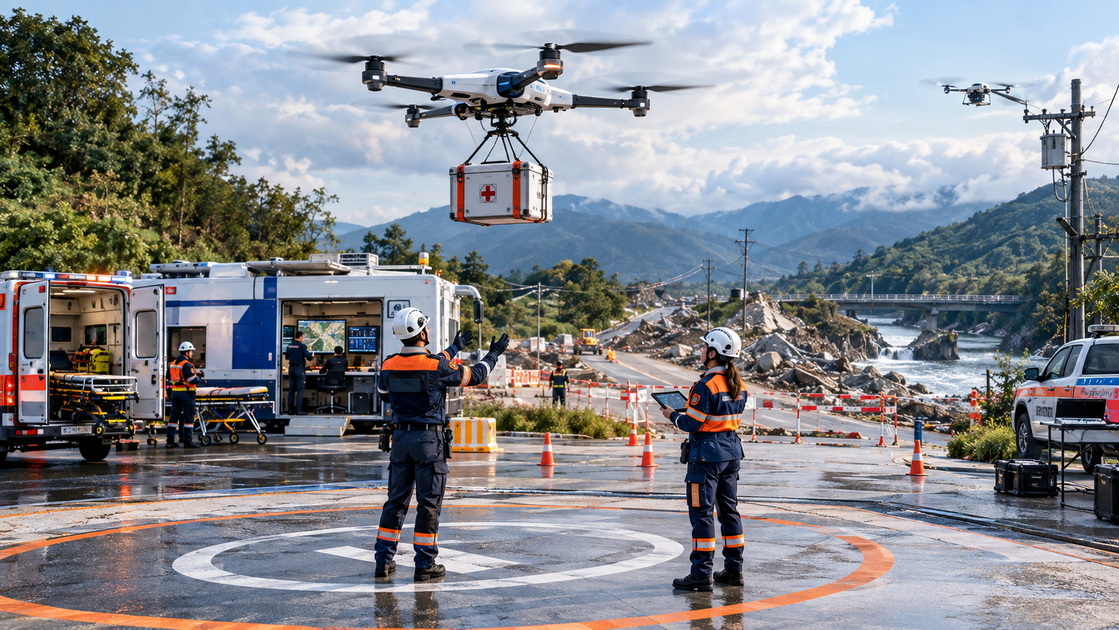
SIDT provides more than a single-purpose drone platform. Its solution approach is built around the integration of low-altitude, ground, and underground environments.
This allows organizations to connect multiple mission types through one intelligent operating framework:
- Low-altitude delivery and transport
- Intelligent inspection and patrol
- Urban airspace 3+1 delivery
- Ground-air coordinated emergency response
- Underground space detection
- Multi-device command and dispatch
- Dynamic perception and environmental awareness
- Data collection and intelligent analysis
- Cloud-based management and decision support
The core value of this approach is operational coordination. A delivery drone can become part of a wider system that also supports inspection, emergency logistics, infrastructure awareness, and site management.
For a city, this can mean connecting aerial delivery, public-safety response, smart stations, and data-driven command. For an industrial park, it can mean combining material delivery, inspection flights, underground detection, and centralized scheduling. For a logistics provider, it can mean creating a scalable service network that expands without requiring disconnected systems at every new location.
The future of drone delivery is not defined by one aircraft or one route. It is defined by the ability to connect assets, people, locations, and data into one efficient and manageable network.
Drone delivery has the potential to improve logistics speed, accessibility, flexibility, and resilience. Its most valuable applications are found where traditional transport faces time pressure, difficult access, long travel distances, operational disruption, or urgent demand.
The path to successful deployment requires more than capable drones. It requires an integrated operating model that connects aircraft, ground infrastructure, data systems, safety procedures, customer experience, and centralized command.
SIDT's one-network coverage concept supports this transition by connecting low-altitude, ground, and underground operations through an intelligent cloud control platform. By combining dynamic perception, precise data collection, intelligent analysis, and coordinated dispatch, SIDT helps organizations build practical solutions for delivery, inspection, emergency response, and complex multi-space operations.
Organizations planning to introduce drone delivery should begin with a clear use case, a carefully evaluated operating environment, a secure handoff model, and measurable performance goals. A connected pilot program can provide the operational insight needed to develop a reliable and scalable long-term network.
A drone delivery solution is a complete system for transporting goods with unmanned aircraft. It includes the drone, payload equipment, flight planning, route management, communication systems, loading process, delivery handoff, safety procedures, cloud control, and performance analysis.
Drone delivery can be suitable for lightweight and time-sensitive items, including prepared food, retail products, e-commerce parcels, medical supplies, prescriptions, industrial spare parts, documents, samples, and emergency materials. The suitability of each item depends on its weight, size, handling requirements, urgency, and delivery destination.
Urban airspace 3+1 delivery is a coordinated logistics model that connects low-altitude drone delivery with multiple ground-side service points. These may include pickup stations, smart lockers, community collection points, delivery vehicles, retail stores, or other logistics nodes.
Yes. Rural areas can be suitable for drone delivery because long road routes, limited delivery density, difficult terrain, and remote customer locations may make conventional delivery slower or more expensive. The final design depends on route distance, weather, landing options, communications coverage, and local operating requirements.
A cloud control platform can provide centralized visibility and management across delivery missions. It can support dispatch planning, live monitoring, route management, battery supervision, payload tracking, alerts, delivery confirmation, equipment diagnostics, historical records, and performance analytics.
A well-designed operating system should include weather monitoring, predefined operating limits, route adjustment procedures, alternate landing locations, return-to-home functions, and emergency response protocols. Operators should not begin or continue a mission when conditions exceed approved safety limits.
Yes. Drone delivery can support emergency response by transporting urgent supplies, providing aerial awareness, reaching locations affected by traffic disruption or damaged roads, and coordinating with ground teams. A unified command platform can help manage multiple missions and resources during complex events.


