Global Distributors Wanted
1.Free Cloud Service Deployment
2.Free Technical Training
3.Exclusive Territory Protection

1.Free Cloud Service Deployment
2.Free Technical Training
3.Exclusive Territory Protection


Views: 209 Author: Aaron Publish Time: 2026-09-25 Origin: Site


Content Menu
● Cargo Drone vs Fixed-Wing Aircraft: Key Differences
● Why Remote Industrial Supply Delivery Requires a Different Strategy
● When Cargo Drones Are the Better Choice
>> Cargo Drones for Critical Spare Parts
>> Cargo Drones for Difficult Terrain
>> Cargo Drones for Frequent Small Deliveries
>> Cargo Drones for Emergency Response
● When Fixed-Wing Aircraft Are the Better Choice
>> Fixed-Wing Aircraft for Bulk Cargo
>> Fixed-Wing Aircraft for Long-Distance Routes
>> Fixed-Wing Aircraft for Scheduled Replenishment
● Cargo Drone vs Fixed-Wing Aircraft: Operational Comparison
● Safety, Airspace, and Operating Readiness
● A Practical Decision Framework for Industrial Buyers
>> Step 1: Classify Each Delivery Need
>> Step 2: Identify the Real Delivery Bottleneck
>> Step 3: Compare Total Mission Value
>> Step 4: Build a Hybrid Supply Network
● The Role of Unified Cloud Control
● Common Mistakes in Remote Drone Logistics Planning
>> Choosing Technology Before Defining the Mission
>> Focusing Only on Payload and Range
>> Treating Cargo Drones as a Complete Replacement
>> Ignoring the Receiving Site
>> Operating Disconnected Systems
● FAQ
>> 1. What is the main difference between a cargo drone and a fixed-wing aircraft?
>> 2. Can cargo drones deliver spare parts to mining sites?
>> 3. Are cargo drones suitable for emergency industrial deliveries?
>> 4. Can cargo drones replace fixed-wing cargo aircraft?
>> 5. What types of cargo are best suited for a cargo drone?
>> 6. Why is a hybrid logistics model effective for remote industrial sites?
>> 7. How does a cloud control platform improve cargo drone delivery?
>> 8. What should companies assess before using cargo drones for industrial delivery?
Remote industrial supply delivery is no longer limited to trucks, helicopters, or scheduled cargo flights. Mining operations, energy facilities, construction sites, pipeline corridors, islands, emergency-response zones, and remote infrastructure projects increasingly need faster and more flexible access to spare parts, tools, sensors, medical supplies, and inspection equipment.
The comparison between a cargo drone and a fixed-wing aircraft is not simply about which vehicle can fly farther or carry more weight. It is about matching the right transportation method to the right mission.
A fixed-wing aircraft can move large quantities of cargo over long distances. A cargo drone can deliver a critical replacement part directly to a hard-to-reach industrial site when time matters most.
For many organizations, the best solution is not choosing one system over the other. It is building an integrated logistics network in which fixed-wing aircraft, cargo drones, vehicles, field personnel, sensors, and digital dispatch systems work together.
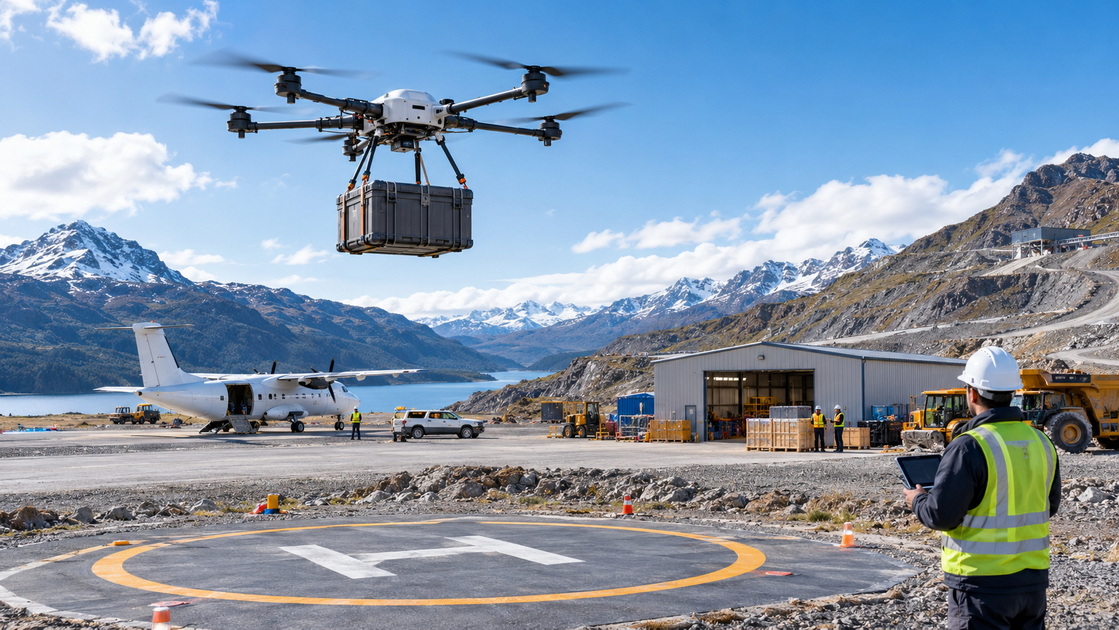
Cargo drones and fixed-wing aircraft are both valuable transportation assets. However, they are designed for different operational priorities.
Cargo drones are typically used for lightweight, urgent, short- or medium-range deliveries. They can avoid damaged roads, difficult terrain, traffic congestion, and limited ground access. Many designs can take off and land vertically, making them suitable for locations without conventional airport infrastructure.
Fixed-wing aircraft are more suitable for long-range transport, heavy cargo, bulk inventory replenishment, and planned supply movements. They can transport larger loads efficiently, especially between regional airports, logistics hubs, industrial airstrips, and remote project bases.
| Decision Factor | Cargo Drone | Fixed-Wing Aircraft | Best Operational Fit |
|---|---|---|---|
| Primary mission | Urgent, lightweight, point-to-point delivery | Long-range, high-volume cargo transport | Use drones for critical items and aircraft for bulk resupply |
| Payload capability | Small to medium payloads | Medium to heavy payloads | Fixed-wing aircraft for large equipment and palletized cargo |
| Takeoff and landing | Can use compact landing pads or VTOL zones | Usually requires a runway, airstrip, or airport | Drones for remote sites with limited infrastructure |
| Route flexibility | Can fly direct routes over difficult terrain | Must operate between suitable aviation facilities | Drones for complex or inaccessible locations |
| Delivery speed | Fast for short and urgent missions | Efficient for long-distance cargo transport | Depends on the distance and urgency |
| Cargo frequency | Suitable for frequent small deliveries | Suitable for scheduled bulk replenishment | Drones for high-frequency urgent tasks |
| Last-mile delivery | Strong capability | Often requires vehicle transfer after landing | Drones for direct site delivery |
| Operating environment | Ideal for remote, hazardous, or hard-to-reach areas | Ideal for established regional logistics routes | Use both in a hybrid transport network |
| Workforce exposure | Can reduce road travel and hazardous-site access | Requires conventional aircraft and ground operations | Drones can reduce exposure in high-risk areas |
| Network integration | Can connect with real-time inspection and dispatch systems | Can serve as a regional logistics backbone | Integrated cloud management provides the strongest result |
The key difference is clear: cargo drones improve response speed and access, while fixed-wing aircraft improve cargo capacity and long-distance transport efficiency.
Remote industrial sites operate under very different conditions from urban warehouses or standard distribution centers.
A manufacturing facility in a city may receive a replacement part through regular trucking within a few hours. A remote mine, offshore-adjacent facility, mountain construction project, power station, or pipeline station may require a much more complex delivery process.
The challenge is not always the distance. The challenge is the combination of terrain, weather, road conditions, site access, limited infrastructure, safety requirements, and communication gaps.
A small component can have a major impact on operations.
For example, a damaged sensor, replacement battery, control module, valve seal, communication device, or inspection camera may weigh only a few kilograms. Yet the absence of that component may delay maintenance work, reduce production capacity, interrupt inspections, or create safety risks.
In these cases, transportation cost alone is not the right decision metric.
The more important question is:
Operational Value=Downtime Avoided+Safety Improvement+Time Saved−Total Delivery Cost
A cargo drone may cost more per kilogram than a truck or scheduled cargo flight. However, it may create far greater value if it delivers a critical part within minutes or hours rather than days.
This is why remote industrial delivery requires a mission-based logistics strategy instead of a standard transportation model.
Cargo drones are especially valuable when the delivery requirement is urgent, lightweight, repetitive, and difficult to support through conventional transport.
A cargo drone is often the better option when an industrial site urgently needs a small, high-value item.
Typical cargo drone payloads may include:
- Sensors and monitoring devices
- Communication modules
- Replacement batteries
- Small tools and calibration equipment
- Electrical connectors and cables
- Inspection cameras
- Valves, seals, and fittings
- Testing instruments
- Medical kits
- Emergency communication devices
- Small replacement parts
- Laboratory samples
Consider a remote solar farm that experiences a failure in a monitoring or inverter-control component. A fixed-wing aircraft may be able to transport dozens of replacement units from a regional city to a nearby airport. However, the final delivery may still depend on a long road journey.
A cargo drone can potentially transport the urgent component from a local logistics point directly to the maintenance team. The result is faster equipment recovery and reduced operational disruption.
Cargo drones are particularly effective in locations where roads are unreliable, unsafe, blocked, or unavailable.
These environments may include:
- Mountainous construction sites
- Remote mining areas
- Forest operations
- Pipeline inspection corridors
- Transmission tower networks
- Island communities
- Coastal energy facilities
- Disaster-affected zones
- Flooded areas
- Snow-covered industrial routes
- Underground-to-surface logistics points
- Hazardous industrial environments
In these cases, a cargo drone can bypass terrain that would make vehicle access slow or dangerous.
A vertical takeoff and landing cargo drone can also operate from a compact logistics pad. This reduces dependence on traditional airport infrastructure. However, the site still needs safe loading procedures, cargo handling rules, weather checks, communication systems, emergency plans, and trained operating personnel.

Traditional logistics systems are usually designed around consolidated shipments. This approach works well for predictable supply chains, but it may not work well for urgent industrial operations.
A cargo drone can support frequent small deliveries without waiting for a vehicle or aircraft to accumulate a full load.
This is useful when industrial sites require:
- Urgent replacement components
- Time-sensitive maintenance tools
- Inspection equipment
- Sensors for temporary monitoring
- Safety supplies
- Medical materials
- High-value documents
- Samples for rapid testing
- Emergency communication devices
A digital cargo drone workflow may include the following process:
1. A field technician identifies an urgent need through a maintenance or inspection system.
2. The nearest inventory location confirms that the required item is available.
3. The dispatch platform evaluates payload weight, weather, route conditions, battery or fuel status, airspace conditions, and landing-zone availability.
4. The drone is assigned to the task.
5. The field team receives real-time delivery status and estimated arrival information.
6. The package is delivered to a designated landing area or receiving point.
7. Delivery confirmation, aircraft status, mission data, and maintenance records are stored in a centralized management platform.
This type of operation can improve equipment availability and reduce unnecessary safety stock at remote sites.
Cargo drones can also play an important role in emergency response.
When roads are blocked, damaged, flooded, or unsafe, a drone can provide rapid delivery of lightweight emergency supplies. These may include first-aid kits, portable radios, sensors, thermal cameras, emergency batteries, safety equipment, inspection tools, and communication devices.
Cargo drones can support emergency response in industries such as:
- Mining
- Oil and gas
- Power generation
- Renewable energy
- Telecommunications
- Construction
- Rail infrastructure
- Water management
- Forestry
- Public safety
- Disaster recovery
The strongest results occur when cargo delivery is connected with real-time situational awareness.
For example, an intelligent inspection drone may detect a damaged power line, pipeline anomaly, or structural issue. The system can send inspection data to a cloud platform, notify maintenance teams, identify nearby inventory, and arrange delivery of an urgent replacement component.
This creates a faster operational loop between detection, decision-making, dispatch, delivery, and verification.
Cargo drones are not designed to replace fixed-wing aircraft in every logistics scenario.
Fixed-wing aircraft remain a critical part of industrial supply networks, especially when organizations need to move larger loads over longer distances.
Fixed-wing aircraft are generally better for transporting heavy, oversized, or palletized cargo.
This may include:
- Large replacement equipment
- Heavy batteries
- Generators
- Construction materials
- Drilling equipment
- Maintenance inventory
- Food and living supplies
- Large tool kits
- Heavy electronic systems
- Workforce support cargo
- Fuel-support equipment
- Bulk spare-parts inventory
A remote industrial operation may need regular shipment of tonnes of equipment and supplies. This type of mission is beyond the capability of most cargo drones.
A fixed-wing aircraft can transport a large consolidated shipment to a regional airport, mining airstrip, construction base, or remote logistics hub. From there, trucks, utility vehicles, helicopters, or cargo drones can distribute goods to final destinations.
Fixed-wing aircraft are usually more efficient when the delivery route covers a long regional distance.
Cargo drone range depends on several factors:
- Battery capacity
- Fuel or hybrid-energy system
- Payload weight
- Wind speed
- Temperature
- Altitude
- Route complexity
- Required safety reserves
- Communication coverage
- Emergency diversion requirements
Fixed-wing aircraft can generally sustain longer flights and carry more cargo over greater distances. They are well suited for connecting central warehouses with remote regional supply hubs.
For example, an industrial company may operate a central warehouse in a city, a regional airstrip near a mine, and multiple work zones spread across difficult terrain.
In this model:
- A fixed-wing aircraft delivers bulk inventory to the regional hub.
- Ground vehicles deliver standard supplies to accessible locations.
- Cargo drones deliver urgent packages to hard-to-reach work zones.
This hybrid model creates greater flexibility and supply-chain resilience.
Fixed-wing aircraft are particularly effective when delivery demand is predictable.
Scheduled cargo flights can support:
- Weekly inventory replenishment
- Monthly maintenance supply deliveries
- Construction project material transfers
- Workforce support logistics
- Bulk spare-part movements
- Seasonal supply operations
- Large equipment transport
When the site has a reliable airstrip and stable demand patterns, fixed-wing logistics can improve load efficiency and reduce cost per kilogram.
This approach is most effective when the final destination can accept planned delivery windows and when ground transport from the airport or airstrip remains practical.
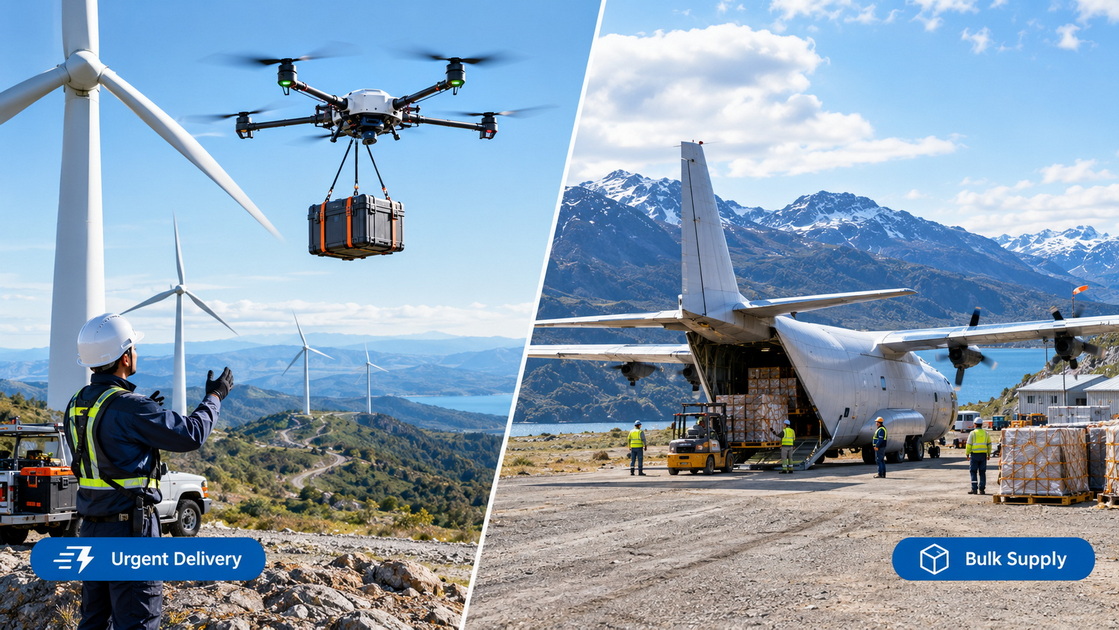
| Operational Requirement | Cargo Drone | Fixed-Wing Aircraft |
|---|---|---|
| Urgent spare-parts delivery | Excellent | Moderate |
| Heavy equipment transport | Limited | Excellent |
| Remote final-mile delivery | Excellent | Limited without ground transfer |
| Large inventory replenishment | Limited | Excellent |
| Operation without a runway | Strong, especially with VTOL platforms | Limited |
| Mountain or forest access | Strong | Depends on nearby airstrip availability |
| Scheduled bulk transport | Limited | Excellent |
| Emergency supply delivery | Strong for lightweight cargo | Strong for larger emergency cargo loads |
| High-frequency short-distance missions | Strong | Less efficient |
| Long-range regional logistics | Moderate to limited | Strong |
| Integration with inspection data | Strong | Possible but usually less immediate |
| Direct delivery to technicians | Strong | Usually requires a secondary delivery method |
| Weather resilience | Depends on aircraft design and operating limits | Depends on aircraft, crew, and airfield conditions |
| Payload scalability | Limited by aircraft size | High |
The best choice depends on the cargo mission, not on which aircraft type appears more advanced.
Industrial buyers should not evaluate a cargo drone based only on payload capacity, range, speed, or flight time.
A successful remote delivery operation requires a complete operating system.
This includes the aircraft, but it also includes the people, procedures, software, safety systems, communications infrastructure, receiving-site processes, maintenance support, and airspace planning.
Cargo drone operations beyond the direct visual range of a remote pilot require careful planning and appropriate approvals. These operations must account for route safety, aircraft reliability, command-and-control links, weather conditions, emergency landing locations, local aviation requirements, and the presence of other aircraft.
An industrial cargo drone program should include:
- Flight planning procedures
- Defined operating areas
- Secure cargo loading
- Weight and balance control
- Pre-flight inspections
- Weather monitoring
- Remote pilot procedures
- Communication backup systems
- Emergency response planning
- Lost-link procedures
- Maintenance schedules
- Landing-zone safety management
- Cargo handover procedures
- Delivery verification
- Flight-data recording
- Incident reporting
- Cybersecurity protection
- Cloud platform access control
The aircraft itself is only one component of the delivery system.
A reliable operation requires clear responsibilities across warehouse teams, flight crews, field technicians, operations supervisors, safety managers, and emergency-response personnel.
The right aircraft decision begins with mission analysis.
Instead of asking, "Should we buy a cargo drone or use a fixed-wing aircraft?" industrial buyers should ask, "Which transportation method provides the best result for this delivery mission?"
Every supply request should be assessed according to:
- Payload weight
- Cargo dimensions
- Delivery urgency
- Operational impact of delay
- Delivery distance
- Terrain
- Road conditions
- Weather exposure
- Site accessibility
- Receiving-site infrastructure
- Cargo value
- Safety requirements
- Delivery frequency
- Security needs
- Availability of alternative transport
A 2 kg emergency sensor and a 500 kg pallet of maintenance inventory should not be evaluated using the same delivery model.
Many industrial operators assume that distance is the main issue. In reality, delays may occur because of:
- Poor road access
- Limited flight schedules
- Long ground transfer times
- Lack of inventory visibility
- Manual approval processes
- Inaccurate delivery information
- Weak coordination between teams
- Unsafe driving conditions
- Weather disruptions
- Delayed access authorization
- Limited communication coverage
If the final 20 km creates most of the delay, a cargo drone may create significant value.
If the challenge is transporting several tonnes of equipment to a remote regional base, fixed-wing aircraft may be the more practical solution.
A useful comparison should include both direct and indirect value.
| Evaluation Area | Cargo Drone | Fixed-Wing Aircraft |
|---|---|---|
| Transport cost per kilogram | Often higher | Often lower for large loads |
| Cost of downtime avoided | Potentially very high | High for bulk inventory replenishment |
| Ability to bypass roads | Strong | Limited after landing |
| Remote access | Strong | Depends on airstrip availability |
| Large-payload capability | Limited | Strong |
| Dispatch speed | High for small urgent deliveries | Moderate for scheduled operations |
| Infrastructure requirements | Drone pads, communications, control systems | Airstrip, ground handling, aircraft support |
| Inventory strategy | Supports rapid micro-replenishment | Supports bulk stock movement |
| Personnel travel reduction | Can be significant | May still require ground transfer |
| Data integration potential | Strong for real-time dispatch | Strong for logistics planning and regional coordination |
A cargo drone may be financially justified even when its direct transport cost is higher. The value may come from reduced downtime, lower safety exposure, faster maintenance response, and improved visibility across remote operations.
The strongest industrial logistics systems usually use multiple transportation methods.
A practical hybrid model may include:
1. Fixed-wing aircraft transporting bulk cargo from central warehouses to regional logistics hubs.
2. Ground vehicles handling routine deliveries on safe and accessible roads.
3. Cargo drones delivering urgent, lightweight packages to remote or difficult final destinations.
4. Intelligent inspection drones identifying equipment issues and providing real-time site information.
5. A unified cloud control platform coordinating aircraft, vehicles, personnel, data, inventory, and emergency tasks.
This approach improves flexibility because each asset performs the mission it handles best.
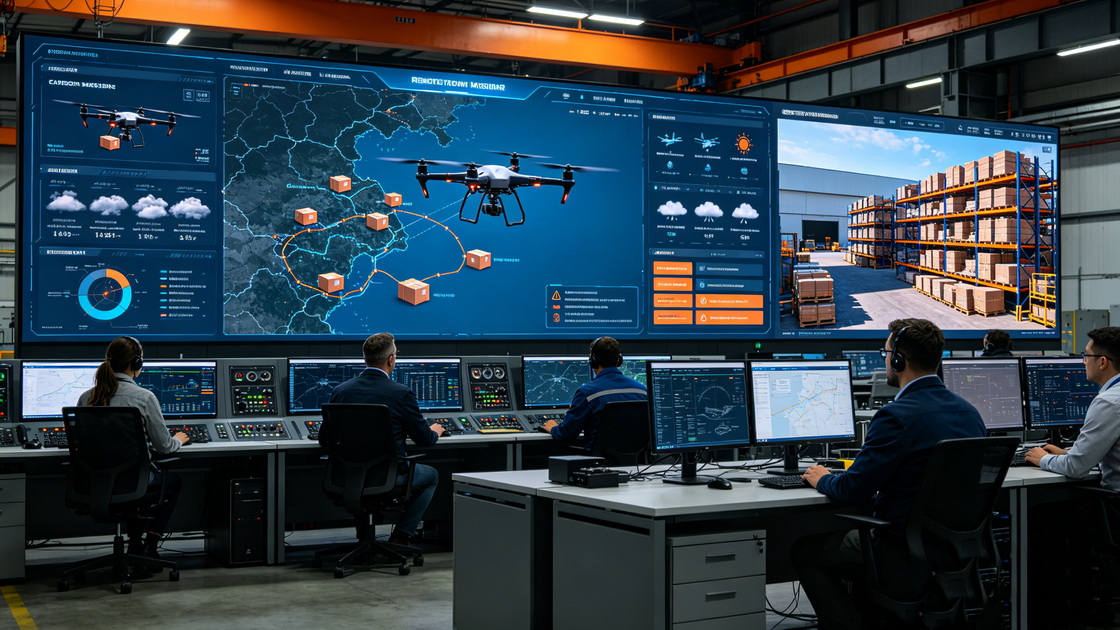
The future of remote industrial delivery is not based on aircraft alone. It depends on the ability to coordinate resources across air, ground, and underground environments.
An intelligent cloud control platform can connect:
- Cargo drones
- Inspection drones
- Ground vehicles
- Field technicians
- Warehouses
- Emergency teams
- Sensors
- Cameras
- Maintenance systems
- Delivery tasks
- Weather data
- Route information
- Asset status
- Incident alerts
This type of connected platform supports faster decisions and more efficient dispatch.
For example, an inspection drone may identify a problem at a remote industrial site. The system can automatically transmit images, location data, equipment status, and maintenance requirements to the central platform. The platform can then identify the nearest replacement part, assign a delivery method, notify the responsible team, and track the mission from dispatch through delivery confirmation.
This creates a complete operational process:
Detection→Analysis→Decision→Dispatch→Delivery→Verification
SIDT's one-network coverage approach supports this type of coordinated operation. By connecting intelligent flight platforms, dynamic perception, precise data collection, inspection systems, emergency-response resources, ground assets, and centralized control functions, organizations can create a more responsive supply network.
The objective is not simply to move cargo through the air. The objective is to deliver the right resource to the right location at the right time while improving visibility, safety, and operational continuity.
A cargo drone may look impressive in a demonstration, but industrial value depends on real operating requirements.
Organizations should first define the delivery mission, payload, urgency, route, risk profile, and site conditions before selecting an aircraft platform.
Payload and range are important. However, they do not show whether an aircraft can operate consistently in real conditions.
A delivery route must also consider:
- Return or diversion capability
- Wind and weather conditions
- Battery or fuel reserve
- Terrain
- Communications coverage
- Landing-zone safety
- Route authorization
- Emergency procedures
- Cargo-security requirements
Cargo drones are not designed to replace every truck, helicopter, or fixed-wing aircraft.
They are most valuable when they complement other transport methods. Their strongest role is often rapid, lightweight, hard-to-reach, or emergency delivery.
A successful delivery does not end when the drone reaches the destination.
The receiving site needs:
- A designated landing or handover area
- Clear safety rules
- Trained receiving staff
- Secure package handling
- Communication with the operations center
- Delivery confirmation procedures
- Emergency contact processes
Without these elements, even advanced aircraft technology can create delays or safety risks.
A drone fleet that is not connected to inventory systems, maintenance data, site information, inspection results, and dispatch workflows may create limited business value.
The most effective delivery model connects all operational stages, from demand detection to delivery confirmation.
Cargo drones and fixed-wing aircraft both have important roles in remote industrial supply delivery.
Cargo drones are ideal for urgent, lightweight, high-value, and time-sensitive deliveries. They can improve access to remote locations, bypass difficult terrain, reduce dependence on road transport, and support rapid emergency response.
Fixed-wing aircraft remain essential for long-distance transportation, bulk cargo movement, heavy equipment delivery, and scheduled replenishment between regional logistics hubs and remote industrial bases.
The strongest solution is often a hybrid logistics network. Fixed-wing aircraft can move large inventory volumes to regional locations. Ground vehicles can serve normal routes. Cargo drones can complete urgent final-mile deliveries to difficult or high-priority sites.
By connecting aircraft, ground resources, sensors, inspection systems, maintenance teams, and command functions through one intelligent cloud platform, industrial organizations can create a faster, more visible, and more resilient supply network.
SIDT supports the development of integrated low-altitude, ground, and underground application solutions for intelligent inspection, remote delivery, emergency response, and coordinated industrial operations. A unified delivery network can help remote organizations improve operational continuity, respond faster to equipment needs, and strengthen resilience across complex environments.
A cargo drone is generally better for lightweight, urgent, point-to-point delivery, especially in difficult terrain or locations without runway access. A fixed-wing aircraft is generally better for larger payloads, long-distance transport, and scheduled bulk cargo delivery.
Yes. Cargo drones can deliver lightweight spare parts, sensors, batteries, inspection equipment, communication devices, and emergency supplies to mining sites when the route, weather, payload, landing area, safety procedures, and operating permissions are suitable.
Cargo drones can be highly suitable for emergency delivery of lightweight cargo. They can transport medical kits, communication devices, sensors, replacement parts, inspection tools, batteries, and safety equipment to locations affected by damaged roads, severe weather, or industrial incidents.
Cargo drones cannot replace fixed-wing cargo aircraft for every mission. They are not normally suitable for bulk cargo, heavy equipment, or long-distance regional supply routes. However, they can complement fixed-wing aircraft by handling urgent final-mile delivery and small-payload missions.
The best cargo types include urgent spare parts, sensors, communication devices, small tools, batteries, inspection equipment, medical supplies, emergency kits, laboratory samples, calibration tools, and lightweight safety equipment.
A hybrid model assigns each transportation method to the mission it performs best. Fixed-wing aircraft handle bulk cargo and long-distance routes. Ground vehicles serve accessible roads. Cargo drones deliver urgent and lightweight packages to difficult final destinations. This improves flexibility, speed, and resilience.
A cloud control platform can connect aircraft, field teams, warehouses, sensors, maintenance systems, route information, weather data, and delivery tasks. This allows faster dispatch decisions, real-time mission monitoring, clearer communication, and better delivery verification.
Companies should assess payload requirements, delivery distance, terrain, weather, route safety, communications coverage, landing zones, workforce training, maintenance requirements, cargo handling, emergency procedures, data security, and local aviation requirements.
1. Federal Aviation Administration. "Package Delivery by Drone (Part 135)."
2. Federal Aviation Administration. "Unmanned Aircraft System (UAS) or Drone Operations."
3. National Aeronautics and Space Administration. "UAS Traffic Management Project."
4. International Civil Aviation Organization. "UAS Regulations."
5. International Civil Aviation Organization. "ICAO Model UAS Regulations."
6. European Union Aviation Safety Agency. "Drones & Air Mobility."


