Global Distributors Wanted
1.Free Cloud Service Deployment
2.Free Technical Training
3.Exclusive Territory Protection

1.Free Cloud Service Deployment
2.Free Technical Training
3.Exclusive Territory Protection


Views: 211 Author: Aaron Publish Time: 2026-09-07 Origin: Site


Content Menu
● Quick Answer: What Does Drone Delivery Cost?
● What Does a Customer Pay for Drone Delivery?
>> Common Drone Delivery Pricing Models
● What Does Drone Delivery Cost for Businesses?
>> Delivery Drones and Payload Equipment
>> Ground Infrastructure and Delivery Hubs
>> Safety, Compliance, and Operational Readiness
>> Cloud Control and Intelligent Fleet Management
>> Maintenance, Staffing, and Insurance
● Drone Delivery Cost by Industry
>> Retail and Consumer Delivery
>> Healthcare and Pharmacy Delivery
>> Industrial and Infrastructure Delivery
● The Main Factors That Affect Drone Delivery Price
>> Payload Weight and Package Size
>> Weather and Local Environment
● How to Calculate Your Drone Delivery Budget
>> Step 1: Define the Delivery Mission
>> Step 2: Measure the Existing Delivery Cost
>> Step 3: Compare Delivery Models
>> Step 4: Start with a Measurable Pilot
● When Is Drone Delivery Worth the Cost?
● Building a Connected Drone Delivery Network
● Summary
● FAQ
>> 1. How much does drone delivery cost for customers?
>> 2. Why does a drone delivery service cost more than a normal courier?
>> 3. Is drone delivery cheaper than van delivery?
>> 4. What types of products can drones deliver?
>> 5. Can drone delivery work in bad weather?
>> 6. What is the ideal distance for drone delivery?
>> 7. Can drone delivery support emergency response?
>> 8. What should a company evaluate before deploying drone delivery?
For customers, drone delivery can cost anywhere from free to around $5–$10 per order, depending on the retailer, delivery zone, order value, membership benefits, and service availability. For businesses, the real cost is much broader. It includes the aircraft, charging systems, delivery hubs, software platforms, maintenance, safety operations, regulatory preparation, insurance, and integration with existing logistics systems.
The question, "How much does it cost to have a drone delivery?" therefore has two different answers. A customer may pay only a small convenience fee. A retailer, hospital, industrial operator, city authority, or logistics provider may invest from a limited pilot budget to a multi-million-dollar intelligent delivery network.
Drone delivery is no longer only about moving a package through the air. It is becoming part of a connected operational system that links low-altitude flight, ground equipment, underground spaces, cloud-based command, real-time data, and emergency-response capabilities.
The visible price paid by a customer is often low because retailers may subsidize the service. Free drone delivery may be available for qualifying orders, while smaller orders may include a modest delivery fee.
However, the delivery fee is only one part of the total cost.
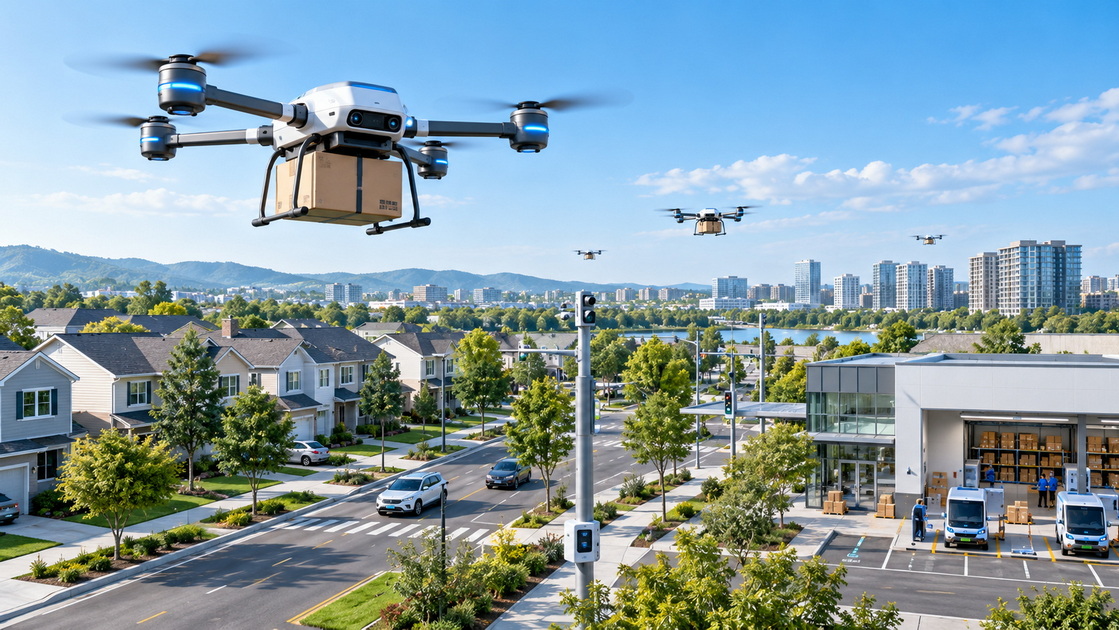
A professional drone delivery operation requires a complete system that can safely manage aircraft, payloads, flight routes, data connections, customer orders, weather conditions, maintenance schedules, landing or drop locations, and operational exceptions.
| Cost Category | Typical Cost Range | What It Covers |
|---|---|---|
| Customer drone delivery fee | Free to about $5–$10 | The fee visible to the person placing an order |
| Early commercial delivery cost per mission | Often around $15–$30 | Aircraft use, operations, maintenance, software, labor, and infrastructure |
| Mature high-density delivery target | Often below $7 per delivery | A potential long-term cost level after scale and automation improve |
| Small pilot program | Approximately $150,000 and above | Limited fleet, equipment, staff, safety procedures, and initial operations |
| Multi-site intelligent delivery network | Millions of dollars | Fleet, hubs, cloud platform, integrations, compliance, maintenance, and expansion |
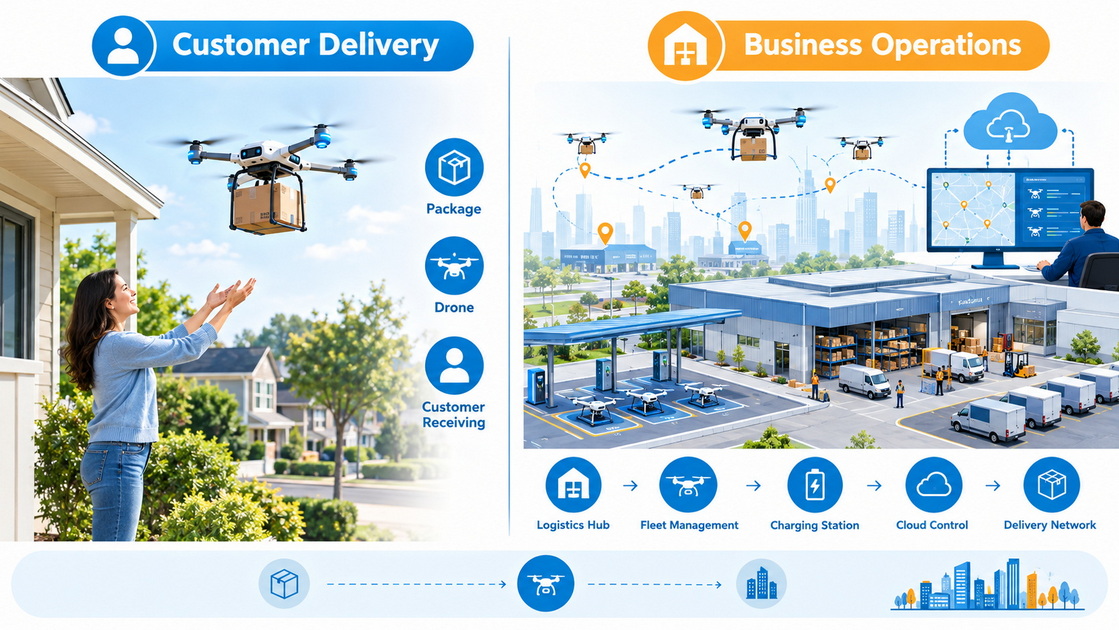
The exact cost depends on how far the drone travels, how much it carries, how frequently it flies, what level of automation is used, and how complex the surrounding environment is.
For most customers, drone delivery is priced as a premium local-delivery option. It may be offered through a retailer's mobile app, website, delivery platform, or membership program.
The final price can depend on:
- Order value
- Distance from the fulfillment point
- Delivery speed
- Customer membership status
- Demand at the time of ordering
- Service-area availability
- Package size and weight
- Promotional offers
A customer ordering medicine, a phone charger, baby supplies, snacks, prepared food, or household essentials may choose drone delivery because the item can arrive quickly. In some locations, the difference between drone delivery and standard local delivery may be measured in minutes rather than hours.
This speed changes the customer's decision-making process. A person does not always compare drone delivery with normal shipping. They often compare it with driving to a store, waiting for a courier, delaying a task, or going without an urgently needed item.
Businesses commonly use several pricing structures for customer drone delivery.
| Pricing Model | How It Works | Best Use Case |
|---|---|---|
| Free above an order minimum | Customers receive free delivery when they spend above a set threshold | Grocery, retail, pharmacy, household goods |
| Flat delivery fee | Customers pay one fixed charge per drone delivery | Simple consumer delivery programs |
| Membership benefit | Eligible members receive discounted or free delivery | Loyalty and subscription programs |
| Dynamic delivery pricing | The fee changes based on demand, distance, speed, or capacity | High-demand urban or suburban delivery areas |
| Retailer-funded delivery | The business absorbs all or part of the cost | Promotions, customer acquisition, urgent goods |
| Enterprise service fee | A company pays for a managed delivery network rather than billing each recipient | Hospitals, campuses, industrial facilities |
A low customer fee does not always mean the service is low cost. A retailer may choose to pay part of the delivery cost because rapid delivery can increase order frequency, improve customer retention, and create a stronger service experience.
For businesses, drone delivery cost should be viewed as a total operating model rather than a drone purchase.
A company may spend relatively little on a limited proof-of-concept project. But a scalable system requires reliable hardware, intelligent software, trained personnel, secure communication, maintenance capabilities, safety processes, and connections to inventory, fulfillment, and command systems.
The most useful question is not simply, "How much does a delivery drone cost?"
The better question is:
What is the cost per safe, completed, trackable, and repeatable delivery mission?
Commercial delivery drones are purpose-built aircraft. They are not the same as recreational camera drones.
A professional delivery aircraft may need to include:
- High-efficiency propulsion systems
- Secure payload boxes or cargo bays
- Precision landing or tether-delivery systems
- Swappable battery systems
- Route-planning technology
- Remote identification and tracking functions
- Obstacle detection capabilities
- Weather-monitoring support
- Reliable communications equipment
- Emergency landing and fail-safe mechanisms
The cost of a delivery drone can vary widely. A small aircraft designed for lightweight parcels may cost significantly less than an industrial-grade platform that carries heavier payloads, operates in demanding weather, or integrates advanced sensing technology.
The final price also depends on whether the drone needs thermal cameras, LiDAR, high-precision positioning, gas-detection sensors, encrypted communications, or real-time video transmission.
These advanced capabilities are especially important in industrial inspection, underground-space detection, emergency response, infrastructure monitoring, and complex urban operations.
Drone delivery requires reliable ground infrastructure. The drone must have a safe place to launch, land, charge, load parcels, receive maintenance, and communicate with the wider control system.

A delivery hub may include:
- Automated launch and recovery equipment
- Charging or battery-swapping systems
- Secure loading areas
- Weather-monitoring stations
- Maintenance workspaces
- Delivery package handling equipment
- Connectivity systems
- Safety barriers and monitoring tools
- Storage for spare batteries and spare parts
- Access-control systems
Delivery hubs can be installed at retail stores, micro-fulfillment centers, hospitals, industrial parks, logistics sites, campuses, emergency-response centers, or temporary field locations.
The cost of a hub depends on the desired level of automation. A simple launch site may support limited flights. A highly automated hub can support higher delivery frequency, faster turnaround, reduced manual handling, and more consistent operations.
Drone delivery requires careful planning because it operates in shared environments. The aircraft may fly over roads, buildings, neighborhoods, industrial sites, waterways, fields, or restricted zones.
Operational readiness includes:
- Airspace planning
- Flight route design
- Risk assessment
- Weather limitations
- Maintenance procedures
- Remote-pilot supervision
- Emergency-response procedures
- Data protection
- Communication reliability
- Fleet monitoring
- Customer delivery-zone management
- Incident reporting and improvement processes
These requirements create an important difference between a demonstration flight and a real delivery business.
A single flight can be simple. A repeatable delivery network must be dependable every day, during changing weather, different demand levels, technical exceptions, and unexpected operational events.
Businesses should build their delivery model around safety from the beginning. This includes aircraft redundancy, secure communications, detailed pre-flight checks, route restrictions, emergency landing options, and real-time monitoring.
The cloud platform is the operational center of a scalable drone delivery network.
A connected control platform can collect data from drones, delivery hubs, customer orders, cameras, sensors, ground equipment, weather systems, and dispatch teams. It can then turn that information into actionable mission decisions.
A complete fleet-management system should support:
- Real-time drone position monitoring
- Mission planning and route assignment
- Flight authorization workflows
- Battery health tracking
- Maintenance alerts
- Payload status tracking
- Weather and environmental risk information
- Video and sensor-data collection
- Exception alerts
- Delivery confirmation
- Historical mission records
- Multi-site operational dashboards
For organizations operating in complex environments, isolated systems can create inefficiency. A drone fleet that cannot exchange information with ground teams, security systems, emergency command centers, inventory systems, or underground sensing equipment may create new information gaps instead of solving existing problems.
This is why integrated operational architecture matters.
SIDT's "one-network coverage" approach is designed to connect low-altitude, ground, and underground operations through a unified intelligent cloud control platform. Rather than managing each device or environment separately, organizations can coordinate multiple systems through one operational view.
This model is particularly useful for:
- Urban airspace delivery
- Ground-air emergency coordination
- Underground-space inspection
- Industrial facility operations
- Smart-city logistics
- Infrastructure monitoring
- Security and public-safety missions
- Multi-node command and dispatch
The ongoing cost of drone delivery includes much more than electricity or battery charging.
Even highly automated systems require human oversight. Teams may be needed to supervise operations, maintain equipment, load packages, manage customer exceptions, monitor fleet health, inspect aircraft, and respond to unusual conditions.
Ongoing operating costs may include:
- Remote operations personnel
- Maintenance technicians
- Battery replacement
- Spare parts
- Software subscriptions
- Cloud storage and data processing
- Connectivity services
- Insurance
- Training
- Security systems
- Site leasing
- Customer support
- System updates
Battery management is especially important. Batteries lose capacity over time, and high-frequency delivery networks must track charging cycles, temperature exposure, power output, and replacement schedules.
A drone delivery program may look low-cost when only the aircraft price is considered. The economics change when the full operating system is included.
The financial value of drone delivery is different in every industry. A low-value consumer item and an urgent industrial replacement part should not be evaluated using the same cost standard.
| Industry or Use Case | Main Cost Concern | Main Business Value | Suitable Delivery Type |
|---|---|---|---|
| Retail and convenience | Cost per order | Fast local service and customer retention | Small consumer goods |
| Grocery delivery | Delivery density | Faster fulfillment for nearby households | Lightweight food and household items |
| Pharmacy and healthcare | Reliability and urgency | Faster access to critical medicines and supplies | Medicine, samples, medical products |
| Industrial facilities | Avoided downtime | Rapid replacement of urgent components | Small spare parts, sensors, tools |
| Rural logistics | Route distance | Reaching locations with difficult road access | Essential goods and healthcare supplies |
| Emergency response | Speed and situational awareness | Rapid movement of equipment and information | Medical kits, communications devices, sensors |
| Campuses and closed sites | Operational efficiency | Frequent short-distance movement | Documents, supplies, food, maintenance items |
For retailers, drone delivery must be efficient enough to support frequent small orders. The service performs best when a store or local fulfillment center can serve a dense group of customers within a practical flight radius.
Retailers should focus on:
- High-frequency product categories
- Small and lightweight orders
- Strong order density
- Short flight routes
- Convenient customer delivery zones
- Clear service availability
- Fast order processing
The most attractive products are often items that customers need quickly but do not want to travel to purchase.
Healthcare delivery is often less focused on the lowest cost per mission. Instead, it prioritizes reliability, speed, patient access, and operational resilience.
Drone delivery can support the movement of:
- Prescription medicines
- Laboratory samples
- Blood products
- Vaccines
- First-aid supplies
- Medical devices
- Emergency treatment kits
In these scenarios, the value of a faster delivery may be much greater than the direct flight cost. A delivery system that reduces waiting time, improves access, or supports urgent care can provide value beyond normal logistics calculations.
Industrial locations can be ideal for drone delivery because the value of time is often high.
A large factory, energy facility, port, warehouse, mining site, construction project, or utility network may require urgent movement of small equipment, sensors, replacement parts, documents, or safety materials.
For example, if a production line stops because a small control component is missing, the cost of downtime may be far greater than the cost of a rapid drone delivery. In this case, the drone does not need to be cheaper than a vehicle trip. It needs to be faster, more predictable, and operationally dependable.
No two drone delivery projects have exactly the same cost. Several factors have a direct impact on both customer fees and business investment.
Short routes usually cost less because drones use less energy, complete more missions per hour, and remain closer to the launch hub.
Longer routes may require larger batteries, more charging capacity, more careful route planning, and greater weather reserves.
Lightweight packages are easier to deliver and allow for smaller aircraft. Larger or heavier payloads require more powerful drones, stronger cargo systems, and potentially more advanced safety features.
The package itself matters too. Fragile, temperature-sensitive, hazardous, high-value, or irregularly shaped items may need special handling.
High delivery volume can improve economics because fixed costs are spread across more missions.
A single drone delivery each day is difficult to justify. A predictable network completing many repeatable missions from one hub can become far more efficient.
Wind, rain, temperature, tall buildings, power lines, trees, restricted airspace, dense traffic, and electromagnetic interference can affect the complexity and cost of operations.
Urban environments may have strong demand but more route complexity. Rural environments may have open airspace but longer distances. Industrial sites may have controlled access but demanding safety requirements.
Higher automation can reduce repetitive manual work, but it may require more sophisticated hardware, software, testing, and monitoring.
The correct level of automation depends on the use case. A hospital campus may need a controlled scheduled route. A citywide network may require more advanced dispatch, traffic awareness, and integrated command capabilities.
Integration is often one of the largest and most valuable parts of a drone delivery project.
A useful delivery system may need to connect with:
- Warehouse management systems
- Inventory systems
- Retail ordering platforms
- Customer notification tools
- Hospital supply systems
- Industrial maintenance platforms
- Emergency-response dashboards
- City command centers
- Security systems
- Geographic-information systems
A disconnected drone fleet can create operational complexity. A connected network can become part of the organization's wider decision-making system.
Businesses should calculate drone delivery cost using a structured method rather than relying on a single equipment quotation.
Start with the operational requirement.
Ask the following questions:
1. What items need to be delivered?
2. What is the maximum payload weight?
3. How far must the drone travel?
4. How quickly must the package arrive?
5. How many deliveries are expected each day?
6. Is the route fixed or variable?
7. What weather conditions are expected?
8. Is the area urban, suburban, industrial, rural, or underground-connected?
9. What happens if delivery is delayed?
10. What systems must the delivery platform connect with?
Do not compare drone delivery only with fuel costs.
Calculate the true cost of current delivery methods, including:
- Driver or courier labor
- Vehicle use
- Fuel or electricity
- Vehicle maintenance
- Road congestion
- Parking and access delays
- Failed deliveries
- Inventory delays
- Emergency response time
- Equipment downtime
- Customer dissatisfaction
- Lost orders
For an industrial site, include the cost of delayed repairs. For healthcare, consider the impact of delayed access to critical supplies. For retail, measure lost conversion when customers cannot receive an item quickly.
| Delivery Model | Initial Investment | Operational Control | Best Fit |
|---|---|---|---|
| Managed drone delivery service | Low to medium | Lower | Retailers and organizations testing demand |
| Private managed fleet | Medium to high | Medium to high | Hospitals, campuses, factories, industrial parks |
| Integrated multi-domain network | High | High | Smart-city projects, emergency systems, large logistics operators |
A managed service can reduce initial complexity. A private fleet can provide more operational control. An integrated multi-domain network provides the greatest long-term capability when an organization needs to coordinate air, ground, and underground resources.
A pilot program should demonstrate operational value, not only flight ability.
Measure:
- Delivery time
- Completion rate
- Delivery cost per mission
- Package damage rate
- Weather-related cancellation rate
- Battery performance
- Customer satisfaction
- Reduction in vehicle trips
- Staff workload
- System uptime
- Safety events
- Integration reliability
A successful pilot produces data that supports a realistic expansion decision.
The best delivery system is designed to scale.
A company may begin with one route, one hub, and a small fleet. Over time, the network may expand to support more locations, more payload types, higher delivery frequency, and integration with ground equipment and intelligent command systems.
Planning for growth from the beginning helps avoid costly replacement of disconnected platforms later.
Drone delivery is worth the cost when it solves a problem that traditional ground delivery handles poorly.
It is especially valuable when:
- The package is lightweight but urgent.
- The route is short and repeatable.
- Road delivery is slow or unpredictable.
- The delivery zone is difficult to access by vehicle.
- The cost of delay is high.
- The business serves a dense local customer base.
- The system can connect to existing operations.
- The organization needs stronger emergency-response capability.
- The network can support both delivery and broader operational missions.
The strongest drone delivery programs are not built around novelty. They are built around a clear operational problem.
A retail business may use drone delivery to increase convenience. A hospital may use it to improve access to medical supplies. An industrial facility may use it to avoid downtime. A city may use it to coordinate emergency resources. A logistics provider may use it to improve last-mile service in difficult areas.
The value comes from the outcome: faster movement, better visibility, safer operations, stronger coordination, and more resilient service.
A single drone can complete a single mission. A connected drone delivery network can support a larger operational strategy.
SIDT focuses on the deep integration and innovation of drone technology across low-altitude, ground, and underground environments. Through independently developed intelligent flight platforms, dynamic perception, precise data collection, and intelligent analysis, SIDT supports a wide range of operational needs.
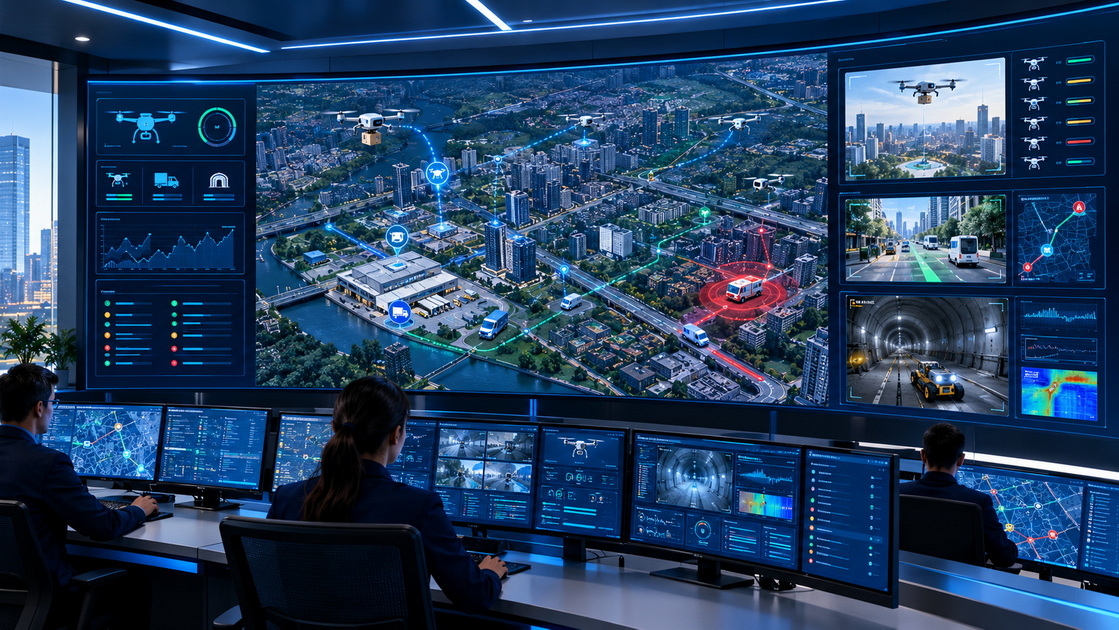
These include:
- Intelligent inspection
- Underground-space detection
- Urban airspace 3+1 delivery
- Emergency response
- Ground-air coordination
- Multi-node dispatch
- Intelligent command management
- Cross-environment data collection
The "one-network coverage" model helps organizations move beyond isolated equipment and fragmented workflows. Through a unified intelligent cloud control platform, different assets can be coordinated through one command, dispatch, and management framework.
This approach supports seamless connection between people, devices, locations, data, and mission requirements.
For organizations planning drone delivery, the key is to think beyond the aircraft. The real opportunity is to build an intelligent delivery capability that can create measurable value across daily operations, high-priority logistics, inspection work, emergency missions, and future smart-city applications.
Drone delivery may cost a customer only a few dollars, but a business-grade delivery network requires a much broader investment. The total cost includes aircraft, payload systems, hubs, cloud control, maintenance, staffing, safety management, operational readiness, and data integration.
The most important factor is not the lowest price per flight. It is whether the delivery system creates meaningful value.
For retailers, that value may be faster service and better customer loyalty. For hospitals, it may be rapid access to critical supplies. For industrial operators, it may be reduced downtime. For cities and emergency teams, it may be faster coordination across complex environments.
A well-designed drone delivery network can become more than a logistics tool. It can become part of a connected operational system that improves speed, visibility, safety, and decision-making across low-altitude, ground, and underground environments.
Drone delivery may be free for qualifying orders or cost approximately $5–$10, depending on the retailer, membership program, order value, delivery zone, and local service conditions.
Drone delivery requires specialized aircraft, charging systems, maintenance, monitoring, safety processes, communications technology, and delivery infrastructure. New or low-volume networks may have higher costs because they have not yet reached scale.
Drone delivery can be more cost-effective when packages are lightweight, routes are short, delivery demand is high, and road delivery is slow or inefficient. It is not automatically cheaper for every location or every type of package.
Drones are often used for small and lightweight goods such as food, medicine, consumer electronics, documents, household items, emergency supplies, laboratory samples, tools, and industrial spare parts.
Weather can affect drone delivery. Strong winds, heavy rain, thunderstorms, extreme temperatures, and poor visibility may limit or pause operations. A professional system should include weather monitoring, operational limits, and safe alternative procedures.
Short and repeatable routes are generally the most efficient. The ideal distance depends on aircraft design, payload weight, battery capacity, weather conditions, and the location of launch hubs.
Yes. Drone delivery can move lightweight medical supplies, communications equipment, sensors, and emergency materials. It can also work alongside aerial observation drones, ground vehicles, and command systems to improve response speed and coordination.
A company should evaluate payload requirements, route distance, delivery volume, operating environment, weather conditions, safety processes, system integration, staffing needs, maintenance requirements, data security, and the cost of delayed delivery.
1. Federal Aviation Administration. "Package Delivery by Drone (Part 135)."
2. Federal Aviation Administration. "Unmanned Aircraft System (UAS) or Drone Operations."
3. Wing. "Drone Delivery in Minutes, Not Hours or Days."
4. Zipline. "Safety Facts."
5. eMarketer. "FAQ on Drone Delivery: What Retailers Need to Know in 2026."
6. Robotomated. "How Much Do Delivery Robots Cost? Last-Mile Automation Pricing."
7. WFMD. "Amazon Drone Delivery Is Coming to Nearly 500 Cities."


