Global Distributors Wanted
1.Free Cloud Service Deployment
2.Free Technical Training
3.Exclusive Territory Protection

1.Free Cloud Service Deployment
2.Free Technical Training
3.Exclusive Territory Protection


Views: 211 Author: Aaron Publish Time: 2026-09-30 Origin: Site


Content Menu
● How Each Delivery Network Works
>> What a Drone Logistics Solution Includes
>> What Traditional Warehousing Networks Provide
>> Why Drones Still Need Warehouses
● Drone Logistics vs Traditional Warehousing
>> Speed: Measure the Entire Customer Journey
>> Cost: Compare Completed Deliveries
>> Coverage: Design the Fallback Before Launch
>> Sustainability: Count the Whole Network
● What Operating Examples Reveal
>> Medical Delivery Shows the Value of Urgency
>> Existing Retail Sites Can Support an Air Network
>> Inventory Location Can Change the Result
● How to Evaluate a Hybrid Network
>> 1. Segment Orders Before Selecting Aircraft
>> 2. Map Stock Against Usable Coverage
>> 3. Use the Same Scorecard for Both Options
>> 4. Run a Limited, Reversible Pilot
● Coordinating Air and Ground Operations
● The Strongest Network Is Purpose-Built
>> 1. Can Drone Delivery Replace a Distributed Warehouse Network?
>> 2. When Is Drone Delivery More Useful Than a Van Route?
>> 3. Is Drone Delivery Always Faster?
>> 4. Is Drone Delivery Always Cheaper or Greener?
>> 5. What Approvals Are Needed for Commercial Drone Delivery?
>> 6. What Should a Buyer Ask a Drone Solution Provider?
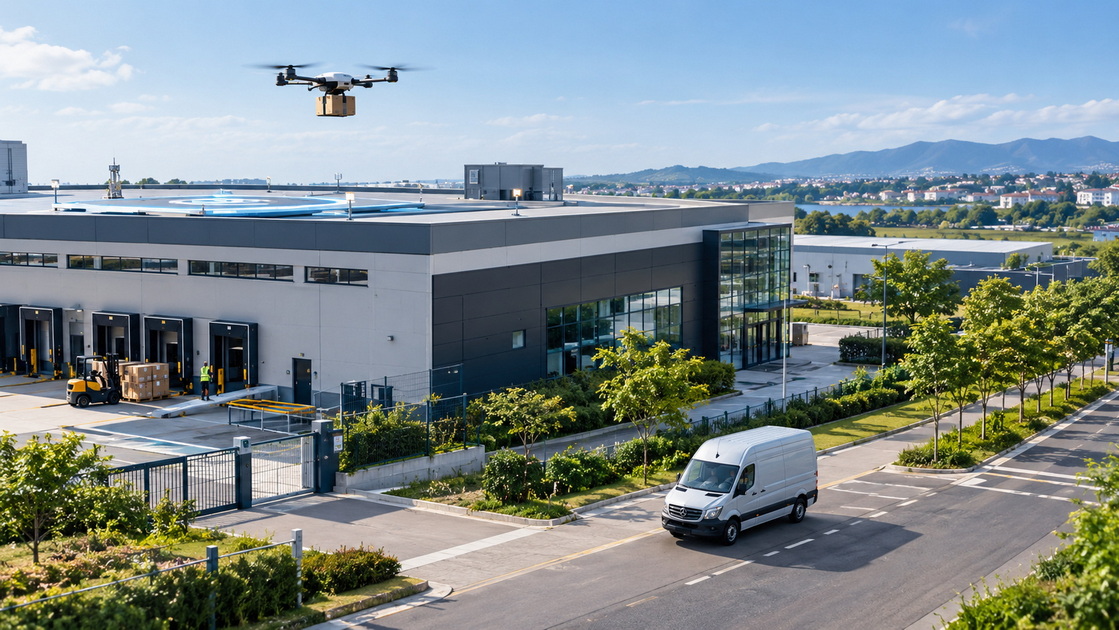
A drone logistics solution and a traditional warehousing network address different parts of distributed delivery. Warehouses position inventory near demand; drones transport selected shipments from a stocked location to a delivery point. For most operators, the strongest option is a hybrid network: keep warehouses and ground vehicles for broad coverage, then add drone delivery where speed, geography, and shipment characteristics justify it.
The decision is not whether an aircraft can fly faster than a van can drive. It is whether the complete network can deliver the right item, to the right place, within a reliable time window and at an acceptable total cost.
A commercial drone logistics solution is more than an aircraft. It requires a stocked origin, order and inventory data, a suitable launch site, flight planning, operational oversight, maintenance, a delivery point, and a process for flights that cannot be completed.
The drone performs one leg of a wider supply chain. It does not replace purchasing, storage, picking, packing, or replenishment. A fast flight has little value if the requested product is at the wrong facility.
Service coverage also depends on more than a route drawn on a map. Payload, battery capacity, weather, airspace, site access, and operating permissions determine whether a particular order can fly at a particular time.
A traditional distributed warehousing network places inventory across central and regional facilities. Ground vehicles then replenish those facilities and deliver orders to customers.
Its major strength is flexibility. Vans and trucks can carry heavier or mixed loads, combine multiple stops, and reach many destinations that are unsuitable for drone delivery. Established ground operations can also provide a practical fallback when an air leg is unavailable.
The trade-off is inventory placement. More local facilities can shorten delivery distances but increase space, labor, replenishment, and stock requirements. Fewer facilities can pool inventory more efficiently but may make rapid delivery harder. Facility location and inventory policy must therefore be evaluated together.
A drone must collect a product from somewhere. In most delivery models, that origin is a warehouse, store, hospital, or other stocked site.
Adding drone coverage may even require additional launch locations. If those locations need duplicated inventory, staff, or dedicated space, a faster last mile can create higher costs elsewhere in the network. The more useful question is not "drones or warehouses?" but "which stock should be close to demand, and which orders benefit from an air leg?"

| Decision factor | Drone logistics solution | Traditional warehousing and ground network |
|---|---|---|
| Primary role | Moves eligible shipments rapidly from a stocked node | Stores, fulfills, replenishes, and delivers a broad product range |
| Best-fit orders | Small, urgent shipments that are inefficient to serve individually by road | Mixed baskets, heavier goods, scheduled orders, and dense delivery routes |
| Speed advantage | Can shorten the transport leg when an aircraft and route are available | Benefits from local stock and efficient vehicle scheduling |
| Scale advantage | Depends on aircraft utilization and operating capacity | Can consolidate many parcels into one vehicle route |
| Inventory need | Requires stock at a suitable origin | Can distribute or pool stock across facilities |
| Key constraints | Payload, range, weather, delivery point, airspace, and permissions | Stock accuracy, facility capacity, road access, traffic, and vehicle availability |
| Failure response | Needs a return, re-dispatch, or ground handoff | Can often reroute through established ground operations |
These are network-design tendencies, not guarantees. A drone's advertised flight range, for example, is not automatically its usable delivery radius once payload, route, operating conditions, and the return journey are considered.
Flight time is only one component of delivery time. The customer's wait also includes order release, picking, packing, loading, dispatch, flight, and delivery confirmation.
A ground vehicle may travel more slowly between two points yet deliver more orders efficiently on a planned route. Conversely, an urgent item may reach a remote or congested destination faster by air when the product and aircraft are ready at a nearby hub.
Published retail services show both the potential and the limits. Amazon says eligible Prime Air orders can arrive in as fast as 30 minutes, while most arrive around 60 minutes after checkout. Its eligibility rules also restrict package size and weight. Those are details of one operator's service, not a delivery-time promise for every drone network.
For a fair comparison, measure order-to-receipt time across all eligible orders. Include the slowest periods and orders that shift to ground delivery when flying is not possible.
A drone's cost per flight does not tell a buyer what a delivery network costs. The full calculation includes aircraft, batteries, hubs, software, staffing, maintenance, insurance, compliance, and unsuccessful attempts. The ground comparison must likewise include facilities, inventory, vehicles, labor, and routing.
Industry modeling illustrates why assumptions matter. One analysis estimated a direct operating cost of about $13.50 for a single-package drone delivery under its modeled conditions. In a future scenario where one operator manages 20 drones, the same analysis estimated $1.50–$2 per delivery. The lower figure is a scenario, not a current price or a guaranteed saving.
A dense van route may still be cheaper because one vehicle carries many packages. Drone delivery is more likely to offer an advantage where an urgent shipment would otherwise require a dedicated trip or where road access makes conventional delivery unusually slow or expensive.
Drone coverage is conditional. An address may be geographically close to a hub but unsuitable because of the delivery point, route, weather, or applicable operating restrictions.
That makes exception handling part of the service—not an afterthought. When a flight cannot proceed, the system should identify the problem quickly, release the order to another delivery mode, and update the customer's expected arrival time. If the handoff requires staff to locate and pick the same order again, the apparent speed advantage may disappear.
Electric flight produces no exhaust at the delivery point, but that alone does not establish a lower environmental footprint. Electricity generation, batteries, aircraft size, additional buildings, and the ground trip being replaced all matter.
Life-cycle research has found favorable results for small drones in many modeled circumstances, while results for larger drones are more sensitive to assumptions. Extra warehouse energy can also reduce the environmental benefit. Claims should therefore be based on emissions per completed delivery across the full network, not on a comparison between an electric motor and a fuel-powered engine.
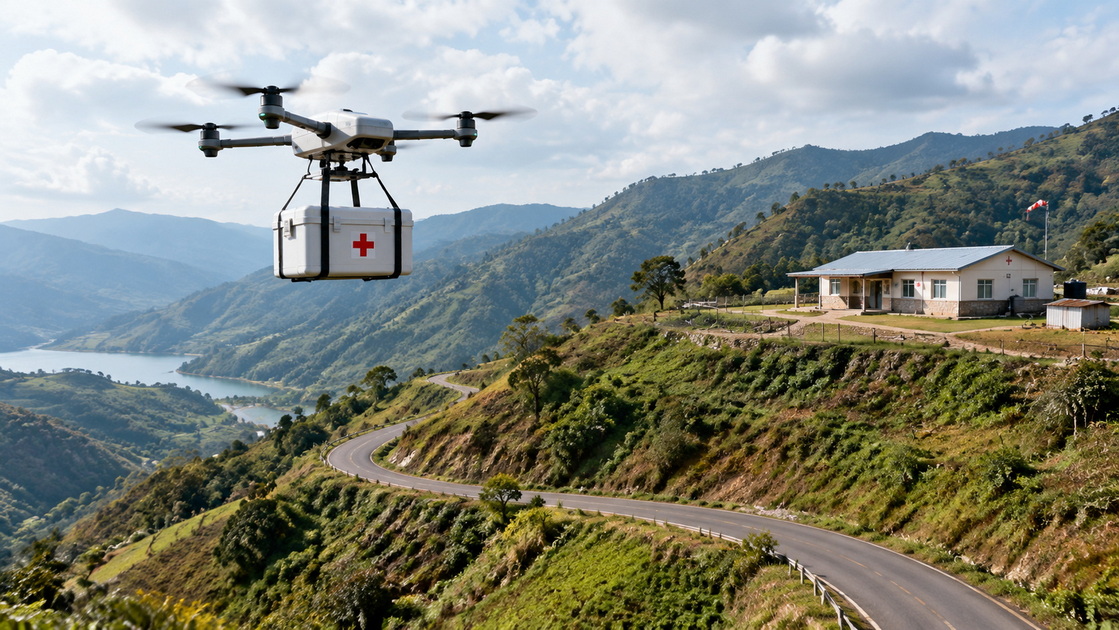
Blood-product delivery in Rwanda demonstrates a use case where a rapid air connection can have value beyond transport speed. A published study reported shorter delivery times and fewer product expirations after drone delivery was introduced. In its comparison data, the median drone delivery time was 41 minutes.
The operation still relied on supply hubs and inventory management. Its wider lesson is that dependable, rapid replenishment may help a destination avoid holding as much time-sensitive stock. That possibility must be tested for each product and service area; results from medical logistics should not be treated as a forecast for ordinary retail parcels.
Retail drone delivery can be easier to assess when it begins at a site that already stocks products and serves customers. Amazon describes Prime Air as part of its existing shopping experience. In August 2026, the company reported operations from 11 U.S. locations and announced plans to expand its geographic reach.
For another retailer, the relevant question is not how quickly it can copy that footprint. It is whether its existing stores or fulfillment sites have suitable inventory, demand, operating space, and delivery geography. Reusing a stocked site may avoid some duplication, but it does not remove the need to assess safety, approvals, and local conditions.
Supply-chain research on multi-facility networks shows why inventory decisions belong in the same model as delivery decisions. Pooling some stock can reduce costs under the right conditions, while placing more stock near customers can improve responsiveness. Neither approach wins in every case.
Consider an urgent replacement part ordered by several industrial sites. Stocking one part at a regional hub and delivering it by air on demand might work better than keeping a spare at every site. If flights are frequently unavailable, however, local stock or a dependable ground route may provide a stronger service. The answer comes from demand patterns, stockout costs, and measured reliability.
Start with actual orders. Group them by weight, dimensions, urgency, destination, order frequency, handling needs, and the cost of a late delivery.
This reveals where an air leg may matter. A small emergency part for an isolated work site is different from a household basket on a dense suburban route. Both may fit inside a drone, but only one may justify a dedicated flight.
Remove clearly unsuitable orders from the initial pilot. Eligibility should account for the product, the receiving location, and the operating conditions—not weight alone.
Plot inventory locations and order destinations. Then test workable routes rather than drawing a simple circle around each hub.
Account for the dispatch process, route restrictions, payload, charging, return requirements, and delivery-point access. Compare at least three designs: ground-only delivery, drones operating from existing stocked sites, and a hybrid that adds new nodes.
This exercise exposes costs that a flight map cannot show. A new hub may expand nominal coverage while increasing rent, stock duplication, replenishment, and energy use.
A pilot should compare complete orders under the same service promise. Useful measures include:
- Median and 95th-percentile order-to-receipt time
- On-time delivery and first-attempt completion rates
- Total cost per completed order, including fallback
- Stock availability when an order is released
- Aircraft and hub utilization
- Weather and airspace cancellations
- Customer complaints and safety events
- Energy use and estimated life-cycle emissions per delivery
Do not compare a drone's fastest flight with the ground network's average delivery cost. Keep the geography, order mix, measurement period, and treatment of unsuccessful attempts consistent.
Choose one use case with a clear potential advantage, such as urgent lightweight items or a destination with a difficult road connection. Keep the ground route available throughout the pilot.
Set thresholds for safety, reliability, customer experience, and cost before operations begin. Review results by order segment. If drones improve service only for a narrow category, that may still justify deployment. A targeted, dependable service is more valuable than an air network designed around every possible parcel.
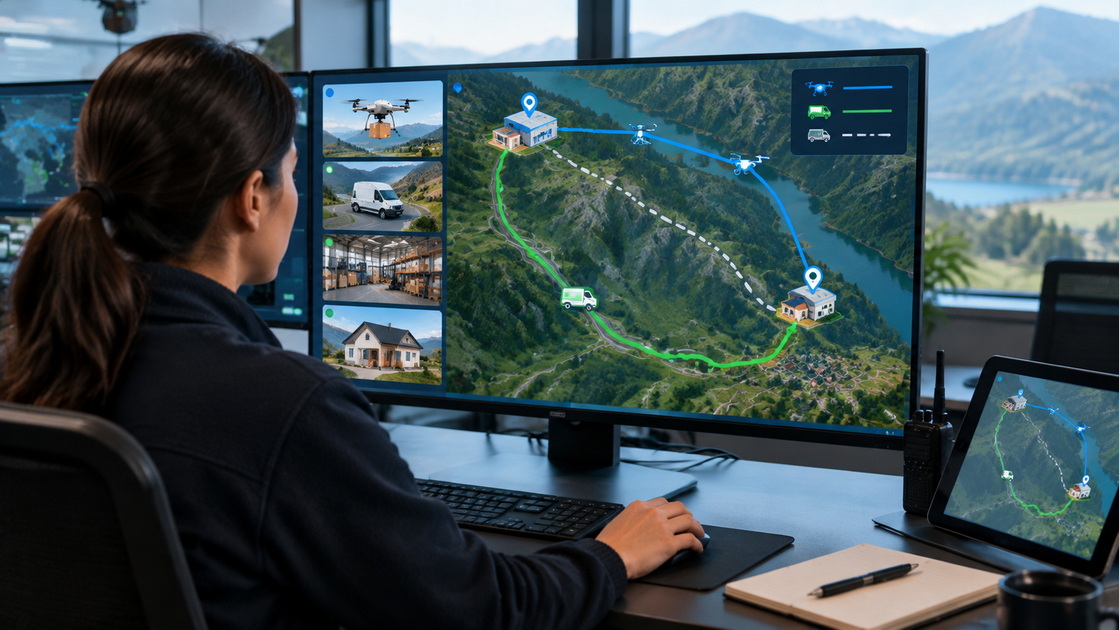
Shenzhen Intelligent Drone Technology Co. Ltd. describes its offering as a full-stack approach spanning low-altitude, ground, and underground environments. Its stated capabilities include an intelligent flight platform for perception, data collection, and analysis, alongside a unified cloud-control platform intended to coordinate equipment across locations.
For distributed delivery, the most relevant question is how that coordination works when an order changes course. Can an operations team see the order, confirm inventory, dispatch an aircraft, detect an exception, assign a ground alternative, and confirm completion within one connected workflow?
SIDT calls its cross-environment approach "one-network coverage." That is a useful concept for evaluating coordination, but it should not be mistaken for a measured guarantee of delivery speed, cost reduction, or coverage in a proposed service area. Buyers should request a demonstration using their own order profiles and ask how integrations, operational responsibilities, data access, maintenance, and ground fallback would work in practice.
Traditional warehouses and ground vehicles remain the foundation for broad product coverage and consolidated delivery. Drones can add a valuable fast lane for selected orders, especially when urgency or difficult geography makes a conventional trip less effective.
The strongest design gives each mode a defined job and measures their combined performance. If your organization is considering distributed drone delivery, share a representative order dataset and proposed service area with SIDT. Request a hybrid-network feasibility assessment covering usable coverage, inventory placement, end-to-end delivery time, total cost, and ground fallback before committing to a rollout.
No. Drone delivery still requires stocked products, picking, replenishment, and exception handling. It may change where some inventory is held, but it does not eliminate the need for inventory facilities.
It is worth testing for small, urgent shipments when road access is slow or destinations are too dispersed for efficient route consolidation. A van is often better suited to heavier goods and a high volume of stops on one route.
No. A drone may shorten the transport leg, but customers experience the full order-to-receipt time. Picking, dispatch, flight eligibility, and fallback can change the result.
Neither outcome is automatic. Cost depends on utilization, staffing, facilities, and unsuccessful attempts. Environmental performance depends on aircraft size, electricity, warehousing, and the ground delivery that a flight replaces.
Requirements vary by jurisdiction and operating model. In the United States, the FAA describes a Part 135 certification pathway for small drones carrying another party's property for compensation beyond visual line of sight, together with other applicable authorizations. An operator must verify the requirements for its specific routes and service.
Ask for a method to determine eligible orders, a map of usable rather than theoretical coverage, documented operational responsibilities, integration requirements, ground-fallback procedures, and measured pilot results. Separate estimates from performance demonstrated in the proposed service area.
1. Federal Aviation Administration. "." Guidance on U.S. commercial drone package-delivery operations and applicable authorizations.
2. Andrea Cornell, Benedikt Kloss, DJ Presser, and Robin Riedel. "." McKinsey & Company, January 2023. Source of the cited modeled delivery-cost scenarios.
3. Joshuah K. Stolaroff and coauthors. "." *Nature Communications*, 2018. Research on aircraft size, warehouse energy, and life-cycle impacts.
4. M. P. Nisingizwe and coauthors. "00048-1/fulltext)." *The Lancet Global Health*, 2022. Study of medical delivery times and blood-product wastage.00048-1/fulltext)
5. Tyler Greenawalt. "." About Amazon, August 2026. Company-reported service details and expansion plans.
6. Hari Kishan Sharma and Angelica Bojorquez Aispuro. "." MIT Supply Chain Management capstone, 2020. Study of inventory pooling and facility-network decisions.


