Global Distributors Wanted
1.Free Cloud Service Deployment
2.Free Technical Training
3.Exclusive Territory Protection

1.Free Cloud Service Deployment
2.Free Technical Training
3.Exclusive Territory Protection


Views: 211 Author: Aaron Publish Time: 2026-11-06 Origin: Site


Content Menu
● Introduction: Why Source Intelligent Drone Management Systems from China?
● What Are Intelligent Drone Management Systems?
● Selection Criteria: How to Evaluate a Long-Term Supplier
>> Separate Factory Capability from Integration Capability
>> Treat Certifications as Model- and Scope-Specific Evidence
● Top 10 Companies to Consider
>> 2. DJI — An Established Enterprise Operations Ecosystem
>> 3. JOUAV — Industrial UAVs and Unified Fleet Dispatch
>> 4. Autel Robotics — Command, Maintenance, and Deployment Options
>> 5. GDU Technology — Aircraft, Docks, Payloads, and Low-Altitude Data Operations
>> 6. HEISHA — Autonomous Docks and Infrastructure Integration
>> 7. EFY Intelligent — Fleet Control and Mission-Specific Development
>> 8. XAG — Agricultural Fleet and Air-Ground Operations
>> 9. EHang — Infrastructure-Led Autonomous Aircraft Operations
>> 10. Walkera — Industrial Aircraft and Automated Airport Workflows
● Comparison Table: Capacity, MOQ, and Certification Evidence
● Technical Buyer's Guide: What to Specify Before Requesting a Quotation
>> 1. Write a Mission Specification, Not a Feature Wishlist
>> 2. Specify Materials and Manufacturing Controls
>> 3. Build a Destination-Specific Compliance Matrix
>> 4. Use a Staged Sample and Acceptance Process
>> 5. Contract Delivery and Logistics as Separate Workstreams
● The Insider Pitfall: "Integrated" May Mean Viewable, Not Controllable
● Conclusion: Choose a Partner Around Operational Fit
● FAQ
>> 1. How Can We Verify Whether a Supplier's ISO Certificate Is Expired or Inapplicable?
>> 2. Does CE Marking Mean a Drone Can Legally Perform Autonomous Delivery in Europe?
>> 3. How Can We Prove That a Multi-Brand Platform Offers Genuine Integration?
>> 4. Can We Request OEM Branding Without Funding a Completely New Aircraft?
>> 5. Which Acceptance Tests Matter Most Before Scaling an Unattended Fleet?
Selecting a drone supplier is no longer simply a matter of comparing aircraft specifications. For logistics operators, infrastructure owners, and industrial procurement teams, the more important question is whether a supplier can deliver a dependable operating system: aircraft, docking infrastructure, mission software, communications, maintenance support, and usable operational data.
China offers a substantial supplier ecosystem for this integrated approach. According to the Civil Aviation Administration of China's Statistical Bulletin of Civil Aviation Industry Development in 2025, released in April 2026, the country had 3.287 million registered drones at year-end 2025, up 51.0% year on year. Annual drone flight time reached 45.3029 million hours, an increase of 69.89%. These are measures of domestic operational activity—not export sales or management-software revenue—but they demonstrate the scale of the operating environment supporting Chinese suppliers.
That scale does not make every manufacturer equally suitable for international procurement.
A purchasing team should examine factory identity, research and development ownership, quality-control records, delivery commitments, system interoperability, and destination-market requirements before comparing prices. A polished dashboard or successful demonstration flight is not sufficient evidence of long-term operational reliability.
This guide compares ten China-based companies across different parts of the intelligent drone management market. Shenzhen Intelligent Drone Technology Co. Ltd. appears first as the commissioning company and a candidate for customization-led projects. The remaining entries represent different procurement needs rather than a descending quality ranking.
Disclosure: This is a research-based supplier shortlist, not a factory-audited ranking. SIDT's description draws on the company information supplied for this article; its provided About Us page could not be independently retrieved. Unverified founding dates, production volumes, certifications, and minimum order quantities are identified rather than estimated.
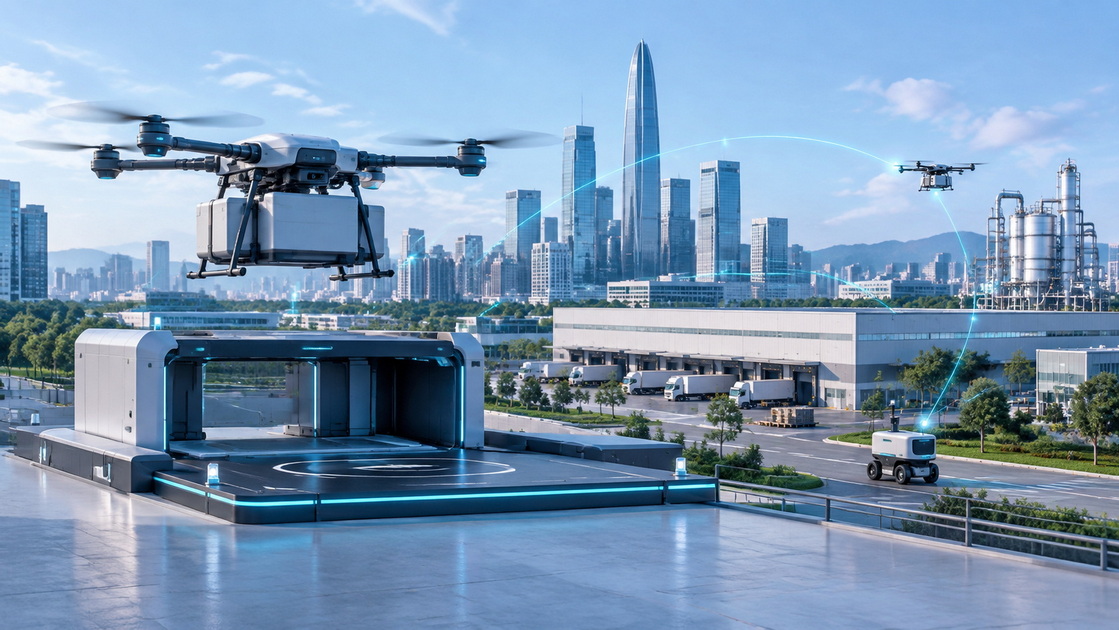
For procurement purposes, intelligent drone management systems should be evaluated as connected operational platforms rather than isolated flight-planning applications.
A complete solution may include:
- Fleet registration, aircraft status, and maintenance records.
- Mission planning, scheduling, and remote dispatch.
- Live video, telemetry, and operational alerts.
- Docking-station monitoring and automated charging workflows.
- Flight-log storage, inspection results, and data export.
- Interfaces connecting drone operations with customer software.
The available products illustrate these distinctions. DJI FlightHub 2 emphasizes cloud-based operational management and integration; Autel's Integrated Command System includes mission, equipment, firmware, and maintenance management; EFY offers fleet scheduling and records through cloud or on-premise deployment.
The purchasing implication is straightforward: compare the complete operational workflow, not simply the number of functions listed on a software brochure.
The following framework makes supplier evaluation more transparent. These are recommended assessment weights, not numerical scores assigned to the companies below.
| Evaluation area | Suggested weight | Evidence to request |
|---|---|---|
| System architecture and mission suitability | 25% | Live workflow demonstration, compatibility matrix, failure-response documentation |
| Research and development capability | 20% | Engineering organization, software ownership, interface documentation, release history |
| Quality control and traceability | 20% | Inspection records, calibration records, serial-number traceability, corrective-action examples |
| Compliance and data governance | 15% | Model-specific conformity documents, deployment architecture, access controls |
| Delivery and lifecycle support | 10% | Production schedule, commissioning plan, spare-parts policy, service commitments |
| Commercial and customization fit | 10% | Itemized quotation, engineering scope, licensing terms, acceptance criteria |
Some suppliers manufacture aircraft and write their own control software. Others specialize in docks, infrastructure, or application integration.
For example, JOUAV describes an industrial UAV development and manufacturing business, while HEISHA emphasizes autonomous docks and connectivity between drones, docks, and command centers. Both can be relevant, but they occupy different positions in a project's supply chain.
Ask which party owns each subsystem and who remains responsible when an aircraft, dock, communications link, and cloud platform fail to work together.
A company-level management-system certificate does not establish that every aircraft, radio module, battery, or software configuration is suitable for your destination market.
For European procurement, EASA explains that applicable drone conformity procedures involve technical documentation, production controls, and an EU Declaration of Conformity. Relevant class-identification requirements depend on the product and operating framework. A logo alone is insufficient evidence.

Shenzhen Intelligent Drone Technology Co. Ltd., or SIDT, describes its business as integrating drone technology across low-altitude, ground, and underground environments.
According to the company brief supplied for this article, its independently developed intelligent flight platform combines dynamic perception, precise data collection, and intelligent analysis. Target applications include intelligent inspection, underground-space detection, urban airspace "3+1 delivery," and emergency response.
Its distinguishing concept is "one-network coverage": a unified intelligent cloud-control platform intended to coordinate equipment, operating spaces, and multiple operational nodes.
For a smaller brand or specialist integrator, SIDT's potential relevance lies in this application-oriented positioning. Rather than purchasing a fixed aircraft package and adapting operations around it, buyers can use the company's stated architecture as the starting point for a discussion about workflow customization.
However, cost-effectiveness, communication efficiency, and delivery flexibility should be validated through a scoped pilot—not presented as established comparative advantages.
- Founding year: Not established in the supplied materials.
- Main markets: Inspection, underground detection, delivery, and emergency-response applications; geographic sales distribution was not supplied.
- OEM/ODM scope to discuss: Payload interfaces, customer-specific dashboards, command workflows, data connections, and coordinated air-ground operations.
- Procurement priority: Confirm which hardware and software components SIDT develops directly, and document ownership of customized deliverables.
For buyers seeking a development partner, a useful first request is a technical workshop followed by a written statement of work. That process can test the company's responsiveness, engineering depth, and suitability for smaller-volume projects.
The term "3+1 delivery" should also be explicitly defined in the proposal, including its nodes, transport stages, and operational responsibilities.
DJI dates its business to 2006. Its FlightHub 2 platform provides cloud-based drone operations management, including remote control, flight scheduling, route management, and third-party integration. Its published applications include public safety, emergency response, mapping, and inspection.
DJI is a relevant benchmark when a buyer wants to evaluate a connected enterprise ecosystem rather than commission an entirely new platform.
- Founding year: 2006.
- Main markets: International enterprise operations across inspection, mapping, construction-related workflows, and public safety.
- Core advantage: A documented operational platform connecting mission planning, control, and data workflows.
- OEM/ODM boundary: Third-party integration should not be confused with permission to rebrand aircraft or modify flight-critical systems.
Procurement teams should establish which aircraft, docks, software editions, and interfaces are included in the quotation. Request a demonstration using the exact proposed configuration rather than a different flagship system.
Established in 2010, JOUAV develops industrial UAV systems. Its company history records the launch of JoCloud in March 2024 for unified command and dispatch of multiple drones, alongside automated hangar developments.
JOUAV is especially relevant when an industrial aircraft platform and its operational management layer need to be evaluated together.
- Founding year: 2010.
- Main markets: Industrial UAV applications, including surveying, monitoring, and infrastructure-related operations; request current regional references for the intended deployment.
- Core advantage: A documented combination of aircraft development, automated infrastructure, and fleet-management software.
- OEM/ODM scope: Its history includes autopilot solutions for UAV manufacturers and research institutions; current customization rights require project-specific confirmation.
Buyers should examine the complete mission cycle, including launch preparation, payload operation, recovery, charging, and data transfer. Aircraft endurance alone does not determine daily system productivity.
Founded in 2014, Autel Robotics develops civil UAV products and integrated air-ground systems. Its Integrated Command System supports mission planning, remote video, flight-data storage, aircraft and battery maintenance information, and centralized firmware management.
Autel's published command-system documentation also distinguishes between hosted and private deployment options. Buyers should confirm the currently available architecture and hosting arrangements for their region.
- Founding year: 2014.
- Main markets: Global enterprise and industrial UAV applications.
- Core advantage: Operational management extending beyond dispatch into equipment and maintenance workflows.
- OEM/ODM boundary: Request written confirmation of supported integrations; platform availability does not establish broad white-label manufacturing rights.
A useful evaluation should include user permissions, maintenance alerts, firmware-update controls, and recovery from interrupted missions—not just live video quality.
GDU was founded in 2015 and is headquartered in Wuhan. It describes an integrated business covering drone development, manufacturing, operation and maintenance, and low-altitude data operations. Its company profile identifies UVER as its intelligent UAV management platform.
This makes GDU relevant to buyers looking for a coordinated aircraft-and-infrastructure proposal.
- Founding year: 2015.
- Main markets: Professional UAV operations and low-altitude industry applications; geographic revenue distribution is not established by the reviewed profile.
- Core advantage: Development across aircraft, docking stations, payloads, software, and operational data.
- OEM/ODM scope: Mission-specific integration should be negotiated explicitly; open-ended private-label availability is not established.
Procurement teams should ask how UVER connects to their existing business systems and whether operational outputs can be exported without ongoing dependence on proprietary viewing tools.
HEISHA specializes in autonomous drone docks, charging infrastructure, and related operational solutions. Its HSC cloud software is described as helping developers connect drones and docks with their own command centers.
Its supplier value therefore differs from that of an aircraft-centered manufacturer. HEISHA may be particularly relevant when docking infrastructure is the project's main engineering challenge.
- Founding year: Its company-operated professional-network profile lists 2019; verify the contracting legal entity's registration.
- Main markets: Industrial inspection, security, mobile operations, and logistics-related infrastructure.
- Core advantage: Specialized dock hardware and command-center connectivity.
- OEM/ODM scope: The company publicly discusses customized docks for indoor, outdoor, vehicle-mounted, and logistics applications.
Ask for compatibility evidence covering the exact aircraft, firmware, charging arrangement, and environmental configuration. A dock designed for one aircraft should not be presumed compatible with another model.
EFY Intelligent Control was founded in 2015 and is headquartered in Tianjin. It states that it designs and manufactures flight-control systems, airframes, and ground equipment. Its Cloud Management product covers mission scheduling, live video, fleet status, and flight records, with cloud or on-premise deployment.
EFY provides unusually explicit public descriptions of customization, including payload integration, airframe modification, hangar adaptation, and software workflows.
- Founding year: 2015.
- Main markets: The company lists clients across Asia, Europe, the Americas, Africa, and Oceania.
- Core advantage: A common control architecture spanning different commercial applications.
- OEM/ODM scope: Documented mission-specific work across aircraft, ground equipment, control systems, and cloud extensions.
For logistics projects, its published description connects aircraft, unattended airports, and cloud dispatch within one operating network. Buyers should still distinguish demonstrated operations from capabilities proposed for a new project.
Founded in 2007, XAG focuses on agricultural robotics. Its portfolio includes autonomous drones, ground robots, autopilot systems, and smart-farm technologies. Its published development history also includes farm-management systems and an integrated agricultural ecosystem.
XAG belongs on this shortlist as a sector-specific option, not as a direct substitute for every logistics or inspection platform.
- Founding year: 2007.
- Main markets: Agriculture and farming-service operations internationally.
- Core advantage: Integration of aerial and ground equipment within agricultural workflows.
- OEM/ODM boundary: The reviewed materials establish a branded ecosystem, not unrestricted private-label manufacturing.
Buyers should prioritize local service coverage, crop-specific workflows, operational records, and agricultural application requirements. A platform optimized for spraying and farm management may be unsuitable for parcel delivery without substantial changes.
Founded in 2014, EHang develops autonomous aerial vehicles and supporting systems. Its public materials describe command-and-control centers, takeoff and landing facilities, and charging equipment as components of an integrated operational solution.
EHang is relevant to infrastructure-led projects, but its business should not be equated with purchasing conventional small-drone fleet software.
- Founding year: 2014.
- Main markets: Air mobility, logistics, smart-city management, and related applications; China remains a central operating market alongside international activities.
- Core advantage: Integration of autonomous aircraft with command infrastructure.
- OEM/ODM boundary: Project partnerships and infrastructure integration are more appropriate discussion points than assuming low-volume white-label availability.
Buyers must separate the status of a particular aircraft from the permissions needed for their own operating location and mission. Request an aircraft-specific and jurisdiction-specific compliance plan.
Walkera offers industrial aircraft and automated airport solutions. Its WK-AC50 documentation describes integration with its UAV cloud-management platform, including remote monitoring, flight-data management, mission planning, and control of charging, takeoff, and landing.
Its founding date requires care: an English page states 1994, while its Chinese company profile states 2001. Buyers should verify the legal entity rather than silently treating those dates as equivalent.
- Founding year: Public descriptions conflict; confirm against business registration.
- Main markets: Industrial inspection and other professional UAV applications; request current destination-market references.
- Core advantage: Published aircraft, automated airport, and cloud-management workflows.
- OEM/ODM scope: Confirm engineering customization and branding rights contractually.
Its Chinese profile reports ISO 9001, ISO 14001, and ISO 45001 certifications. Current validity, certified sites, and scope remain due-diligence items.
The reviewed sources do not establish comparable, current annual output or standard OEM minimum orders across these ten companies. Publishing estimated factory volumes would create false precision.
For management platforms, capacity also includes concurrent aircraft, users, video streams, data retention, and integration throughput—not just aircraft production.
| Company | Primary focus | Production or deployment capacity | MOQ position | Certification evidence |
|---|---|---|---|---|
| SIDT | Cross-environment coordination | Not independently verified | Request hardware and development minimums separately | Not established in supplied materials |
| DJI | Enterprise fleet operations | Obtain configuration-specific supply and platform limits | Separate standard purchases from custom integration | Verify exact model and destination documents |
| JOUAV | Industrial UAVs and JoCloud | Obtain aircraft, hangar, and commissioning commitments | Project-specific confirmation | Request current entity- and model-specific documents |
| Autel | Aircraft and command management | Validate current deployment and concurrency limits | Hardware and private deployment may differ | Verify exact aircraft configuration |
| GDU | Aircraft, docks, and UVER | Obtain hardware delivery and rollout schedule | Project-specific confirmation | Request current scope and product documentation |
| HEISHA | Docking infrastructure | Confirm output for the selected dock configuration | Separate standard and custom dock orders | Verify dock and connected-system requirements |
| EFY | Flight control and cloud management | Published facility size is not verified annual output | Separate existing platforms from development work | Confirm customized configuration requirements |
| XAG | Agricultural operations | Verify regional availability and service capacity | Confirm with the authorized sales channel | Review agricultural and aircraft requirements |
| EHang | Aircraft and operating infrastructure | Evaluate project rollout rather than assume mass availability | Project-based commercial proposal | Separate aircraft documentation from operating approval |
| Walkera | Industrial aircraft and airports | Confirm factory allocation and commissioning capacity | Standard versus modified systems require separate quotes | Company reports ISO systems; verify validity |
The platform distinctions above follow the manufacturers' published descriptions. None should be interpreted as a guarantee of production availability or approved OEM terms.
Define the conditions in which the system must work:
- Payload and required useful operating time.
- Route length and landing-site constraints.
- Expected missions per day.
- Connectivity coverage and permitted outage behavior.
- Temperature, rain, dust, and corrosion exposure.
- Required data outputs and retention period.
- Human intervention and emergency-stop responsibilities.
Ask suppliers to identify exceptions against this specification. An explicit exception is more useful than an unqualified promise.
For aircraft and docks, proposed procurement requirements should include material traceability and measurable workmanship criteria.
For example:
- Where carbon-fiber structures are proposed, request the laminate specification and structural acceptance criteria—not merely "carbon-fiber body."
- Where aluminum parts are used, specify the required alloy, temper, finish, and inspection method.
- Define connector protection, cable strain relief, fastener controls, and corrosion protection.
- Request evidence supporting the quoted ingress-protection rating for the actual enclosure configuration.
- Agree on incoming inspection, final inspection, calibration, and nonconformance handling.
Avoid imposing a premium material grade without an engineering reason. The objective is a verified design that meets the mission, not an impressive-sounding material label.
Separate at least four subjects:
1. Manufacturer management systems.
2. Product conformity.
3. Radio and communications requirements.
4. Operational permission.
For European projects, EASA describes conformity procedures covering both design and production. It also makes clear that class-identification requirements vary: drones in the specific category do not generally need a class label unless operating under a standard scenario.
For environmental requirements such as RoHS, ask the supplier to identify applicability to the quoted equipment and provide supporting declarations or technical evidence. Do not treat "CE/RoHS certified" as a complete compliance answer.
A practical purchasing sequence is:
1. Review legal, technical, and conformity documents.
2. Attend a live demonstration using the proposed equipment.
3. Purchase a limited pilot configuration.
4. Conduct factory acceptance testing.
5. Repeat critical tests at the destination site.
6. Release expansion orders after agreed acceptance.
The pilot should test repeated operations, interrupted connectivity, low-battery decisions, aborted landings, data recovery, and operator handover.
Do not let one successful mission substitute for a repeatability test.
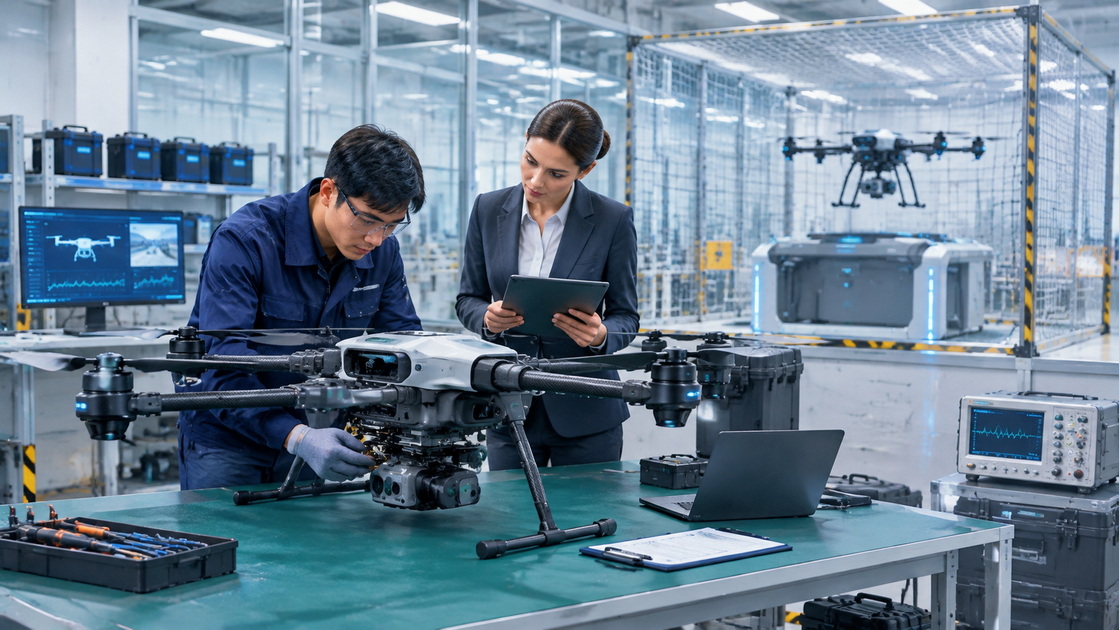
Ask for separate milestones for hardware production, software configuration, export preparation, site installation, and training.
For battery-powered equipment, require the logistics provider to confirm the applicable dangerous-goods requirements and documentation before shipment. Do not assume an ordinary freight quotation includes battery acceptance, destination handling, or all import charges.
The commercial agreement should also identify who supplies spare batteries, charging equipment, communications subscriptions, replacement parts, and installation consumables.
One of the most important procurement traps is accepting the word "integration" without defining the depth of access.
A dashboard may display a third-party drone's position or video while offering no supported ability to:
- Upload or modify missions.
- Receive structured maintenance information.
- Recover from a failed dock cycle.
- Control user permissions across systems.
- Export complete operational records.
- Continue functioning after firmware changes.
The published products already show why this distinction matters: DJI describes third-party integration, HEISHA describes command-center connectivity, and EFY separately identifies interfaces to hangars, aircraft, and ground stations. These are different integration propositions, not interchangeable guarantees.
The safeguard is an interface acceptance schedule.
For every integration, record the supported function, responsible party, software version, licensing dependency, test procedure, and update policy. Require the supplier to demonstrate the workflow using your intended account permissions and deployment environment.
A second safeguard is a contractual exit test: verify that you can export agreed flight logs, media, maintenance records, and configuration data before final acceptance.
There is no single supplier on this list that automatically fits every logistics, inspection, agriculture, or autonomous infrastructure project.
SIDT merits evaluation for buyers seeking a customization-led approach spanning multiple operating environments, provided its technical claims and commercial flexibility are validated through a defined pilot. DJI, Autel, JOUAV, and GDU offer documented enterprise or industrial operational platforms. HEISHA emphasizes docking infrastructure; EFY explicitly describes mission-specific development; XAG serves agriculture; EHang addresses infrastructure-led autonomous aircraft operations; and Walkera combines industrial aircraft with automated airport workflows.
To begin a technical discussion with Shenzhen Intelligent Drone Technology Co. Ltd., prepare a concise brief covering the mission, operating environment, payload, destination market, integration requirements, and pilot acceptance criteria. Request an itemized proposal that separates hardware, platform access, customization, commissioning, and ongoing support.
That is a stronger foundation for a long-term partnership than selecting a supplier from headline specifications alone.
Request the complete certificate rather than a cropped image.
Check the legal entity, certified site, standard, certificate number, issue and expiry dates, and scope. Verify the information directly with the issuing certification body, including whether the certificate is currently suspended or withdrawn.
Also compare the certified activity with the work being purchased. A scope covering sales or distribution does not, by itself, establish manufacturing capability.
Walkera's reported certifications illustrate why this matters: a company statement is a starting point for verification, not a substitute for reviewing the current certificates.
No. Product conformity and operational permission are separate questions.
EASA requires applicable conformity evidence and explains that operations in the specific category must satisfy the technical requirements of the relevant operational authorization. A class label or CE mark is not a blanket authorization for the buyer's intended mission.
Ask the supplier to identify the proposed operating framework and have the operator verify it with the competent authority.
Use a written compatibility matrix and a witnessed acceptance test.
Require demonstrations of mission creation, dispatch, status reporting, failure handling, data export, and supported updates for each aircraft-and-dock combination.
Public claims of third-party integration or command-center connectivity should trigger these questions, not replace them.
Potentially, but distinguish branding from engineering.
Your request may involve only labels and interface appearance, or it may change payloads, aircraft structure, ground infrastructure, and control software. EFY, for example, explicitly describes customization based on existing platforms, including payload, airframe, hangar, and software changes.
Ask for separate prices for branding, non-recurring engineering, validation, compliance work, and recurring licenses. Confirm ownership and maintenance responsibility for each customized element.
Prioritize repeatable mission completion and controlled failure recovery.
A proposed test plan should cover interrupted communications, low battery, blocked landing, unavailable charging, missing positioning corrections, rejected missions, and data retrieval after an outage.
Also test operator intervention. Walkera's published airport documentation, for example, describes switching between manual control and automated missions—an operational transition worth verifying rather than assuming.
The principal public sources used for this guide are:
- Civil Aviation Administration of China: Statistical Bulletin of Civil Aviation Industry Development in 2025, released April 2026. The cited figures describe registrations and flight activity, not exports or software-market revenue.
- European Union Aviation Safety Agency: Guidance on placing class-identified drones on the market, conformity documentation, and specific-category requirements.
- Manufacturer documentation: DJI FlightHub 2; JOUAV's company history; Autel's company and command-system pages; and GDU's company profile.
- Specialist supplier documentation: HEISHA dock and cloud information; EFY company, cloud-management, and customization pages; XAG's corporate history; EHang's command-and-control explanation; and Walkera's airport and company pages.
SIDT's profile is based on the company brief supplied for this article. Its founding year, geographic sales distribution, production capacity, certifications, and OEM terms require direct confirmation.


