Global Distributors Wanted
1.Free Cloud Service Deployment
2.Free Technical Training
3.Exclusive Territory Protection

1.Free Cloud Service Deployment
2.Free Technical Training
3.Exclusive Territory Protection


Views: 216 Author: Aaron Publish Time: 2026-11-09 Origin: Site


Content Menu
● Drone Medical Supply Delivery vs Helicopter Medical Transport: Key Differences
● Clinical Mission: Deliver the Supply or Move the Patient?
>> When Medical Delivery Drones Fit Rural Clinic Needs
>> When Helicopter Medical Transport Is the Better Choice
● Delivery Speed: Measure Time to Treatment, Not Cruise Speed
>> What the Rwanda Blood Delivery Study Actually Shows
● Cost Comparison: Match the Mission Before Comparing Prices
>> What to Include in Drone Delivery Costs
>> What to Include in Helicopter Medical Transport Costs
● Payload, Cold Chain, and Clinical Acceptance
>> Packaging Changes the Aircraft Calculation
>> Product Integrity Must Survive the Entire Journey
● Safety, Weather, and Regulatory Limits
>> Permissions Are Specific to the Operation
● A Practical Framework for Rural Clinic Transport Decisions
>> 3. Patient Transfer or Specialist Response
● Building a Coordinated Network with SIDT
● Pilot Deployment: Six Metrics That Reveal Real Value
● Plan the Healthcare Mission Before Selecting the Aircraft
>> 1. Can medical delivery drones replace helicopter air ambulances?
>> 2. Are drones always faster than helicopters for rural clinics?
>> 3. Can drones safely deliver blood products?
>> 4. Is drone medical delivery always cheaper?
>> 5. What happens when a medical drone cannot complete a delivery?
>> 6. What should a rural clinic ask SIDT before starting a pilot?
Drone medical supply delivery vs helicopter medical transport for rural clinics is not simply a contest between two aircraft. It is a choice between different healthcare capabilities. Medical delivery drones move supplies to care teams. Medical helicopters can move patients, specialist personnel, equipment, and supplies while supporting clinical care during transport.
For rural clinics facing difficult roads, fragmented inventories, and limited emergency resources, the strongest strategy is often coordination, not replacement.
My starting point for evaluating either option is straightforward: what must reach the destination, how urgently, and what happens if the mission fails? Those questions reveal which aircraft fits the clinical need—and where a connected ground-air network adds the most value.

Here, "drone" means an uncrewed medical cargo aircraft, not a passenger-carrying aircraft. "Medical helicopter" refers to a crewed aircraft equipped and operated for its approved medical mission.
| Decision factor | Drone medical supply delivery | Helicopter medical transport |
|---|---|---|
| Primary purpose | Transporting small medical consignments | Transporting patients, clinical teams, equipment, or supplies |
| Patient transport | Not provided by conventional delivery drones | Available through appropriately equipped medical services |
| In-transit treatment | No onboard clinical care | Possible with qualified medical crews |
| Typical role | Blood, medicines, specimens, and small consumables | Critical patient transfer, specialist access, and larger missions |
| Payload suitability | Limited by aircraft, packaging, route, and reserves | Greater capacity, subject to aircraft and mission constraints |
| Infrastructure | Approved launch, delivery, and recovery arrangements | Suitable landing facilities or assessed landing zones |
| Cost evaluation | Cost per successful, clinically usable delivery | Mission capability, readiness, staffing, and transport costs |
| Best network role | Frequent, targeted replenishment | Patient movement and clinically complex response |
Neither column guarantees availability. Weather, maintenance, staffing, permissions, and destination readiness can interrupt both services.
Drone delivery is most relevant when a clinic can provide treatment but lacks a particular item.
Examples include:
- Blood products needed for a transfusion.
- Urgently required medicines.
- Small replacement supplies.
- Diagnostic specimens traveling to a laboratory.
Each item still requires an approved transport process. A drone capable of carrying a package is not automatically qualified to carry every medicine, specimen, or blood component.
The key clinical question is whether receiving the item will enable safe treatment locally. A delivery cannot substitute for missing surgical capability, specialist expertise, or appropriate monitoring.
A helicopter becomes relevant when the patient needs care unavailable at the clinic, when a specialist team must travel, or when the mission exceeds the drone's approved capacity.
For example, delivering blood may support stabilization, but it does not eliminate a patient's need for emergency surgery.
Helicopter activation should therefore follow clinical assessment and local transport protocols. The decision should consider the patient's condition, destination capability, ground alternatives, and total time to appropriate care—not distance alone.
Comparing aircraft speed misses much of the real workflow.
For drone medical supply delivery, the full sequence can include:
1. Clinical request and stock verification.
2. Product selection and packaging.
3. Flight release and loading.
4. Air transport.
5. Package retrieval and acceptance.
6. Preparation for clinical use.
Helicopter transport adds its own activation, crew preparation, positioning, patient loading, and receiving-hospital handover requirements.
My preferred comparison is request-to-usable-supply time for cargo and decision-to-appropriate-care time for patients.
A rural clinic should also examine the 95th-percentile completion time, not just the average. Occasional severe delays may matter more than a small improvement in typical performance.
A 2022 study published in *The Lancet Global Health* examined drone blood deliveries serving 20 Rwandan health facilities.
Researchers analyzed 12,733 orders delivered between March 2017 and December 2019. Approximately 43% were emergency orders.
Mean drone delivery time was 49.6 minutes. Compared with two estimates of road transport time, deliveries were approximately 79–98 minutes faster. Drone delivery was also associated with a 67% reduction in blood product expirations at 12 months.
These findings support a specific conclusion: a well-organized drone blood network can improve replenishment and inventory performance.
They do not establish that drones outperform helicopters. The comparison involved road delivery, and the observational findings should not be treated as a universal performance guarantee.
A small medical parcel and a critically ill patient are not equivalent transport units.
It is therefore misleading to compare a drone delivery quotation directly with an air ambulance bill and describe the difference as a saving.
A meaningful drone delivery budget should include:
- Aircraft acquisition or service fees.
- Launch and recovery infrastructure.
- Remote operations and maintenance.
- Batteries, charging, and replacement parts.
- Packaging and temperature monitoring.
- Communications and software integration.
- Regulatory work, insurance, and training.
- Failed deliveries and backup transport.
For supplies, a useful measure is:
Cost per usable delivery = total service cost ÷ deliveries accepted for clinical use.
A package that arrives damaged, outside its validated conditions, or after the treatment window is not a successful clinical delivery.
Medical helicopter services support capabilities beyond cargo movement, including trained personnel, patient care equipment, and emergency readiness.
Evaluate operator costs, contracted availability, and the clinical value of the service separately from patient charges.
A drone network may reduce the need for selected supply-only helicopter missions. However, it should not be assumed to remove the fixed cost of maintaining helicopter readiness for emergencies.
Request route-specific quotations rather than relying on universal cost-per-flight claims.
Usable payload is not simply the weight of the medicine.
The complete load may include:
- The medical product.
- Protective packaging.
- Insulation or temperature-control materials.
- Monitoring devices.
- Labels, seals, and handling materials.
Packaging volume can be as restrictive as weight. A lightweight insulated container may still exceed the aircraft's available space.
Range claims also need context. Evaluate the intended load, terrain, wind, elevation, required reserves, and contingency arrangements together.
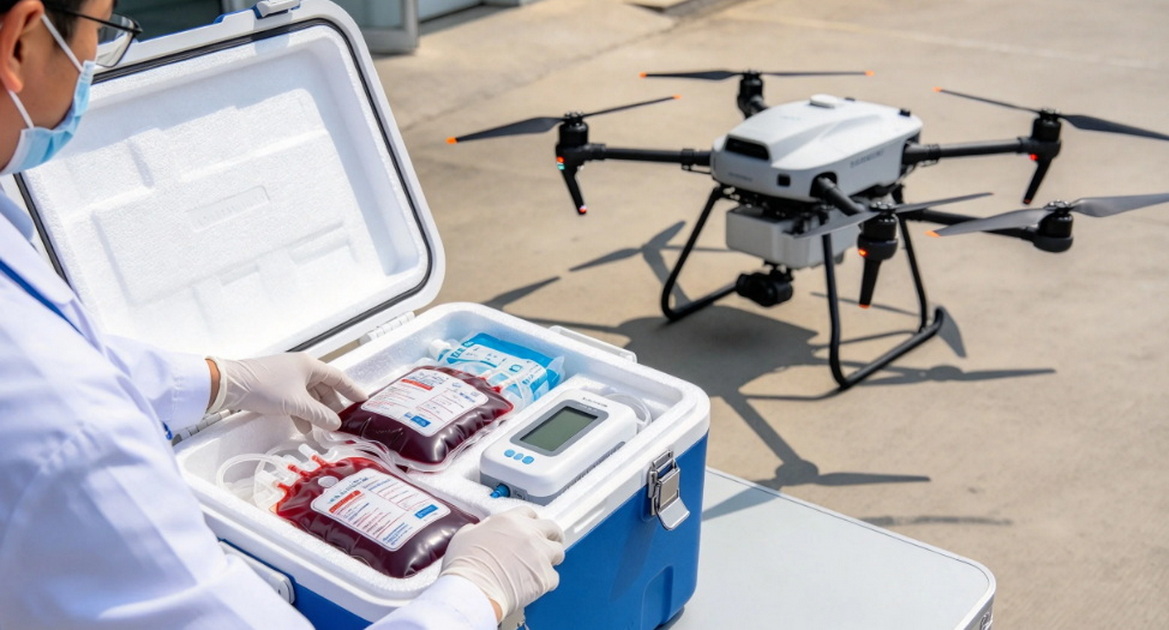
Blood components, vaccines, medicines, and diagnostic specimens do not share one universal transport temperature.
Use requirements established for the specific product and applicable clinical process.
Before service begins, validate packaging under representative transport conditions. Include loading delays, vibration, ambient temperatures, delivery handling, and potential recovery time.
The receiving clinic should have a documented acceptance process. That process should identify who checks the consignment, reviews monitoring information, records receipt, and quarantines questionable products.
Aircraft arrival alone is not proof of clinical usability.
Neither drones nor helicopters provide unrestricted all-weather access.
A drone service needs aircraft-specific operating limits, communications planning, lost-link procedures, and safe contingency locations.
Medical helicopter crews must also assess weather, terrain, landing conditions, aircraft capability, and mission risk.
The practical lesson is to design backup access before the first cancellation. Severe weather may affect both systems simultaneously, so they should not automatically be treated as independent alternatives.
Requirements vary by jurisdiction, aircraft, cargo, and operating model.
In the United States, the Federal Aviation Administration describes Part 135 certification and associated authorizations as central to commercial drone package delivery operations covered by that framework. Beyond-visual-line-of-sight operations require the applicable approvals.
Medical cargo can add further restrictions. Certain specimens, refrigerants, or other materials may qualify as dangerous goods. The FAA states that Part 107 prohibits dangerous-goods carriage.
A supplier's demonstration flight, aircraft brochure, or general operating certificate does not establish approval for a particular clinic route or cargo category.
Rather than selecting one aircraft for every task, divide demand into three mission groups.
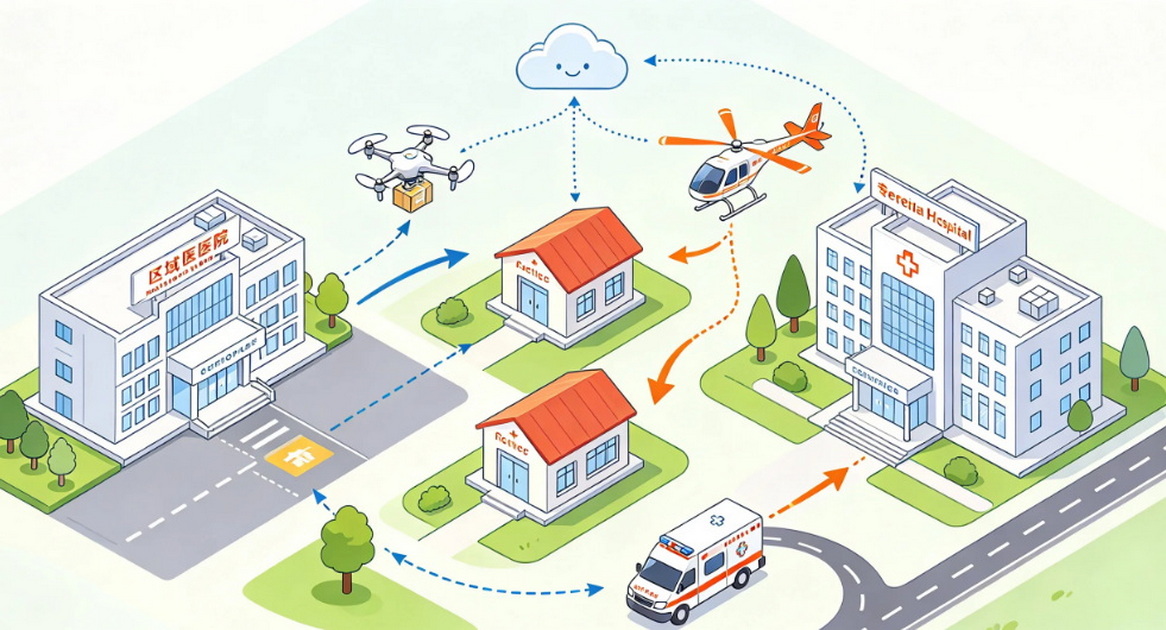
Use established ground logistics for predictable bulk demand where roads and schedules provide acceptable service.
Consider drones for suitable small consignments when route analysis demonstrates an operational advantage.
Assess whether a drone can deliver the required product within its validated conditions and clinical deadline.
Confirm stock availability, receiving staff, destination access, and backup arrangements before dispatch.
Activate the appropriate clinical transport pathway when the patient requires care unavailable locally.
Supply delivery and patient evacuation may need to happen in parallel. Neither should delay the other.
This framework prevents a common procurement mistake: buying an aircraft before defining the healthcare service.
Shenzhen Intelligent Drone Technology Co. Ltd. describes an independently developed intelligent flight platform combining dynamic perception, precise data collection, intelligent analysis, and unified cloud control.
Its "one-network coverage" approach provides a relevant starting point for coordinating equipment across locations and operational nodes.
For rural healthcare planning, the potential value lies in connecting requests, aircraft status, dispatch decisions, and delivery confirmation—not simply displaying flights on a map.
A proposed workflow could connect:
1. A clinic's supply request.
2. Inventory verification at a distribution hub.
3. Selection of an approved delivery option.
4. Flight and ground-handling coordination.
5. Receipt confirmation and exception management.
However, the company background does not establish validated medical packaging, healthcare-system integration, helicopter dispatch authority, or approval for a particular medical route. These capabilities must be verified during project assessment.
Unified visibility should support, not override, clinical decisions or the authority of licensed aviation operators.
Before expanding across multiple clinics, run a defined pilot with agreed success thresholds.
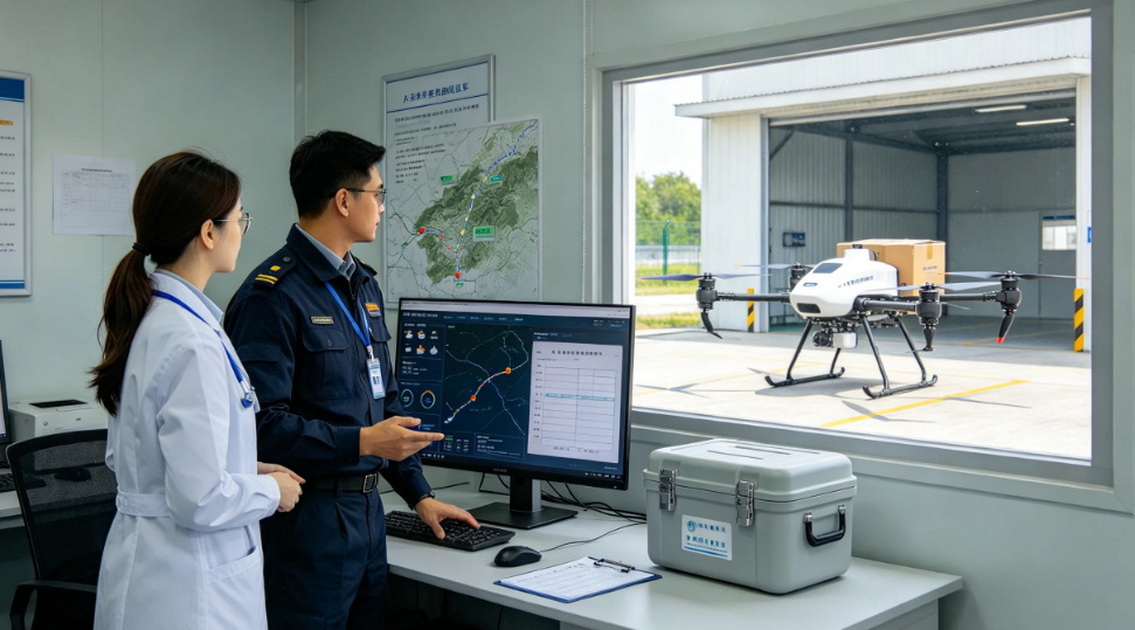
| Metric | What it reveals |
|---|---|
| Request-to-usable-supply time | Whether transport improves practical access |
| On-time completion rate | Whether service meets clinical deadlines |
| Product acceptance rate | Whether delivered goods remain usable |
| Cancellation and recovery performance | How the network handles disruption |
| Cost per usable delivery | Whether the operating model is sustainable |
| Inventory expirations and stockouts | Whether delivery improves supply management |
Separate emergency orders from routine replenishment. Their priorities, deadlines, and economic value differ.
Also distinguish deliveries that replace existing transport from deliveries that create entirely new demand. Both may be valuable, but they produce different business cases.
For rural clinics, drones are best evaluated as targeted supply-chain tools. Medical helicopters serve a broader role in patient transport and clinically complex response.
Contact SIDT with your clinic locations, priority cargo, demand patterns, delivery deadlines, and existing emergency transport arrangements. Request a route-specific feasibility assessment covering operational limits, responsibilities, costs, and a measurable pilot plan.
The objective is a dependable care pathway—not simply a successful flight.
No. Conventional medical cargo drones cannot transport patients or provide onboard treatment. They can complement air ambulances by delivering suitable supplies to clinics.
No. Total response time depends on aircraft location, preparation, approvals, weather, flight distance, and handover. Compare complete workflows rather than cruise speeds.
They can within appropriately approved and validated systems. The Rwanda study provides evidence of operational blood delivery, but each service still needs product-specific packaging, handling, and acceptance procedures.
No. Route demand, utilization, staffing, infrastructure, maintenance, and backup requirements influence cost. Compare equivalent supply missions and include unsuccessful deliveries in the calculation.
The service should follow a predefined contingency plan covering recovery, product assessment, replacement dispatch, and alternative transport. Clinics also need suitable buffer stocks for foreseeable interruptions.
Ask for the proposed aircraft and route envelope, operating responsibilities, relevant permissions, cargo-validation plan, service metrics, integration scope, and contingency arrangements. Request evidence for each claimed capability.
1. Nisingizwe, M. P., et al. "Effect of unmanned aerial vehicle (drone) delivery on blood product delivery time and wastage in Rwanda: a retrospective, cross-sectional study and time series analysis." *The Lancet Global Health*, 2022, Volume 10, Issue 4, pp. e564–e569. Primary evidence for the Rwanda delivery figures and study limitations.00048-1/fulltext)
2. University of British Columbia, Faculty of Medicine. "Drones get blood to patients faster—and reduce waste." March 21, 2022. Institutional explanation of the Rwanda research and its healthcare supply implications.
3. Federal Aviation Administration. "Package Delivery by Drone (Part 135)." Official guidance describing certification, airspace authorization, and operating requirements for relevant U.S. drone package-delivery services.
4. Federal Aviation Administration. "Unmanned Aircraft System (UAS) or Drone Operations." Official guidance on dangerous-goods carriage, Part 107 restrictions, and the Part 135 regulatory pathway.
5. County of San Diego, Emergency Medical Services. "Air Medical Support Utilization," Policy A-475. Example of a jurisdiction-specific clinical framework considering transport time and required medical capabilities; not a universal activation standard.
6. U.S. Government Accountability Office. "Air Ambulance: Effects of Industry Changes on Services Are Unclear." GAO-10-907, September 2010. Historical background on air ambulance readiness, fixed costs, and rural service economics; not used as a current price benchmark.
7. U.S. Government Accountability Office. "Potential Strategies to Address Air Ambulance Safety Concerns." Historical discussion of weather, remote landing environments, and operational risk management; not used to estimate current accident rates.
8. Shenzhen Intelligent Drone Technology Co. Ltd. Company background supplied for this article. Source for SIDT's stated platform functions and "one-network coverage" positioning. No public source page was supplied; medical operating approvals and clinical performance were not independently established.


